
Why Employee Recognition Programs Fail (And How to Make Sure Yours Doesn't)
.png)
You've made the case internally. Leadership is on board. There's budget, there's buy-in, and there's genuine enthusiasm for building something meaningful. Now comes the part no one really prepares you for: actually making it work. Understanding why employee recognition programs fail is one of the most valuable things you can do to set your program up for lasting success.
The reality is that most employee recognition programs don't fail because of bad intentions. They fail because of a handful of predictable, avoidable execution gaps that quietly undermine even the most well-designed initiatives. And for HR leaders at growing companies, where resources are lean, and there's little margin for a costly reset, getting it right the first time matters.
The problem isn't usually a lack of effort
Many HR professionals launching a recognition program for the first time face the same challenge: they know what they want the outcome to look like, but the road between here and there feels uncertain. What are the real risks? Where do programs typically lose traction? And how do you build something that actually sticks?
The good news is that the most common failure points are well-documented, which means they're preventable. Once you know what to watch for, the path forward becomes much clearer.
Here are six reasons why employee recognition programs fail, and exactly what you can do to make sure yours doesn't.

Why Employee Recognition Programs Fail (And How to Make Sure Yours Doesn't)
1. The program launches without real onboarding
One of the most common reasons recognition programs stall has little to do with intention and everything to do with implementation. Even when employees are genuinely excited about the idea of recognition, change requires effort. People need to learn new expectations, new behaviors, and sometimes new tools. And without clear guidance, many default back to old habits.
Organizations that invest in a structured rollout see significantly higher participation rates. Training sessions, clear communication about the program's purpose, and visible leadership involvement all make a meaningful difference. The format of your program matters far less than the clarity and enthusiasm behind how it's introduced.
How to avoid it:
- Plan a structured internal launch across multiple touchpoints: email, team meetings, internal channels
- Run dedicated onboarding sessions that explain the program's purpose, expectations, and mechanics
- Give employees a clear first action (for example, encouraging everyone to recognize one colleague in the first week)
- Ensure managers model participation early and reinforce it consistently
- Have senior leaders publicly endorse the program. When executives visibly participate, it signals that recognition is part of how the organization operates, not just another HR initiative
Recognition programs rarely fail because employees don't care. They fail because no one clearly showed them how to engage.
2. Recognition feels performative or obligatory
Everyone wants to feel appreciated, but not all appreciation is created equal. Recognition loses impact quickly when it becomes routine, generic, or expected. When programs are poorly designed, they can create an appreciation that feels automatic rather than earned. At worst, employees feel pressured to give recognition simply to meet a quota, and that's when it becomes purely transactional.
Workplace psychologist Dr. Paul White draws a clear distinction between traditional recognition and authentic appreciation, noting that recognition often feels impersonal and contrived when it focuses on task completion rather than the individual behind the work. The principle holds: when recognition lacks specificity or emotional sincerity, employees disengage. It starts to feel like going through the motions rather than a meaningful acknowledgment.
How to avoid it:
- Train managers on how to give detailed, behavior-based recognition. What was done, why it mattered, how it contributed
- Tie recognition to real outcomes and company values, not just activity metrics
- Avoid making recognition feel mandatory or quota-driven
- Reinforce that quality and sincerity matter more than volume (i.e. quantity)
- Make space for recognition that is specific to the individual, not just the accomplishment
3. Rewards don't actually feel rewarding
There's nothing particularly inspiring about the same cookie-cutter reward for every employee and every milestone. People are motivated by different things, and a one-size-fits-all approach signals that the organization hasn't really thought about what makes each person tick.
When employees can choose their own rewards from a meaningful selection, recognition lands differently. It feels personal rather than procedural. It also gives HR teams real-time insight into what motivates different people across the organization. Information that's genuinely useful for engagement strategy going forward.
How to avoid it:
- Offer a selection of reward options rather than a single predetermined gift
- Use flexible formats (like gift cards) that give employees genuine choice
- Align reward value with the significance of the contribution being recognized
- Revisit your reward catalog periodically to ensure it stays relevant and appealing
4. The program isn't connected to real goals or behaviors
A recognition program that exists in isolation, disconnected from the work your team is actually doing, quickly feels hollow. The goal of recognition isn't just to make people feel good in the moment. It's to reinforce the specific behaviors, values, and contributions that drive your organization forward.
If your program can't reflect what success looks like for your specific team, it can't do its job. Recognition that isn't tied to meaningful outcomes becomes background noise, present, but not impactful. The most effective programs are built to capture what your organization actually cares about, whether that's collaboration, innovation, customer service, or hitting performance milestones.
How to avoid it:
- Define what behaviors and outcomes you want recognition to reinforce before launching
- Build your program around your company's mission, values, and performance goals
- Allow for customization. Whether that's branded recognition moments, campaign-based incentives, or team-specific criteria
- Regularly assess whether the program is driving the behaviors it was designed to encourage
- If recognition and organizational goals feel out of sync, treat that as a signal to recalibrate, not a reason to abandon the program
5. Over-reliance on a single type of recognition
One of the most common design mistakes is assuming that launching one recognition initiative is enough to shape culture. An organization might introduce a years-of-service program and consider recognition "covered," but milestone awards, while meaningful, are inherently infrequent. They acknowledge tenure, not the day-to-day effort that actually keeps your team motivated.
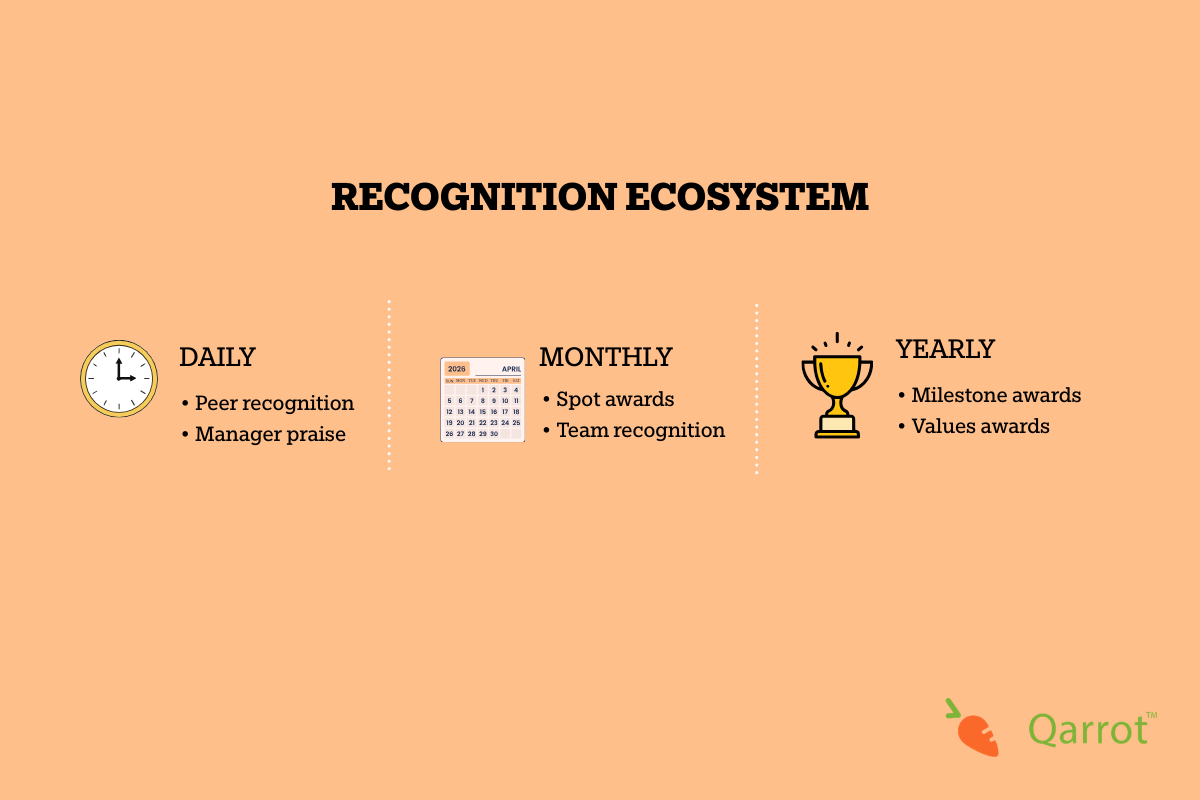
Different types of recognition serve multiple psychological needs. Employees want to feel that their loyalty is valued, but they also want their effort, creativity, and collaboration to be seen in real time. A single program can't address all of those dimensions. The result is a program that exists on paper but doesn't meaningfully influence how people feel about their work. A strong recognition culture requires a recognition ecosystem, a balanced mix of formal and informal programs that ensures employees feel seen all year round, not just on milestone dates.
How to avoid it:
- Audit your current recognition efforts: are you covering both formal milestones and everyday appreciation?
- Layer your approach. Combine structured programs (milestone awards, peer nominations) with informal, peer-to-peer recognition
- Ensure managers have easy tools to recognize their teams spontaneously, not just during formal review cycles
- Build in visibility at multiple levels: individual, team, and company-wide
- Think of recognition as an ecosystem, not a single program
6. The program loses momentum over time
Many recognition programs launch with energy and enthusiasm and then fade. Participation declines, new hires aren't introduced to the program, and leadership attention shifts elsewhere. What started as a meaningful initiative becomes another forgotten initiative.
This is where structure becomes essential. Consistency doesn't create itself. When recognition is treated as a one-time launch rather than an ongoing rhythm, it's only a matter of time before it loses visibility. Research consistently shows that while recognition programs are widespread, only about one in three employees receive recognition regularly, and nearly half want more frequent acknowledgment. The gap between intention and experience is almost always structural.
How to avoid it:
- Monitor participation rates and recognition frequency on an ongoing basis
- Share program highlights in company meetings and internal communications to keep it visible
- Reintroduce the program during onboarding so new hires are part of the culture from day one
- Periodically refresh messaging or run themed campaigns to re-engage the organization
- Integrate recognition into broader cultural moments, values communication, internal events, and team rituals
- Treat recognition as infrastructure, not a campaign. It should be embedded in how your organization operates, not layered on top of it
Recognition isn't a mystery; it's a practice
If this list felt familiar, that's a good thing. It means you're already thinking about the right problems. and that puts you ahead of most organizations that launch a recognition program and hope for the best.
None of these failure points is inevitable. They're patterns, and patterns are preventable.
The HR leaders who build recognition programs that actually stick aren't doing anything radically different. They're deliberately applying the fundamentals.
- They launch with structure, not just enthusiasm.
- They build a recognition ecosystem that covers the full range of employee needs, not just infrequent milestone moments.
- They resist the urge to chase consistency before they've built the structure that makes consistency possible.
- And they treat recognition as an ongoing practice, not a one-time initiative that gets checked off the list.
The road ahead isn't as uncertain as it might feel right now. The challenges are knowable. The solutions are practical. And you don't have to figure it all out from scratch.

Want to know how Qarrot can transform your workplace?
Take a peek and discover the many benefits our software has to offer!
