
How to Build an Employee Recognition Program That Works
Summary
Most recognition programs don't fail because of bad intentions, they fail because they're treated as a one-time initiative rather than an ongoing cultural practice.
In this guide, we'll walk you through how to audit what you already have in place, design a recognition program that fits your culture, and layer different types of recognition to keep appreciation consistent year-round. We'll also cover why programs lose momentum over time and how to prevent it, what a realistic budget looks like, and how to build a business case for leadership approval.
Finally, we'll explore what makes recognition feel genuinely impactful, and when a recognition platform becomes the right next step.
How to Avoid ‘Check-Box’ Recognition
If you’re an HR leader, you likely already believe appreciation matters; you’ve already been convinced of that, and you’ve seen the employee recognition statistics. The challenge now lies in launching an employee recognition program that has a tangible impact on your organization.
Because too often, programs start strong but slowly lose momentum. What was meant to boost your culture begins to feel procedural, even transactional. Just another HR program to manage rather than a meaningful practice to sustain
At Qarrot, we’ve worked to support teams as they implement recognition systems. One principle consistently holds true: recognition programs work best when they understand and reflect what employees value, reinforce the behaviors that matter, and are viewed as an ongoing system rather than a one-time event.
This guide is designed to help you do exactly that. In the sections ahead, we’ll walk through:
- How to evaluate your current approach to recognition.
- How to design a recognition program that fits your size and culture
- Why programs lose momentum and how to prevent it
- What type of budget can you expect when launching a program
- When recognition software becomes the right next step
Ultimately, the goal is to build something uniquely tailored to your organization. Taking the time to look at the big picture of how appreciation fits into your culture and to build something built just for your people will have the strongest long-term impact.
.png)
What Is an Employee Recognition Program?
An employee recognition program is a structured system that acknowledges employee contributions and reinforces desired behaviors.
Of course, most companies and their leaders offer recognition to their employees, just in inconsistent ways. Therein lies the problem. In early-stage companies, recognition often happens, but on the fly.
For example, shout-outs during a team meeting, Slack messages, or even a thank-you card with a small gift attached. Some teams may have leaders who are proactive about appreciation, while others feel overlooked.
Ultimately, without a structure or system in place, recognition can become inconsistent and, at times, biased toward more visible roles or departments. An employee recognition program introduces structure. It ensures appreciation is consistent, visible, and aligned with company values, rather than left to the whims of people's individual habits.
A well-designed recognition program typically aims to:
- Increase consistency so recognition doesn't depend solely on individual managers
- Improve fairness and visibility so contributions are acknowledged across teams
- Reinforce specific behaviors and values the organization wants to see repeated
- Create transparency around how and why people are recognized
- Make appreciation scalable as the company grows
In the end, the goal of an employee recognition program is to ensure recognition doesn't get lost as the organization scales, matures, and becomes more complex.

Common Misconceptions About Employee Recognition Programs
1. "Recognition is the same as compensation."
How valued employees feel is closely tied to compensation. Competitive salaries, bonuses, and raises send a clear signal that the organization values its employees' contributions. Pay can absolutely feel like appreciation.
But recognition is not just about money. Monetary rewards and authentic appreciation serve two very different functions. Research shows that public social rewards — such as praise or public acknowledgment — can actually be more effective than monetary incentives in motivating behavior.
These findings suggest that social forms of recognition, something as simple as small gestures of praise, may have stronger emotional resonance than cash rewards for many employees.
It's best to think of recognition initiatives as a complement to an already strong compensation system. It fills the space between annual raises and bonuses by recognizing the everyday contributions that move work forward.
2. “Perks and benefits count as recognition.”
Workplace perks and benefits contribute to a positive employee experience. Offering flexible dress codes, wellness stipends, social events, or catered lunches can signal that an organization cares about comfort, flexibility, and morale. These initiatives can strengthen culture in important ways.
At the same time, perks and benefits are typically available and apply to everyone, regardless of individual contributions. Recognition, on the other hand, is inherently specific. It highlights a particular effort, achievement, or behavior and connects it to the organization’s values or goals. Recognition creates a sense of visibility and personal significance that generalized perks cannot replicate.
3. “Recognition happens during performance reviews.”
Performance reviews remain an important practice. They provide structured time to evaluate progress, discuss growth, and reflect on achievements over a longer period. In many organizations, they are also one of the few formal opportunities employees have to receive praise.
The limitation is frequency and timing. When acknowledgment only occurs once or twice a year, it tends to be retrospective and broad. Feedback such as “You did great this year” may be encouraging, but it does little to reinforce specific behaviors in real time.
The best employee recognition programs are designed to close that gap. They encourage more timely acknowledgment, connecting appreciation to specific actions as they occur. This immediacy increases emotional impact and clarifies which behaviors the organization wants to see repeated.
4. “A single program is enough.”
Many companies begin their recognition journey with a single initiative. Most often, a milestone-based award program. Of course, these programs are meaningful and well-intentioned, and it's a great start to building a culture that values appreciation. However, milestone recognition alone rarely creates sustained cultural impact.
Case in point: a recent study from CPHR Alberta found that most employers report having a recognition program in place, but fewer than 30% rate those programs as highly effective. Notably, 83% of organizations focus primarily on milestone-based recognition, with far fewer offering real-time or behaviour-based appreciation.
This finding suggests that focusing on a single program, especially when employees have to wait long periods before being recognized, might not yield the results organizations are looking for.
Organizations should think of recognition as a system, rather than just a singular event. This system should layer different forms of recognition rather than relying on a single recognition event. Together, these approaches create a culture in which employees feel seen throughout the year, not just at isolated moments.
After addressing some of the most common misconceptions about employee recognition platforms, it becomes easier to see the real role these tools play in modern organizations. Recognition platforms are not just digital “thank-you boards” or reward catalogs—they are systems designed to make appreciation visible, consistent, and embedded in everyday work.
5. “Recognition programs are only for creative or tech companies.”
Recognition programs are often associated with more "glamorous" work environments. Places like startups, tech companies, or highly creative companies, where employees are young, and culture initiatives are visible and celebrated. This perception can lead leaders in more operational environments to assume that recognition programs are less relevant to them.
In reality, everyone desires to be appreciated. That is just human nature. To that end, recognition can be even more impactful in process-driven or frontline environments, such as manufacturing.
Recognition programs can even be tied to safety standards, quality benchmarks, or customer service behaviors, reinforcing and rewarding the actions that directly affect outcomes.
As we mentioned, recognition is not about trendy perks or informal culture. It is simply about acknowledging and celebrating the behaviors and actions valued within an organization. And that can be applied to any type of work environment.
Types of Employee Recognition Programs
“Employee recognition” is a broad term. It can mean many different things and cover various actions.
For example:
- Offering verbal praise for a job well done.
- Planning a paid lunch to thank employees upon completing a big project.
- Offering employees a reward for an important milestone, like their 5th or 10th year of service.
As you can see, organizations can recognize their employees in many ways.
But this begs the question: If you know your business is lacking in the recognition department and employees aren’t feeling appreciated, how do you know where to start? What types of recognition programs should you implement?
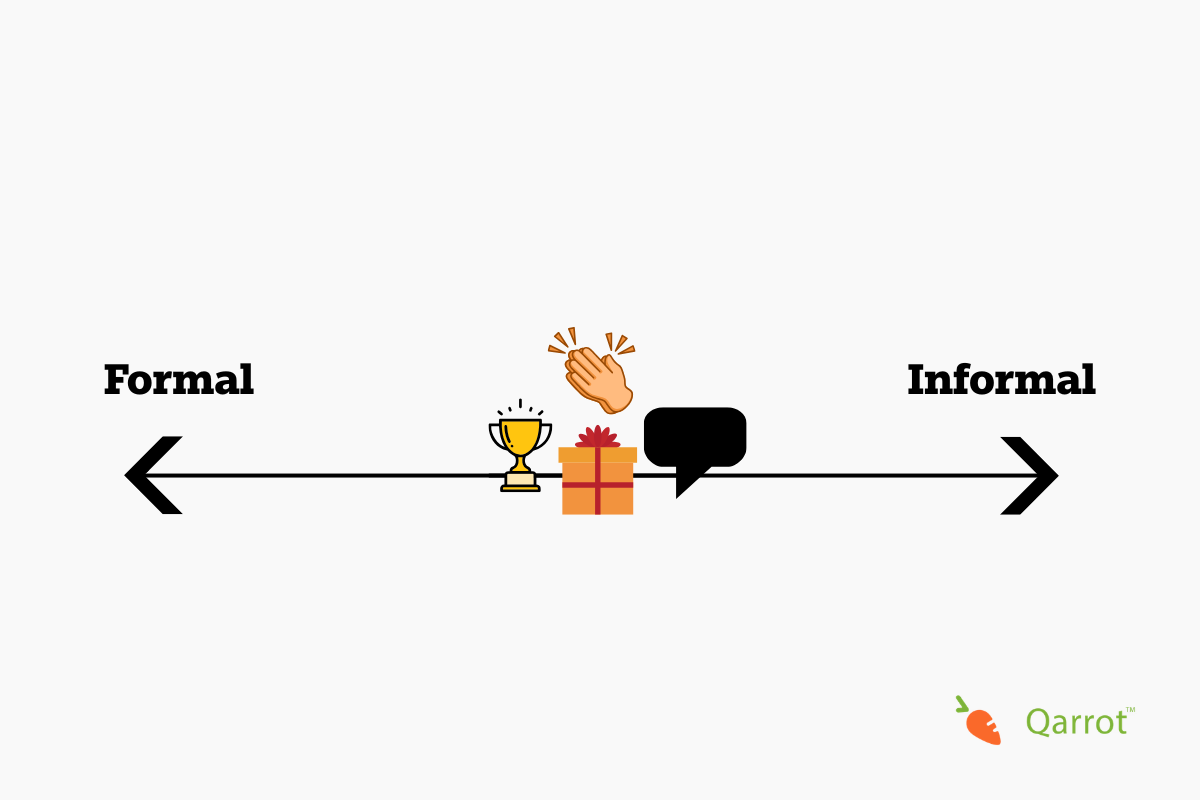
First, it helps to classify all recognition initiatives into two main types: formal and informal programs.
All types serve an important purpose in motivating employees and improving their happiness, and there are many examples of how recognition programs can come to life.
Let’s review each in a little more depth and go over the pros and cons to see why each type is critical to building a well-rounded culture of appreciation in your workplace.
Formal Recognition
Formal methods are more traditional ways of offering recognition. This type of recognition is labelled as “formal” because it is structured and ceremonial, often expected and occurring at predictable times.
Here are a few examples of formal recognition:
- Years of service awards
- Milestone programs
- Performance awards
- Birthday celebrations
- Employee of the month
- Nomination programs
Think of formal recognition as the foundation of your appreciation culture. These events give employees something to look forward to. Formal methods are excellent at addressing long-term employee needs. These recognition initiatives incentivize and sustain deeper employee motivation.
However, this type of recognition method has its drawbacks. Let’s look at the pros and cons of formal recognition in a little more detail.
Benefits of formal recognition
- Predictable & consistent: Formal recognition gives managers a clear picture of when to give recognition, and employees also have a scheduled recognition event to look forward to.
- Impactful: Recognition is usually given on behalf of the organization or its executives, and its formal nature gives it greater impact and weight.
- Fair & inclusive: For most formal programs, every employee is included (or at least has an opportunity to be) and can therefore be recognized.
Drawbacks of formal recognition
- Generic: Because formal recognition is often predictable and universal, it can feel generic or transactional without deliberate personalization.
- Infrequent: Employees often have to wait long periods to receive formal recognition.
- Resource & time-intensive: Formal programs are structured and involve budgets; they must be carefully planned, approved, and rolled out.
Informal Recognition
Informal recognition is flexible and unstructured. It is often offered by an employee's direct manager or even peers. Little planning and preparation are required for these recognition initiatives; they are often offered on an “as-needed” basis and delivered verbally, but they can also include tangible gifts or rewards.
More “informal” programs usually involve initiatives like:
- Shoutouts in meetings
- Peer-to-peer recognition
- Recognition boards
- Organizing paid outings or events
- Thank you letters
- Offering small gifts for a job well done
Recognition has a strong impact, but it is also short-lived. Recognition must be offered in small, consistent ways to have the most impact. When leaders cultivate a culture that regularly offers informal recognition to employees and peers, the team benefits from the continuous boost to morale that appreciation and recognition can provide.
Again, this type of recognition method is critical but not without drawbacks. Let’s look at the pros and cons of informal recognition in a little more detail.
Benefits of informal recognition
- Flexible & frequent: Employees don’t have to wait for a formal event to receive appreciation or praise.
- Easy to administer and inexpensive: Informal programs or appreciation methods are easy to set up and roll out and can often be completely free.
- From a manager or a peer: Praise comes directly from a manager or a peer rather than from the organization, making it feel more personal.
- Meaningful & personalized: With informal methods, employees are usually praised for specific skills and accomplishments.
Drawbacks of informal recognition
- Overly casual: Informal recognition is casual and given spontaneously. As a result, it can sometimes come across as vague and lack the impact and weight of more formal methods.
- Consistency: Creating a culture of regular recognition takes practice. The frequency and consistency with which recognition is offered to employees may fluctuate.
- Perceived favoritism: Managers may inadvertently single out a few employees, leading to feelings of favoritism. However, this is easy to avoid when managers try to recognize different types of actions and people.

How to Build the Best Employee Recognition Program for Your Company
Understanding the spectrum of recognition — from formal to informal — is only the first step.
The real challenge is deciding how those elements come together to reflect your organization’s culture, values, and priorities.
An effective employee recognition program is not a template copied from another company or a checklist of “best practices.” Think of it more as building a deliberate system that aligns with how work actually happens in your organization.
That process begins by examining what you already have in place, listening to employees, and clarifying what you are truly trying to reinforce. When recognition is designed with intention rather than imitation, it becomes more than a program; it becomes part of your culture.
1. Audit what’s already in place
Before introducing anything new, take stock of what already exists.
Most organizations already recognize employees in some way. These may not be labeled as “recognition programs,” but they shape how appreciation is experienced inside the company.
Start by documenting them all on a spreadsheet or table.
For each initiative, clarify:
- What is the purpose?
- Who presents it?
- Who receives it?
- How often does it occur?
- Is there a budget attached?
- Is it tied to behaviour, performance, tenure, or something else?
You may discover that recognition is heavily weighted toward one type — for example, milestone-based rewards — while other forms, such as real-time or peer recognition, are absent.
This exercise often reveals gaps in frequency. Employees may experience appreciation only once or twice a year, even though meaningful contributions happen every week.
Speak to managers and employees
An audit should not be limited to a spreadsheet exercise. Recognition exists to meet employee needs, so it’s essential to understand how it is currently perceived.
Managers can provide insight into what is working and where participation feels forced or ineffective. Employees, however, are the most important source of truth.
When employees say they “want more recognition,” that can mean very different things. It might mean:
- They want more frequent acknowledgment.
- They want recognition tied to specific behaviours.
- They want something less generic.
- They want appreciation from peers, not just leadership.
Gathering this feedback does not require a complex research project. Anonymous surveys, small focus groups, or brief 1:1 conversations can surface valuable patterns.
Simple questions can go a long way:
- Do you feel your contributions are noticed?
- What types of recognition feel meaningful to you?
- When recognition does happen, does it feel timely?
- How often would acknowledgment feel appropriate?
The goal is not to please everyone. The goal is to understand the emotional gaps your current approach may be leaving unaddressed.
2. Clarify your goals and identify the gaps
Once you understand your current landscape, step back and define what you are trying to achieve. Recognition should not exist simply because “other companies have it.” It should support a clear objective.
For example:
- Are you trying to reinforce company values?
- Improve retention?
- Increase morale during a period of change?
- Motivate high performance?
- Celebrate tenure and loyalty?
Each goal requires a different approach to recognition. If your primary objective is to motivate high performance, relying solely on service awards will likely fall short. Service awards acknowledge longevity, but they do not reinforce recent effort.
When your goals are clear, gaps become visible. You may realize that you celebrate tenure but rarely recognize collaboration. Or that bonuses reward results but not the behaviours that lead to them. This clarity sets the foundation for designing a system rather than adding another isolated initiative.
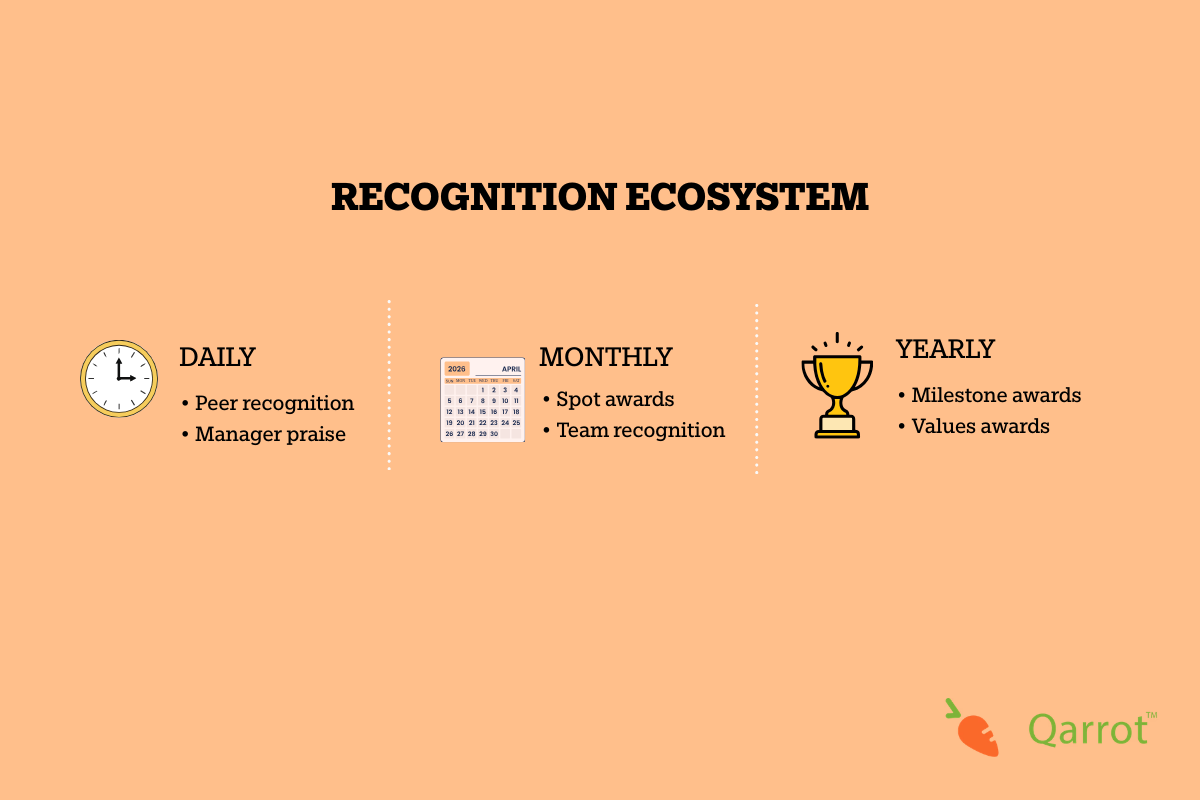
3. Build your recognition ecosystem
With your audit complete and your goals defined, the next step is to formalize your approach.
Don't think of recognition as a single event. It's a collection of complementary recognition initiatives that work together to reinforce appreciation throughout the employee experience.
Instead of relying on a single program, organizations combine multiple recognition practices to create an environment where appreciation is visible year-round.
A practical way to structure your plan is to document each recognition initiative and define:
- The goal it supports
- Who is eligible to receive it
- How often does it occurs
- The budget or reward is attached
- Any tools or external partners involved
When laid out visually, patterns emerge. You can quickly see whether recognition is clustered in one quarter, overly dependent on leadership, or too sparse between milestones.
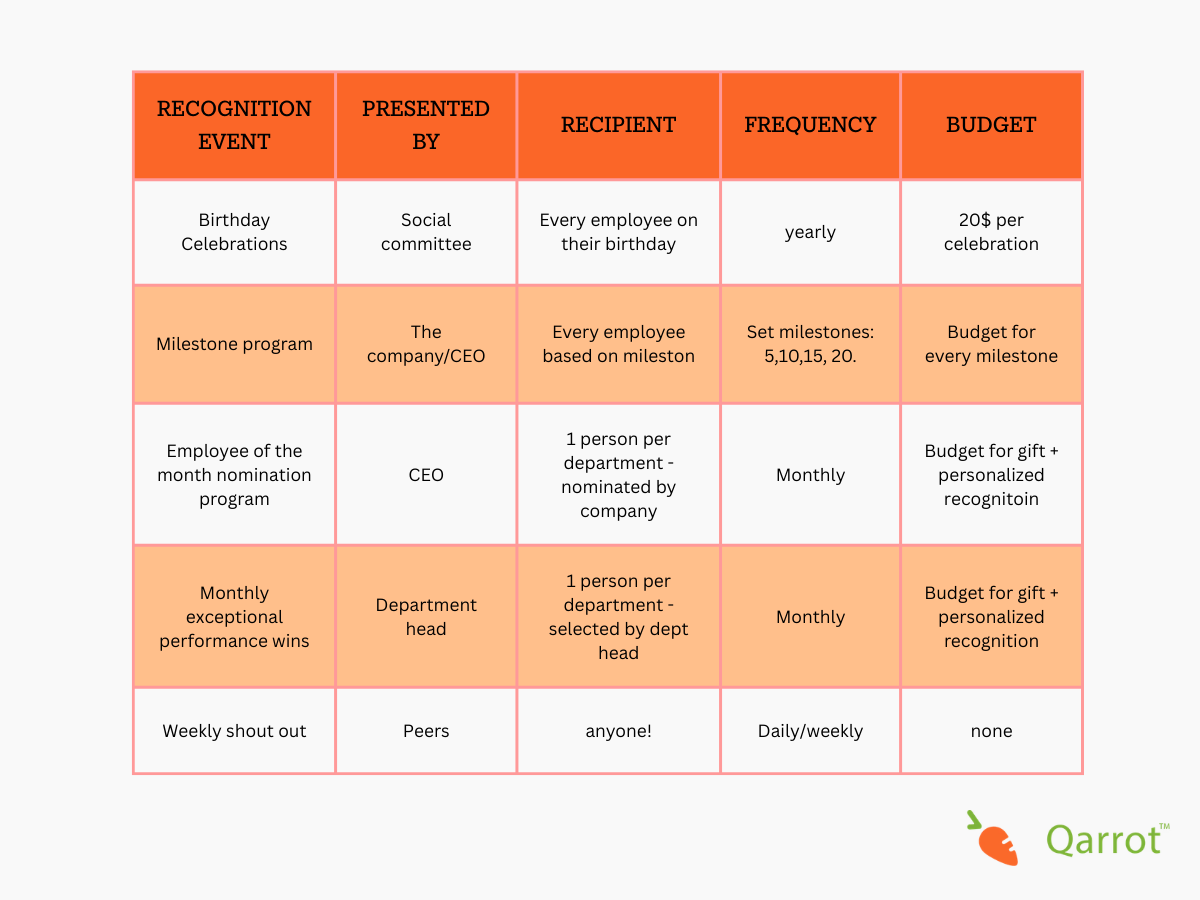
A structured plan also creates transparency and accountability.
- Finance can anticipate costs.
- Managers understand their role in delivering recognition.
- Employees experience consistency rather than unpredictability.
Most importantly, layering both formal recognition (such as milestone or performance-based awards) and informal recognition (such as peer acknowledgment or manager praise) ensures that appreciation is felt throughout the year, not just at scheduled events. Recognition becomes part of how work happens, not an occasional celebration.

Why Employee Recognition Programs Fall Short
Even well-designed employee recognition programs can lose impact over time. In most cases, failure isn’t caused by the platform, the rewards, or even the budget. It often happens because of execution gaps in early onboarding, adoption, authenticity, or long-term consistency.
Here are the most common reasons recognition programs fall flat, and how to prevent them.
1. Inadequate internal training & promotion
One of the most common reasons recognition programs stall has little to do with intention and everything to do with implementation.
Every new initiative introduces friction. Even when employees are excited about the idea of recognition, change requires effort. People must learn new expectations, new behaviors, and sometimes new tools. Without guidance, many default back to old habits.
In practice, organizations that strategically roll out their recognition programs see a huge boost in participation rates. Efforts such as training sessions, explaining the program's purpose and goals, and involving leadership all have a significant impact.
This applies whether you are introducing a simple milestone program or implementing recognition software like Qarrot. The format matters less than the clarity and positive reinforcement behind it.
How to avoid this:
- Plan a structured internal launch across multiple touchpoints (email, meetings, internal channels)
- Run dedicated training sessions to explain the purpose, expectations, and mechanics of the program
- Provide clear first actions (for example, encouraging employees to recognize one colleague in the first week)
- Ensure managers model participation and reinforce it consistently
Recognition programs rarely fail because employees don’t care. They fail because no one clearly showed them how to engage.
Ensure leadership stands behind it
Recognition programs gain the most traction when senior leaders visibly participate. When executives actively get involved, reference the program in meetings, and model the behaviors they want reinforced, participation increases across the organization.
Employees take cues from leadership. If recognition appears to be “another HR initiative,” engagement often remains limited. But when senior leaders publicly endorse and use the program, it signals that recognition and appreciation are now part of how the organization operates on a deeper level
Leadership involvement does three important things:
- It legitimizes the program.
- It normalizes participation.
- It demonstrates what meaningful recognition looks like.
Even simple actions can significantly influence adoption. Recognition becomes cultural when it is modeled from the top.
2. Recognition feels performative or obligatory
Everyone wants to feel appreciated. But not all appreciation is created equal. Recognition loses impact when it becomes routine, generic, or expected.
Similarly, when poorly executed, recognition programs can create appreciation that feels automatic rather than earned. At worst, employees may feel pressured to give recognition simply to "hit a quota," and that's when it quickly becomes transactional.
Workplace psychologist Dr. Paul White, co-author of The Five Languages of Appreciation in the Workplace, draws a distinction between traditional recognition and authentic appreciation.
He notes that "recognition as traditionally practiced often feels impersonal and contrived," emphasizing that for recognition to feel sincere and authentic, it must focus on both performance and the individual, not just the completion of a task.
Bottom line: When a recognition message lacks specificity or emotional sincerity, employees disengage. It feels like a process of "going through the motions" rather than a meaningful acknowledgment.
How to avoid this:
- Train leaders and managers on how to give detailed, behavior-based recognition
- Encourage recognition that clearly states what was done, why it mattered, and how it contributed to the team
- Tie recognition to company values and real outcomes
- Avoid making recognition feel mandatory or quota-driven
- Reinforce that quality and sincerity matter more than volume
Even if you launch a recognition program, it doesn't necessarily mean there should be a quota to hit or that people should feel forced to participate. Recognition is most impactful when it reflects genuine appreciation for specific contributions, not when it meets a formal requirement.
3. The program loses momentum over time
Many recognition programs launch with enthusiasm but gradually lose visibility. Participation declines, new hires aren’t fully introduced to the program, and leadership attention shifts elsewhere.
Research on the importance of employee recognition shows that while recognition programs are widespread, only about one in three employees receive recognition regularly, and nearly half want more frequent acknowledgment.
Without reinforcement, recognition initiatives fade into the background.
How to avoid this:
- Monitor participation rates and recognition frequency
- Share program highlights in company meetings or internal communications
- Reintroduce the program during onboarding for new hires
- Periodically refresh messaging or run themed campaigns
- Integrate recognition into broader cultural touchpoints (company values, website messaging, internal events)
Recognition becomes durable when it is embedded in the organization's rhythm rather than treated as a one-time initiative.
4. Over-reliance on a single type of recognition
One of the most common design mistakes is assuming that launching a single recognition initiative is enough to shape culture.
For example, an organization may introduce a years-of-service program and consider recognition “covered.” While milestone awards are meaningful, they occur infrequently and primarily acknowledge tenure rather than day-to-day contribution. When recognition is limited to one structured event, appreciation becomes episodic rather than deeply embedded in the work culture.
Recognition serves multiple psychological needs. Employees want to feel that their loyalty is valued, but they also want their effort, collaboration, creativity, and problem-solving to be seen in real time. A single program cannot address all of those dimensions. The result is a program that exists on paper but does not meaningfully influence behavior, morale, or retention.
Organizations that see a stronger impact tend to think more holistically. They combine formal initiatives, such as milestone or performance-based awards, with informal, day-to-day acknowledgment. This layered approach ensures that recognition is not confined to isolated events but becomes part of the ongoing rhythm of the workplace.

What’s a Realistic Employee Recognition Program Budget?
The cost of an employee recognition program varies widely depending on how formal, frequent, and reward-heavy the program is. However, a simple starting point is to allocate 1–2% of payroll toward recognition and engagement initiatives, then adjust based on participation and impact.
Within that budget, there is significant variation. Some organizations run lightweight programs with minimal financial investment. Others allocate structured annual budgets per employee. The key is understanding what you’re budgeting for and why.
Informal, low-cost recognition
At this stage, recognition focuses on verbal appreciation, public acknowledgment, small gestures, and occasional team celebrations. There may be minimal or no reliance on external vendors.
These typically include:
- Shout-outs in meetings
- Internal recognition boards
- Small team lunches or gift cards
- Handwritten thank-you notes
- Modest in-house milestone celebrations
Typical budget range: $25–$100 per employee per year
This model works well in smaller or early-stage organizations where culture is still highly relational. The financial investment is minimal, but the tradeoff is that consistency and visibility may be limited without added structure.
Structured informal programs
As organizations grow, many introduce structure to make recognition more consistent and visible. This often includes peer-to-peer recognition programs, digital platforms, or small point allocations that can be redeemed for rewards.
Examples include:
- Peer-to-peer recognition with monthly point allocations
- Quarterly value-based awards
- Small rewards funded through a recognition budget
- Lightweight vendor partnerships for reward fulfillment
Typical budget range: Approximately $100–$200 per employee per year
This level reflects a growing commitment to embedding appreciation into daily work. It increases visibility and fairness across teams while maintaining flexibility. Many growing organizations operate comfortably within this range.
Layered or multi-program investment
At the more structured end of the spectrum, organizations may operate multiple recognition programs simultaneously, such as peer-to-peer recognition alongside formal milestone programs like years-of-service awards, structured nomination programs, or catalog-based reward systems.
Examples include:
- Peer-to-peer points programs
- Formal years-of-service recognition with tiered rewards
- Annual or quarterly company-wide awards
- Vendor-managed reward catalogs
- Larger milestone or performance incentives
Typical budget range: Approximately $200–$300+ per employee per year
At this level, recognition becomes a significant cultural investment. While more resource-intensive, layered programs can reinforce both day-to-day contributions and long-term achievements when thoughtfully integrated.

How to Get A Budget Approved for A Recognition Program
Whether you’re starting with a milestone-based program or introducing more informal initiatives like peer recognition or birthday celebrations, you’ll likely need executive approval for the budget.
Even modest recognition efforts require resources, and leadership will want to understand the impact. How will this investment support retention, reinforce performance, or strengthen culture?
The key is positioning recognition not as a “nice-to-have” perk, but as a structured initiative tied to business outcomes.
Below is a practical framework to help you prepare for that conversation and secure buy-in.
1. Identify a clear business problem
Executives don’t invest in software or cultural initiatives; they invest in solutions that address real, tangible issues in their business. Before discussing your program's design or potential vendors, you must clearly define the business problem that recognition will solve.
Examples:
- Engagement/survey scores or eNPS have dropped.
- Exit interviews mention “feeling undervalued” or “lack of recognition.”
- Employee turnover is increasing, especially among high performers.
- Culture feels fragmented after hybrid or remote growth.
Use internal data or anecdotal evidence from surveys and 1:1s. Frame recognition as a solution that addresses tangible issues, not just a “nice-to-have” culture perk that looks good on paper.
2. Quantify the cost of doing nothing
Employee engagement issues, such as low productivity, low morale, and turnover, have real costs for businesses. Your business case for recognition will be solidified if you can put a dollar amount on the cost of inaction.
Examples:
- Cost of disengagement: Gallup found that an actively disengaged employee costs their organization $3,400 for every $10,000 of salary, or 34 percent. So an employee who makes $60,000 a year costs their company $20,400 a year.
- Turnover cost: Use the industry average (30–50% of annual salary) to estimate the cost of replacing just a few employees.
- Productivity loss: Unengaged employees are ~18% less productive (Gallup).
- Missed employer branding opportunity: Difficulties in attracting top talent due to weaker culture signals.
This doesn’t need to be set in stone; even a rough estimate can be a powerful way to show just how steep the cost of doing nothing to address the issue is.
3. Translate recognition into business outcomes
Connect the dots between recognition and metrics leadership cares about: lower turnover, higher productivity, stronger engagement, and a stronger employer brand that attracts more talent at lower recruiting costs.
The idea here is to focus on results, not activities. It’s not about pitching a “new fun app,” but rather about tying recognition to the business outcomes that leadership cares most about.
4. Estimate a realistic budget
As mentioned earlier, the budget can depend heavily on the type of program you plan to launch. But arriving at this conversation with a rough estimate of the budget required to implement a recognition system is critical. Be ready to show cost ranges and cost breakdowns.
- Reward budget: e.g., $100–$200 per employee per year
- Implementation costs: (if any) for setup or integrations
- Platform cost: per-user or monthly fee (if any)
Use simple scenarios (“For 200 employees, total annual cost ≈ $20,000–$30,000”). It doesn’t have to be absolutely precise. Leadership just needs to get a sense of the overall cost associated with the initiative.
5. Present recognition as a phased investment
Sometimes the best way to get leadership on board is to just get your foot in the door. Don’t ask for everything at once. Start small. Executives love a low-risk pilot because it shows fiscal responsibility and confidence.
For example, you can propose a pilot program:
- 3–6 months in one department or region.
- Clear success metrics (participation, engagement, retention trends).
- Plan to expand company-wide after proving ROI.
6. Anticipate common leadership objections and answer with data
When proposing a structured recognition solution to executives, common objections may arise.
Here are a few you can prepare for:
- “We already say thank you in meetings.”
- Ad-hoc recognition doesn’t scale or reach everyone equally. A system ensures fairness and visibility.
- “Can we do this manually?”
- Manual recognition breaks down past 50 people. It becomes difficult for managers to consistently and systematically recognize their teams, so they don’t, and morale suffers. A recognition tool makes it consistent, measurable, and scalable.
- “We don’t have the budget.”
- Even small budgets can have a measurable impact paired with authentic appreciations.
7. End with a clear next step
Always close your presentation with a concrete proposal:
- Approve pilot for X months with Y department.
- Allocate preliminary budget of $Z
- Review results at the next quarterly meeting
Don’t leave it vague (“We’ll explore options”). Make it easy for leadership to say yes.

How to Ensure Employee Recognition Feels Impactful
Now, let’s zoom in a little.
Because even the most thoughtfully designed employee recognition program can lose impact if the recognition itself feels generic. Structure alone doesn’t create meaning. Giving better recognition is about bringing a human element into this cultural practice.
Because all too often recognition starts to feel transactional when it’s vague, predictable, or disconnected from real contributions. It feels meaningful when it reflects genuine attention, when someone clearly took the time to notice what was done and why it mattered.
There is even emerging research on micro-appreciation — the idea that small, frequent, meaningful acknowledgment can significantly improve employee engagement and morale.
Here’s how to ensure recognition remains impactful and sincere.

1. Be specific
Avoid general praise like “great job” or “thanks for your hard work.” Instead, clearly describe what the person did. Specificity signals that the recognition is earned, not automatic. If you need a little help, we've pre-written a few recognition letter samples to inspire you to get started.
2. Connect to impact
Recognition becomes powerful when it explains why the action mattered. Did it improve efficiency? Strengthen collaboration? Support a company value? Move a project forward? Make that connection explicit.
3. Tie recognition to company values
If your organization has defined values, recognition is one of the most effective ways to reinforce them. Naming the value helps employees understand not only what was done well, but also the behaviors the organization wants repeated.
4. Prioritize quality over volume
Recognition should not feel mandatory or quota-driven. Don’t give recognition simply to go through the mentions. When employees feel pressured to give recognition simply to meet expectations, it becomes performative. Encouraging thoughtful, behavior-based recognition is more impactful than encouraging high volume.

Is Your Business Ready For A Recognition Platform?
A recognition software like Qarrot marks the shift from intention to infrastructure.
It provides a centralized way to support both informal appreciation and more structured recognition initiatives. Instead of relying on isolated programs, a platform helps organizations build a layered system in which recognition occurs throughout the year.
When thoughtfully implemented, an employee recognition platform can help address common challenges:
Consistency: Recognition no longer depends solely on individual managers. Structured systems make appreciation predictable and accessible across teams.
Visibility across departments: Recognition becomes company-wide, reinforcing shared values and reducing silos.
Support for multiple recognition types: From milestone awards to peer shout-outs to nomination programs, a platform enables layered initiatives rather than a single event.
Specific, values-based praise: Recognition can be tied directly to company values or strategic priorities, encouraging meaningful acknowledgment rather than generic praise.
360° participation: Peer-to-peer models allow everyone to both give and receive recognition, not just those with leadership visibility.
Administrative efficiency: Tracking participation, milestones, rewards, and budgets is centralized rather than managed manually.
Scalability: As headcount grows or teams become distributed, recognition remains structured without becoming bureaucratic.
Importantly, a platform alone does not make recognition sincere. It creates the infrastructure that makes sincerity easier to practice consistently and at scale.
Signs You’re Ready for a Recognition Platform
Recognition platforms tend to make the most sense when certain structural realities are in place, particularly when appreciation matters, but the current approach is no longer delivering consistent impact.
You may be ready if:
- Recognition is happening, but inconsistently across teams.
- Growth is making informal appreciation harder to sustain.
- Managers vary widely in how (or whether) they recognize employees.
- You have a milestone or service award program, but it feels too limited or infrequent to meaningfully shape culture.
- You have recognition initiatives in place, but little visibility into how they are being used or how employees feel about them.
- You want company-wide visibility across departments or locations.
- Your workforce is hybrid or fully remote.
- You have clearly defined company values you want reinforced more intentionally.
- Executives are willing to actively participate and model recognition.
Many organizations reach a point where recognition exists in pockets or through a singular formal structured program, but lacks cohesion.
A platform helps organizations promote a recognition system that supports both formal initiatives (such as milestone or nomination-based awards) and informal day-to-day recognition within a single, visible system.
Equally important, recognition software provides insight. Participation rates, reward distribution, and engagement trends can be tracked over time, helping HR leaders determine whether recognition efforts are resonating or merely on paper.
When leadership is aligned on making appreciation part of the culture, a platform becomes less about “adding a tool” and more about strengthening the infrastructure behind recognition as the organization grows more complex.
Recognition Is a Cultural Design Decision
Most HR leaders agree that recognition matters.
The problem arises when recognition is treated as a checkbox and implemented simply to keep pace with expectations. The reality is, culture is built by small actions done consistently rather than by big ones done occasionally.
That’s why the strongest recognition initiatives are not thought of as a singular program, but as a system that supports and embeds appreciation deep into the cultural fabric of your organization.
An employee recognition program should never be a copy of another company's. It reflects your values, your goals, your people, and the behaviors you want to see more of. That design choice belongs to HR.
You may not control every interaction across your organization, but you do shape the standards, expectations, and infrastructure that enable meaningful recognition.
When recognition is treated as an ongoing system rather than a one-time initiative, appreciation stops feeling transactional and starts feeling cultural. And that’s when it begins to have a real impact.
Ready to Launch Your Employee Recognition Program?
Qarrot makes it easy to launch and manage recognition and rewards programs that teams actually use!
