
Gift Cards for Employees: The Complete Guide for HR Teams

For most HR teams at growing companies, employee gift cards start the same way: a manager asks if they can grab something for a team member, you sort it out manually, and it works well enough.
Then it happens again. And again.
Before long, you're fielding ad-hoc requests, maintaining a spreadsheet no one fully trusts, and trying to make sure remote employees don't feel like an afterthought when in-office staff is getting recognized in real time.
At 75, 100, or 150 employees, that informal approach stops being a workaround and becomes a liability. Recognition becomes inconsistent across teams, administrative overhead falls entirely on HR, and the tax compliance question tends to go unanswered until it can't be.
Building a structured employee gift card program solves all of this, but it requires making some deliberate decisions upfront: what format works best for your workforce, how to set budgets managers will actually use, what the CRA expects from you at tax time, and whether you need a platform to manage it at scale.
This guide covers each of those decisions, so you can move from reactive to intentional without having to start from scratch.
Why Gift Cards Work as Employee Incentives
Gift cards are consistently one of the most preferred employee rewards ideas, not because they're easy to give, but because they're genuinely useful to receive.
Unlike company-branded merchandise or fixed-category rewards, gift cards give employees real choice: they can spend on something they actually want, from a retailer they already use, at a time that works for them. That flexibility is what makes gift cards feel personal even at scale.
But flexibility alone isn't what drives employee engagement. What turns a gift card from a nice perk into a meaningful incentive is the recognition moment attached to it.
An employee who receives a $50 gift card with a message that names exactly what they did and why it mattered walks away feeling seen. An employee who receives the same $50 card without context walks away feeling as if HR processed a transaction. The card is identical. The impact isn't.
For HR leaders at scaling companies, gift cards also solve a practical problem: they work equally well for in-office and remote employees, require no physical logistics, and can be delivered instantly. In a hybrid workforce, that consistency matters.
Types of Gift Cards for Employee Programs
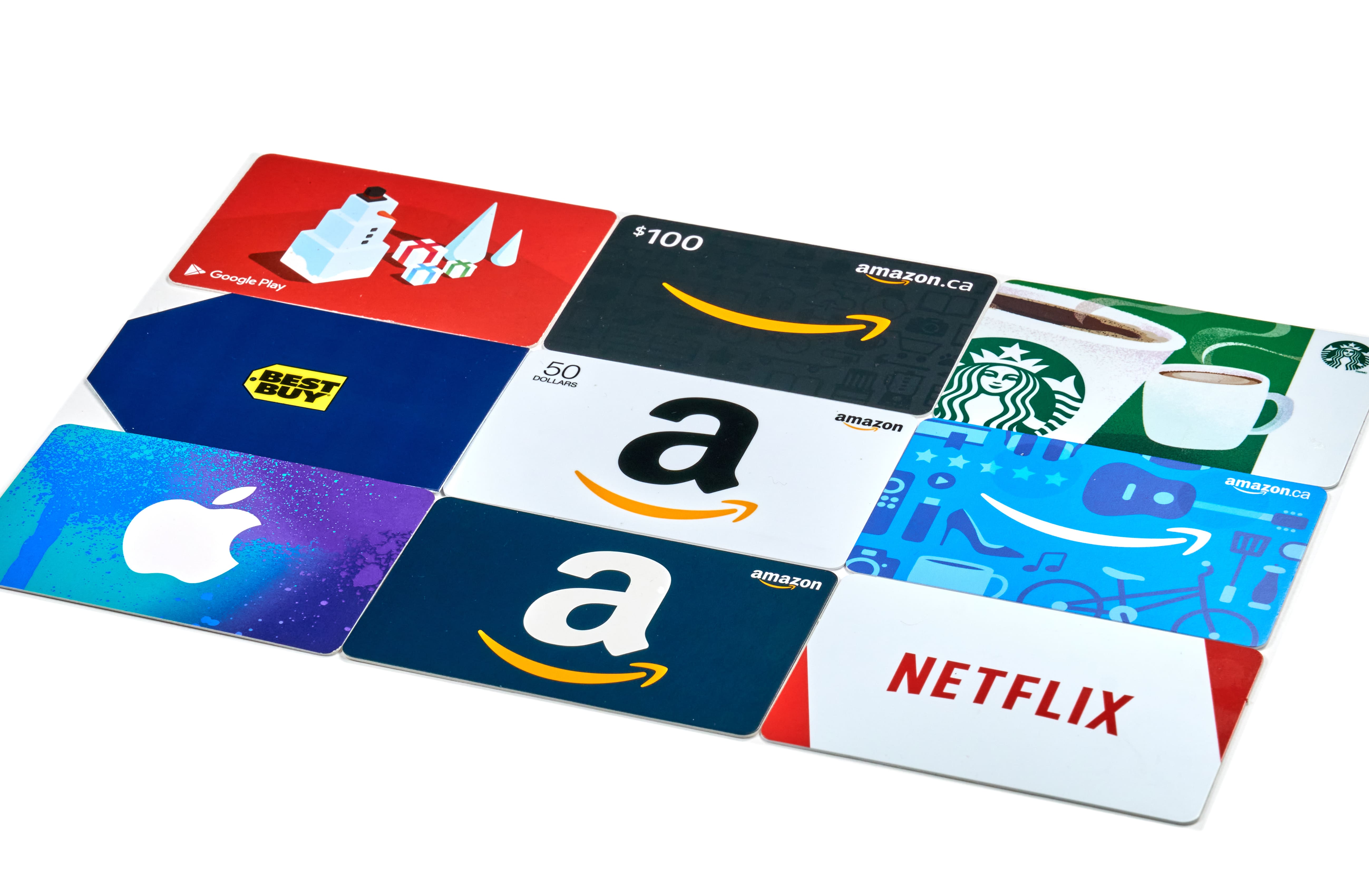
Not all employee gift cards are the same, and the format you choose directly impacts how meaningful and practical your program feels to employees. Understanding the options helps you match the right type of card to the right recognition moment.
Digital vs. physical gift cards
Digital gift cards are delivered by email or through a recognition platform and can be redeemed instantly. They're ideal for remote teams, same-day recognition, and programs that need to scale without manual fulfillment. Physical gift cards still have a place, particularly for formal milestones like service anniversaries, where the tangibility of the reward adds to the occasion, but for most day-to-day incentive programs, digital is more practical and faster.
Single-retailer vs. multi-retailer gift cards
Single-retailer gift cards (e.g., a Starbucks card or an Amazon gift card) are simple but limiting. Not every employee shops at the same places, and a reward that doesn't fit someone's lifestyle can feel tone-deaf. Multi-retailer gift cards, where employees choose from a broad catalog of brands, solve this by giving genuine choice. The employee chooses what matters to them, making the reward feel personal even when it's distributed across a large team.
Reloadable prepaid cards for ongoing recognition
Reloadable prepaid cards function more like a recognition account than a one-time reward. HR or managers can add funds over time, making them well-suited for ongoing spot recognition programs where the goal is frequent, low-friction appreciation rather than a single annual reward. They work particularly well when paired with a points-based system.
International and remote-friendly options
For companies with distributed teams across multiple countries, standard gift cards can create an uneven experience. A Canadian retailer card means nothing to an employee in the UK. Look for platforms that offer region-specific gift card options or globally redeemable alternatives so remote employees have the same quality of choice as their in-office counterparts.
Custom-branded gift cards
Some vendors offer gift cards with your company's branding: your logo, colors, and a custom message on the card itself. These work well for formal programs, onboarding gifts, or company-wide recognition moments where reinforcing the employer brand is a goal. For informal spot recognition, the message's personalization typically matters more than the card's visual branding.

How to Build a Gift Card Reward Program
A gift card program without structure is just ad-hoc spending with extra steps.
The companies that get real engagement lift from gift card programs are the ones that design them intentionally, defining what they're rewarding, how often, at what value, and how managers are expected to participate. Structure is what turns a one-off gesture into a consistent cultural practice.
Define what you're rewarding
Start by clarifying the occasions and behaviors your program is meant to recognize. Common categories include:
- Milestone recognition: work anniversaries, promotions, project completions
- Performance-based rewards: hitting targets, going above and beyond on a deliverable
- Peer-to-peer recognition: colleagues nominating each other for everyday contributions
- Spot recognition: managers reward in-the-moment effort without waiting for a formal review cycle
Each of these calls for a slightly different program design. Milestone programs are typically formal and scheduled. Spot recognition is informal and immediate. A well-rounded incentive program includes both.
Set your budget and cadence
Determine how much you're allocating per employee, per occasion, and per year, and how often recognition should be happening. A common starting point for scaling SMBs is a modest per-employee annual budget split across milestone and spot recognition. The exact number matters less than making it predictable and accessible to managers, so recognition doesn't stall because someone isn't sure if they have budget approval.
Choose your delivery method
This is where many companies underinvest. Manual gift card distribution (buying cards individually, tracking spreadsheets, emailing codes one by one) works when you're recognizing a handful of people. It breaks down at 50 employees, and it becomes a liability at 100+. The administrative drag alone is enough to cause programs to go dormant.
A recognition platform automates delivery, tracks who's been recognized and when, and gives managers a simple interface to send a reward without going through HR for every transaction. For teams at the 75–200-employee stage, this is usually the inflection point at which moving from manual to platform-based delivery pays off immediately.
Decide on personalization
Set clear expectations for how managers should accompany a gift card reward. At a minimum, the message should name the specific contribution, connect it to a company value or team goal, and feel as if it were written for that employee. Not copy-pasted from a template. The gift card is the tangible signal. The message is what makes it stick.
Roll it out to managers
A program that only HR knows about won't move culture. Managers need to understand what the program is, how to use it, and what a good recognition moment looks like. A short enablement session, even a single Teams call, paired with clear guidelines and easy access to the platform, is usually enough to drive adoption if the tool itself is low-friction.
What this means for HR leaders: The most common reason gift card programs underperform isn't budget. It's that managers don't use them consistently because the process feels like work. Removing that friction is the single highest-leverage thing you can do to improve participation.

Tax Implications of Employee Gift Cards in Canada
Gift cards occupy a specific and important place in Canada Revenue Agency (CRA) tax rules, and getting this wrong creates payroll compliance problems. The short answer: most employee gift cards are considered taxable benefits in Canada, which means they need to be tracked, reported, and in many cases included in the employee's income.
Are employee gift cards taxable?
Under CRA guidelines, gift cards are classified as "near-cash" gifts, meaning they function essentially like cash because they can be exchanged for goods of the employee's choice. Near-cash gifts are taxable regardless of the amount. This is different from non-cash gifts (like a physical item), which may qualify for a tax exemption under the CRA's gifts and awards policy up to a certain annual threshold.
The key distinction:
- Non-cash gifts (a physical item): may be non-taxable up to the CRA's annual threshold
- Near-cash gifts (gift cards, gift certificates): taxable in full
For the most current thresholds and rules, refer directly to the Government of Canada page on gifts, awards, and long-service awards. This is the authoritative source and is updated when CRA rules change.
Provincial considerations
While the CRA rules apply federally across Canada, provincial payroll tax implications can vary. HR leaders in Alberta and Quebec, in particular, should confirm how taxable benefits are treated under provincial payroll tax rules, as the reporting and remittance requirements may differ from the federal baseline. Consult your payroll provider or a Canadian tax professional to confirm current provincial requirements.
What to track for payroll compliance
For any gift card given to an employee that is classified as a taxable benefit, you'll need to:
- Record the value and date of each gift card issued
- Include the value in the employee's T4 as a taxable benefit
- Ensure source deductions (CPP, EI, income tax) are calculated on the grossed-up amount where applicable
A recognition platform that logs all reward transactions by employee and amount makes this significantly easier at tax time, especially for companies running frequent spot recognition programs where individual transactions are small but cumulative values add up.
What this means for HR leaders: Don't let tax complexity delay building a program. The compliance piece is manageable, but it does require a tracking system. Manual spreadsheets work at a small scale; a platform solves it automatically.

What to Look for in an Employee Gift Card Platform
For HR teams at scaling companies, the right platform isn't just a gift card vendor. It's the infrastructure that makes a recognition program sustainable. A good employee gift card platform removes manual work, provides managers with a tool they'll actually use, and gives HR visibility into whether the program is working. Here's what to evaluate.
Gift card selection and employee choice
The breadth of the gift card catalog directly affects how meaningful the reward feels to employees. Look for a platform that offers a wide range of retailers across categories (dining, retail, entertainment, travel) so employees at every life stage and lifestyle can find something relevant. A catalog of five options isn't a choice; it's a shortlist.
Bulk purchasing and distribution at scale
For teams of 75 employees or more, the ability to send rewards in bulk or to give managers individual sending access without requiring HR to process every transaction is non-negotiable. Evaluate how the platform handles high-volume distribution and whether it supports automated delivery triggers (e.g., work anniversary dates).
Remote and hybrid workforce support
Digital-first delivery, region-specific gift card options, and a platform that doesn't require employees to be in the office to receive or redeem rewards are table stakes for hybrid teams. Confirm that remote employees have the same quality of experience as in-office employees.
Customization and personalization
The best platforms let managers attach a personal message to every reward — and make it easy enough that they actually do it. Some platforms also allow custom reward amounts, branded notifications, and program-level messaging that reinforces company values alongside the reward.
Reporting and program visibility
HR needs to see who's being recognized, how often, by whom, and at what cost. Reporting gives you the data to demonstrate program ROI to leadership, identify teams where recognition is falling through the cracks, and adjust your approach over time.
Integration with existing tools
Adoption rises sharply when recognition happens inside the tools employees already use. Platforms that integrate with Microsoft Teams, where many SMB teams already spend their workday, remove the friction of logging into a separate app to send or receive recognition. Look for native integrations rather than workarounds.

Common Mistakes to Avoid
Even well-intentioned gift card programs fall flat when the execution misses on a few key dimensions. These are the most common patterns that undermine program impact, and they're all avoidable.
Sending gift cards without a message
A gift card with no accompanying recognition message is a transaction, not an expression of authentic appreciation. Employees notice the difference. If the card arrives without any acknowledgment of what they did or why it mattered, the reward loses most of its motivational value. Every gift card in an employee recognition program should come with a specific, genuine message — this is the difference between checkbox recognition and recognition that actually changes how someone feels about their work.
One-size-fits-all amounts
Giving the same gift card value for a five-year work anniversary as for a quick Friday shoutout signals that your program doesn't differentiate effort or tenure. Build a tiered structure: larger values for formal milestones, smaller amounts for frequent spot recognition. The calibration matters because it communicates what the company values.
Inconsistent distribution across teams
When recognition depends entirely on a manager's personality, with some managers celebrating every win while others never say a word, it creates visible inequity across the organization. Employees notice when one team gets regular recognition, and another goes months without acknowledgment. Consistent programs require consistent structure, not just consistent managers.
Ignoring tax compliance
As covered above, gift cards are near-cash taxable benefits under CRA rules. Failing to track and report them properly creates payroll compliance risk. Build your record-keeping process before you scale the program, not after.
Treating the program as "set it and forget it"
Launching a gift card program and then never reviewing participation data, manager usage, or employee feedback is how programs quietly die. Build a quarterly check-in into your calendar to review what's working, which teams are underusing the program, and whether the reward amounts and occasions still match your company's culture and growth stage.
.png)
How a Recognition Platform Streamlines Your Employee Gift Card Program
At a certain point, managing a gift card program manually stops being a minor inconvenience and starts being a real liability. If you're buying cards individually, tracking redemptions in a spreadsheet, chasing managers to send rewards, and manually logging transactions for T4 reporting, you've already hit that point.
A dedicated employee recognition platform changes the equation entirely.
Instead of HR owning every step of every transaction, the platform handles the infrastructure: reward delivery, manager access, compliance tracking, and reporting.
When you know you're ready for a platform
The signs tend to show up around the same time:
- You have 75 or more employees, and recognition is still manager-dependent. Some teams are celebrated constantly, others go invisible
- You're spending meaningful hours each month on gift card logistics instead of strategic HR work
- Remote or hybrid employees are getting a worse recognition experience than in-office staff
- You can't easily answer the question "how much did we spend on recognition last quarter, and who received it?"
- You've launched a recognition initiative before that quietly died because the process was too manual to sustain
If any of those feel familiar, the problem isn't your managers' intentions. It's the absence of a system.
What the right platform gives you
Beyond just handling gift card delivery, a recognition platform built for HR teams provides:
- Automated program management: milestone recognition (work anniversaries, birthdays, promotions) triggers automatically, so nothing falls through the cracks
- Manager enablement: Managers can send spot recognition directly through the platform or through Microsoft Teams, without routing every request through HR
- A real gift card catalog: employees choose from a broad selection of retailers rather than receiving a card they'll never use
- Compliance-ready reporting: every transaction is logged by employee, amount, and date, making T4 reporting straightforward instead of a Q4 scramble
- Visibility across the organization: HR can see which teams are being recognized and which aren't, and address gaps before they show up in engagement scores
Qarrot is built specifically for HR teams at this stage of growth: scaling companies that need a complete recognition and incentive program, not a single-program tool. Whether you're formalizing what you've been doing informally or building a recognition ecosystem from scratch, Qarrot gives you the structure to make it sustainable.

Want to know how Qarrot can transform your workplace?
Take a peek and discover the many benefits our software has to offer!
