
Blog


How taking lunch feeds employee productivity

Why do 27% of North Americans forfeit their lunch break?
The answer is not that employees are not given one, but rather that they electively choose to take a shorter lunch or work through it completely. By law, all North American companies are required to allot a lunchtime break for their employees, but only one-third of them are taking this opportunity to recharge. Working through lunch, staying at your desk browsing the Internet, or cutting your break short to get back to work sooner all have a direct correlation to lower engagement and productivity!We feel the effects of working relentlessly with no breaks as fatigue, increased stress, and difficulty focusing. Consider this: ten million working days a year are lost due to work-related stress.
In 2015, only 1 in 5 office employees reported taking an actual lunch away from their desk¹. A workforce that is suffering from these symptoms is undoubtedly going to be less productive.If the point of taking a lunch break is to reset and come back to work more focused, we should all be taking full advantage.
Surveys have found that the top reasons expressed by employees for not taking advantage of lunch breaks are:
- Having too much work
- Stress
- Workplace culture
- Wanting to appear hard-working to management
In the moment, choosing to continue working seems more productive: we don’t lose our train of thought and the additional work time makes us feel we’re completing our tasks more quickly. Unfortunately, this is an oversight. We don’t see the long-term and more intrinsic effects of this choice.
Kimberly Lesbach, a management professor at UC-Davis specializing in psychology of the workplace, noted that “never taking a break from very careful thought-work actually reduces your ability to be creative².” It’s not just creativity that is affected; psychologist Dr. Janet Scarborough Civitelli says that overall marginal returns are reduced when our brains are required to exert continuous pressure during long shifts. Walking in a quiet park, going for a lunch-time workout or reading a book - anything to divert your mind from its point of focus for 8 hours a day will noticeably increase your ability to engage back in the office.
The recommended approach to decreasing sick days as an employer is to encourage a healthy lifestyle. This means: A higher percentage of employees utilizing their lunch break equals a lower percentage of disengagement and sick days. While implementing breaks throughout the day grants the opportunity to reset one’s mind, encouraging staff to take advantage of their lunch will have the same effect and more.
Time to leave the office and exercise, have a nutritious lunch, or possibly run some errands effectively minimizes stress, increases cognitive function, and just plain makes your staff happy!
As the employer, there are a few different approaches to increasing your workforce lunch-time takers.
First, lead by example. If employees see you taking a full lunch break, exercising, or meditating, the will likely feel more comfortable doing the same.
Second, actively vocalize to your staff that it is encouraged to take their lunch breaks and do whatever they feel will help them relax and reset. You could even provide healthy snacks or reading materials to entice employees away from their digital screens.
Lastly, ensure that your company culture is pro-breaks. Taking 20-minute breaks to practice meditation or mindfulness - even just from your seat - is a proven way to help relax and focus. Staff should take a few minutes to get up, stretch, have a glass of water or a cup of tea a few times a day. This isn’t wasted time, this is invested time.
Book a demo with Qarrot to learn how recognition can boost productivity (without sacrificing your lunch break!)
Resources
- Peoplematters - How Infeedo is Utilizing AI to Interpret Employees Emotions
- Realbusiness.co - The Importance for Staff to Take Lunch Breaks
- Lifehack.org - The Importance of Breaks at Work
- Psychologytoday.com - Why and How You Should Take Breaks at Work
- Smallbusiness.chron.com - The Importance of Employee Breaks

Motivating different personality types
Here is a winning leadership strategy you may not have thought of: Know the ins and outs of your employees’ personalities and you will unlock exactly how to maximize their effectiveness within your organization.
The more an employer understands the unique traits in each team member, the easier it is to interact with them, inspire them, and have every individual operating at their full potential.
Not only that, but by understanding which personality types work best together and which tend to butt heads, you can more confidently ensure harmonious teams.
Why Motivating Personality Types Matters
But apart from routine interaction with your team members, how can you learn their personality types?
Reliable personality tests take the guessing work out of employee placement and motivation.
Personality tests can be administered at any time - even as part of your onboarding process. Have your employees complete one online and get the results within minutes. An awareness of what your employee holds as a moral belief, what fills her with passion, what behaviour she can’t stand and what their own behavioural habits are is enlightening for both of you.
Take these insights one step further and host a personality-type education workshop for your team. Without having to point out an example in the office of every personality type, your employees are likely to recognize traits and behaviours in themselves and in their co-workers. An awareness of how to interact with and motivate co-workers is invaluable.
Using Personality Types to Motivate Employees
Personalities can be categorized in many ways: for a detailed analysis of the psychological traits in your employees, you can have them complete the Myers Briggs Personality Test. However, even simpler surveys can provide you with useful insights into the relative preferences, traits, and attitudes of your staff.
As an introduction to identifying the different behaviour styles in your organization, here is a brief description of A,B, and C personalities. This approach to personality categorization describes traits exhibited related to work ethic and communication style.
Below is a brief description of these personality types, how they tend to function, and where you may want to consider placing them in your organization
Type A Personality: Achievement-Driven Leaders
- These individuals are fuelled by achievement and recognition, often making them more vocal than other personalities in their pursuit of success.
- Extremely organized, impatient and decisive, you will typically see type-A employees’ work spaces covered in lists, schedules, reminders, and sticky notes.
How to Motivate Them:
Recognition and visible results are key. Assign them leadership roles or decision-heavy projects where their drive for success shines. Motivate Type A personalities with clear goals, measurable outcomes, and leadership opportunities.
Type B Personality: Patient and Compassionate
- Type-B personalities contrast strongly with Type-A; they are less stressed by external pressure, have more patience, are less competitive and achievement-oriented.
- Their perceptive, compassionate, and supportive nature drives them to make a difference in the lives of those around them, co-workers and clients alike.
How to Motivate Them:
Place them in roles that involve human interaction, such as customer service, HR, or team coordination. They are motivated by appreciation and feedback—sometimes a simple thank you goes a long way.
Type C Personality: Analytical and Detail-Oriented
- This last personality type tends to be highly analytical and detail-oriented, valuing time to themselves to achieve precision.
- Unlike Type-A and Type-B, these employees will be appreciative of autonomy. Although they may still enjoy a good conversation, the presence of other people with whom to connect and collaborate is not nearly as effective in keeping them engaged and inspired.
How to Motivate Them
Give them autonomy and projects that require attention to detail, such as data analysis, research, or back-office work. They are motivated by trust, independence, and recognition for their reliability.
Blended Personality Types and Motivation
It’s not uncommon for someone to demonstrate a blend of these personality traits, making the need for each employee to complete a thorough personality test all the more evident!
Some of your work force will be capable of filling numerous roles, so the tricky part is deciding which one will take advantage of their unique qualities best—that’s where a thorough personality test like Myers-Briggs comes in.
The real challenge lies in placing employees in roles where their unique mix of qualities can thrive. When done strategically, aligning personalities with responsibilities boosts both employee engagement and overall company performance.
Motivate Personality Types to Drive Engagement and Growth
At the end of the day, leadership is about people. By learning how to motivate personality types—Type A, B, C, or blended—you’ll build stronger teams, improve workplace culture, and unlock new levels of engagement.
Strategically motivating different personality types can transform your workforce into a more collaborative, productive, and resilient organization.
Explore Qarrot to see just how easy recognizing and motivating employees at scale can be - book a demo today!
Resources
- Crestcomleadership.com - 4 Personality Types that all Leaders Should Learn to Recognize
- Owlcation.com - What is Your Personality Type? Type A, B, C or D?
- Fastcompany.com - 8 Personality Types And How To Manage Them
- Smallbusiness.chron.com - How to Manage Different A,B & C Personality Types at Work
- Theundercoverrecruiter.com - Which Type of Office Worker are You?
- Thenextweb.com - 6 personalities in every office – and how to manage them

Going green one pen at a time: how to be an eco-friendly business
Warming oceans, dwindling ice caps, and noticeable shifts in weather patterns… are you concerned?
Although Global warming is on everyone’s mind these days, Canadians and Americans are not pulling their weight in the global effort to save the planet. In fact, Canadians rank in last place for municipal waste contribution out of 17 developed countries with the USA not much farther ahead!
Both consumers and businesses need to adapt. They say old habits die hard, so do your part by starting with the little changes that you can make right now. Reducing your footprint on the environment is not only possible, it's urgent.
And hey, its not bad for your bottom line either! Green business practices can improve your ROI by significantly reducing the cost of office supplies and energy consumption.
Little Things Make a Difference
- Switch out those pens that end up in a landfill for refillable ones! Just think of how many pens one person goes through in a year…
- Look for companies that make products out of reused materials. Did you know you can get paper clips made from post-consumer metals? Well, now you do.
- No. More. Rubber. Bands.
- You’ve heard it so many times, but we have to say it again: Recycle. Even if it’s just a general recycling box in the staffroom or one for paper by the printer - it makes a difference.
- Make the leap and become a paperless office. Millennials grew up on computers and probably won’t miss it and you’ll earn points with consumers by being so green!
- If you absolutely can’t say goodbye to paper, use recycled paper. Or, save paper by not printing whenever possible and practice double sided printing when do you.
- We would never say stop drinking coffee…but think about all those filters you throw out! Thank goodness for recycled paper coffee filters. We promise you can’t taste the difference.
- Investigate what products are being used to clean your office. Eco-friendly cleaning supplies not only smell fresh but will actually leave your work space just as clean and less toxic.
- Turn off lights and computers when they are not in use. It will save you money on energy bills and decrease the overall power consumption being used by hosting servers.
- On that topic, make your website hosting green!
We know change is hard, so even if you can implement one thing from this list, at least it’s a start.
This short list reflects some of the easiest eco-friendly changes you can make. If you are ready to commit to change on an even grander scale, check out how other companies have gone totally green.
If you can’t get on board the ‘save the planet’ train, think about it this way: waste is waste, and waste means you are throwing away money.
Not only is physical waste adding up in dollars, but your company’s costs incurred by paying for health insurance and employee sick days are affected too; A healthier workplace can result in up to a 20 percent decrease in sick days taken by employees.
Whatever your reasons for going green, both the world and your bottom line will thank you.Wondering how to motivate greener behaviors in the work-place?
Contact us to learn more about connecting employee engagement to your drive to become more environmentally-friendly.
Recognizing a job well done is small gesture that can drive big results - book your free trial with Qarrot today!

The three people your startup can't live without
Why do 50% of startups fail after 5 years? What is happening within these companies, that after ten years, only 30% are still active?
The reasons for failure can be many, but a key building block for success is finding the right team.
Startups are small - very small. The foundations and fuel of the company are almost entirely derived from the skills of the team behind it. Because generous budgets are a luxury startups do not often enjoy, the available resources are limited to what your small group of ambitious visionaries is bringing to the table.
Everyone in your ranks should be a bit of a workhorse. In a startup, being driven, self-motivated, and passionate are essential. Each one of you would never say no to a task considered too small because you all know that every job is equally critical to the company’s success.
Because these qualities are a given, let’s look at the three people you absolutely need to find for your company.
The Visionary
This is usually the founder or CEO of the company, but the qualities would be equally as beneficial coming from any employee!
A visionary sees the big picture and empowers everyone around them to help build their dreams. Charisma comes naturally to a visionary, who is so impassioned by their ideas that they could get you excited about any new project.
Within the company, the visionary encourages all team members to share their ideas as well. While cultivating a work place culture of open communication and collaboration, they also reach out beyond the company to make connections and establish relationships with investors and partners.
A visionary brings an optimism that will keep you all encouraged through the bumps and hurtles which will inevitably come your way. Just make sure they aren’t too impulsive—a little self-restraint and level-headedness are definitely assets.
The Structure Giver
The Yin to the visionary’s Yang, a structure giver is the person who gives shape to ideas. This person sees the vision and identifies the steps needed to get there.
Defining roles, outlining goals, and monitoring performance fall under this team member’s to-do list.
When looking for the right person to fill this role, you want someone who is reliable, organized, inventive, and being a penny pincher also doesn’t hurt. However, for all of their type A personality traits, they are still adaptable. The structure giver within a startup must always maintain a certain malleability—listening to others, staying approachable, and communicating effectively will ensure the company functions as a democracy, not a dictatorship.
The People Person
You are all working very hard, but please, for your own sake don’t forget you are human beings! Putting your heads down and grinding the days out may be productive for a while, but it will inevitably tire everyone out.
Having someone on your team that is naturally a social butterfly and morale booster will keep the positivity alive. You can usually identify the talkative trait in a face to face interview very quickly, but it's not just about being chatty.
This person should be highly perceptive and able to shift their perspective at key moments. They know when a night out for drinks is needed or if the appropriate solution is to offer a helping hand to a stressed out co-worker. They are the consummate listener and mediator: when someone opens up about a problem, they know how to respond and find a solution.
Think of your people person as your HR department, but because you’re a startup, less of a department and more an invaluable force of positive, compassionate energy.
As you sift through resumes hunting for that perfect combination of dreamer and doer, take a moment to reflect on why these applicants are attracted to working for you. Yes, startups are exciting and offer a chance for rapid personal growth and innovation, but they are also agile, fast-paced, and demanding. Many hopefuls are not aware of how vastly different the attitude and skills needed in this environment are from those in a much larger and more stable organization.
But you do know.
So now, your job is to read between the lines of their carefully crafted cover letters and to find indications of courageousness: a startup is no place for the risk-adverse.
You cannot rely on their self-describing adjectives: so they say they are innovative, but what concrete examples of creative “outside-the-box” thinking can they provide?
Lastly, when you think you really have found the right person, have your entire team interview them. A startup is no place for big egos. Put in a room with the rest of your A+ quality team, an arrogant applicant will likely let their need to be the biggest star in the room slip out.
Don’t rush into hiring someone- hold out for the person who can work with every member of your team. Your company’s life depends on it.
You know what else your startup can't live without? A full circle recognition and rewards program!

Group meetings vs the one-on-one
Meetings are a necessary part of company management but have a bad reputation for often being ineffective and time-consuming. Employees and management alike are all too aware of those meetings that run far too long and don’t accomplish their goals. Even with an agenda, group meetings can easily be thrown off track and one on ones can become one-sided lectures. As attention spans dwindle, employees disengage, and the clock ticks away valuable company time, you may think to yourself, there has got to be a better way!
Well, there is!
Group meetings and one on one sessions can be utilized strategically to achieve different results. Knowing the strengths and weaknesses of the two models will save your company time without sacrificing any of the benefits.
The Group Gathering
There will never be enough time in the day for everything on your team’s to-do list, so setting aside time specifically for a meeting guarantees you a chance to address the entire office. Now that you have this distraction-free period, how should it be used?
A group meeting can benefit your organization in several ways a one-on-one cannot. This is a chance to get everyone on the same page and foster communication, collaboration, and workplace culture.
Departments that wouldn’t regularly interact with one another and employees who work remotely and rarely make it into the office can all be called into the same room. With a group meeting, you have the ability to create an interactive environment where new perspectives, ideas, and knowledge can be shared. Something someone says or proposes may inspire a new collaboration or project, fostering an ongoing relationship beyond the boardroom.
With group meetings, watch out for the age-old problem of “too many cooks in the kitchen.” When there are multiple voices vying to share thoughts and comments, the meeting’s schedule can fall off track and that allotted thirty minutes may turn into an hour. Make sure there is a clear leader in the conversation to ensure you stay on track and cover everything on the agenda for the day. Don’t be afraid to cut a conversation short - make a note to schedule a follow-up time for those involved and move onto your next topic.
The One-On-One
The best part of a one-on-one meeting is just that: it’s one-on-one. Making time for an employee shows you care and is the optimal time to check in with that member of your staff on how they are doing in their role, their strengths, weaknesses, and what you can do to help them succeed.
This is your chance to have a personal, honest conversation. Whether it be with a new employee or someone who has been with the company for years, an individual meeting gives you both an opportunity to build a stronger relationship and trust. You can use this time to ask about anything! You may want to know about your employee’s experience with new policies the company implemented, their overall job satisfaction, or even provide feedback yourself on their job performance.
The key here is to be careful that you don’t monopolize the conversation, or you will miss out on learning more about the person in front of you.
Understanding the members of your team on a personal and professional level will help you utilize their personality and skills to their maximum potential. You are effectively assessing the parts of the whole; knowing the members of the team will give you invaluable insights on how to help the group function as a whole.
One-on-one meetings are extremely useful when time is tight. If hitting all your pertinent topics is crucial, a personal meeting will be the better option since you can manage the conversation and won’t have other voices to contend with. Also, shy employees who wouldn’t necessarily feel comfortable speaking up in front of the office will be more engaged and involved in a one-on-one.
If meetings are something you are just beginning to implement, it is important to let staff know that this is a new company-wide practice. Be clear that the intention is to help management connect the team and establish a new workplace culture; employees may feel singled out or concerned that meetings are a punishment if they are not aware of the actual reason.
Whatever meeting model you choose to use, always have clear objectives and an organized timeline going into it. There is nothing more frustrating than setting aside that invaluable time, and at the end of it realizing you haven’t accomplished what you needed to.
Book your free demo with Qarrot to explore all things recognitions and rewards related!

8 Non-monetary Employee Recognition Ideas That Actually Work
When HR leaders think about building an employee recognition program, the first question is usually about budget. How much will this cost? Can we afford it? It's a fair concern, but it's also the wrong place to start.
The real question isn't how much we can spend on recognition? What actually makes employees feel valued?
And the research answer might surprise you: when employees are already fairly compensated, cash rewards and bonuses are not the most powerful drivers of engagement or loyalty. What moves the needle is recognition that is specific, timely, and personal. None of those things requires a big budget. They require intention and structure.
Why so many recognition efforts stall before they stick
Here's a pattern that plays out in many SMBs: leadership decides to "do more recognition," managers are encouraged to thank their teams more often, and then... nothing really changes. Not because people don't care, but because there's no structure to make it easy or consistent. Recognition becomes one more thing to remember, and it quietly falls off the list.
This is the trap of chasing consistency without first building structure. Consistent recognition doesn't happen through willpower; it happens when you've built a recognition system that gives managers a clear framework and multiple touchpoints to work with.
And the good news? Building that ecosystem doesn't require a big monetary investment. It requires the right mix of programs and moments, many of which cost little to nothing.
Let's break down what nonmonetary recognition actually looks like in practice.
What Is Nonmonetary Employee Recognition?
Nonmonetary employee recognition is any type of recognition or appreciation that doesn't involve cash, bonuses, or near-cash rewards (e.g., gift cards given without personal context). It encompasses a wide range of gestures, all designed to make employees feel their contributions matter.
Nonmonetary recognition can come from managers, peers, or the organization as a whole. It can be public or private, individual or team-based. The common thread is this: it's specific, it's human, and it costs more in thoughtfulness than in dollars.

Types of Nonmonetary Employee Recognition (With Examples)
1. Verbal and written praise
The simplest form of recognition is also one of the most underused: just saying it. A specific, sincere "thank you" can have a lasting impact on an employee's feelings about their work.
This can look like:
- A personal thank-you note (handwritten or digital) tied to a specific contribution
- A shoutout in a team meeting that explains what someone did, not just that they did something good
- A message from a senior leader acknowledging a project win
The keyword is specific. "Great job this week" is noise. "The way you handled that client situation on Tuesday, staying calm, finding a solution, keeping the team in the loop, that's exactly the standard we want to set," is recognition. It sees the individual and names the contribution.
2. Peer-to-peer recognition
Recognition doesn't have to flow top-down. Some of the most meaningful acknowledgments come from colleagues, the people who actually see the day-to-day work someone puts in.
Building peer recognition into your culture can be as simple as a structured nomination program ("nominate a teammate who went above and beyond this month") or as informal as a shared channel where anyone can post a shoutout. The goal is to make appreciation a collective habit, not just a managerial responsibility.
This approach does double duty: it builds a culture of appreciation while distributing the recognition load across the whole team, which makes consistency far more sustainable.
3. Autonomy and flexibility
For many employees, being trusted with autonomy is a form of recognition. It signals that leadership believes in their judgment and values their contribution enough to step aside.
Nonmonetary recognition through autonomy and flexibility can look like:
- Offering flexible work hours or remote work options as a reward for strong performance
- Giving an employee ownership over a new project or initiative
- Trusting a high performer to set their own priorities without micromanagement
This form of recognition tends to resonate especially strongly with employees who are internally motivated and results-driven, the people you most want to retain.
4. Professional development opportunities
Investing in someone's growth is a powerful statement: we see your potential, and we want to support it. Development-focused recognition doesn't have to mean expensive courses or conferences, though those work too when the budget allows.
Accessible options include:
- Inviting a high performer to shadow a senior leader or join a strategic meeting
- Offering to cover the cost of an online course or certification in their area of interest
- Assigning a stretch project that builds new skills
- Pairing a junior employee with a mentor for a defined period
This type of recognition is particularly effective because it signals long-term investment, which builds long-term loyalty.
5. Public recognition and visibility
Being seen by the broader organization is meaningful for many employees. This is especially true for contributions that might otherwise go unnoticed.
Public recognition can be structured (e.g., a formal "Employee of the Month" program or a quarterly award) or informal (e.g., a company-wide email shoutout or a post on an internal feed). What matters is that the recognition is genuine, specific, and clearly tied to something the individual actually did, not a rotating trophy that feels like checkbox recognition.
6. Time and experience-based rewards
Time is finite, which makes it genuinely valuable. Giving an employee an afternoon off, an extra vacation day, or a flexible Friday as recognition for exceptional effort sends a clear message: we notice what you give, and we're giving something real back.
Experience-based rewards, such as event tickets, a team lunch to celebrate a milestone, or an opportunity to attend an industry conference, also fall into this category. These moments create memories and associations that cash rarely does.

Does Non-monetary Recognition Actually Work? What the Research Says
The intuition that "employees just want money" is understandable, but it doesn't hold up under scrutiny.
Research consistently shows that once employees feel they're being paid fairly, additional monetary rewards yield diminishing returns on engagement and motivation.
What drives genuine engagement is feeling valued, seen, and connected to meaningful work. Those experiences are created through timely, specific, and personal recognition, not by the size of a bonus.
A few things the research points to:
- Recognition frequency matters more than recognition size. Employees who are recognized regularly report higher engagement than those who receive infrequent but larger rewards. (Gallup)
- Manager recognition is disproportionately impactful. Acknowledgment from a direct manager tends to carry more weight than top-down company awards, because it comes from the person who sees the work most closely. (Gallup)
- Peer recognition builds culture. When appreciation flows laterally, not just from the top down, it creates a culture where people feel collectively supported, not just evaluated. (SHRM)
Building Non-monetary Recognition Programs That Actually Sticks
Here's the honest truth: a list of recognition ideas only gets you so far.
What determines whether nonmonetary recognition actually creates impact in your organization isn't the quality of any individual gesture, it's whether you've built the structure to make recognition consistent.
That means building a recognition ecosystem: a deliberate mix of formal and informal programs that gives employees multiple ways to feel appreciated, year-round, not just on milestone dates or during performance reviews.
For an SMB, a basic recognition ecosystem might look like:
- Daily peer-to-peer recognition that happens spontaneously every day
- Quarterly award per department for best performance
- A years of service program that acknowledges tenure meaningfully
- A monthly company-wide nomination program tied to company values
None of these requires a big budget or any tangible reward at all. A quarterly award doesn't need a gift or bonus to be meaningful. A detailed, specific callout of what someone accomplished and why it mattered can land just as powerfully as anything priced. A work anniversary doesn't need a catered lunch. A handwritten card and a short slide deck of the employee's biggest wins over the year? That costs almost nothing, and it shows you were paying attention.
The point is: the structure matters more than the spend. You can't ask managers to recognize more often if they don't know what to recognize, when to do it, or how to do it. Give them the framework first, and the consistency follows.
Putting It Into Practice
If you're an HR manager at an SMB looking to build or refresh your recognition approach, the most important thing you can do isn't find the perfect reward. It has built the infrastructure that enables repeatable recognition.
Start with one or two programs that give your managers a clear framework, a peer-nomination cadence, a simple spot recognition process, and a way to make appreciation visible across the team. Then layer in the informal, personal moments: the handwritten note, the specific shoutout, the development opportunity that shows someone you're invested in their future.
Recognition doesn't have to be expensive to be meaningful. It has to be specific, sincere, and consistent. And that starts with structure, not spending.

Gift Cards for Employees: The Complete Guide for HR Teams
For most HR teams at growing companies, employee gift cards start the same way: a manager asks if they can grab something for a team member, you sort it out manually, and it works well enough.
Then it happens again. And again.
Before long, you're fielding ad-hoc requests, maintaining a spreadsheet no one fully trusts, and trying to make sure remote employees don't feel like an afterthought when in-office staff is getting recognized in real time.
At 75, 100, or 150 employees, that informal approach stops being a workaround and becomes a liability. Recognition becomes inconsistent across teams, administrative overhead falls entirely on HR, and the tax compliance question tends to go unanswered until it can't be.
Building a structured employee gift card program solves all of this, but it requires making some deliberate decisions upfront: what format works best for your workforce, how to set budgets managers will actually use, what the CRA expects from you at tax time, and whether you need a platform to manage it at scale.
This guide covers each of those decisions, so you can move from reactive to intentional without having to start from scratch.
Why Gift Cards Work as Employee Incentives
Gift cards are consistently one of the most preferred employee rewards ideas, not because they're easy to give, but because they're genuinely useful to receive.
Unlike company-branded merchandise or fixed-category rewards, gift cards give employees real choice: they can spend on something they actually want, from a retailer they already use, at a time that works for them. That flexibility is what makes gift cards feel personal even at scale.
But flexibility alone isn't what drives employee engagement. What turns a gift card from a nice perk into a meaningful incentive is the recognition moment attached to it.
An employee who receives a $50 gift card with a message that names exactly what they did and why it mattered walks away feeling seen. An employee who receives the same $50 card without context walks away feeling as if HR processed a transaction. The card is identical. The impact isn't.
For HR leaders at scaling companies, gift cards also solve a practical problem: they work equally well for in-office and remote employees, require no physical logistics, and can be delivered instantly. In a hybrid workforce, that consistency matters.
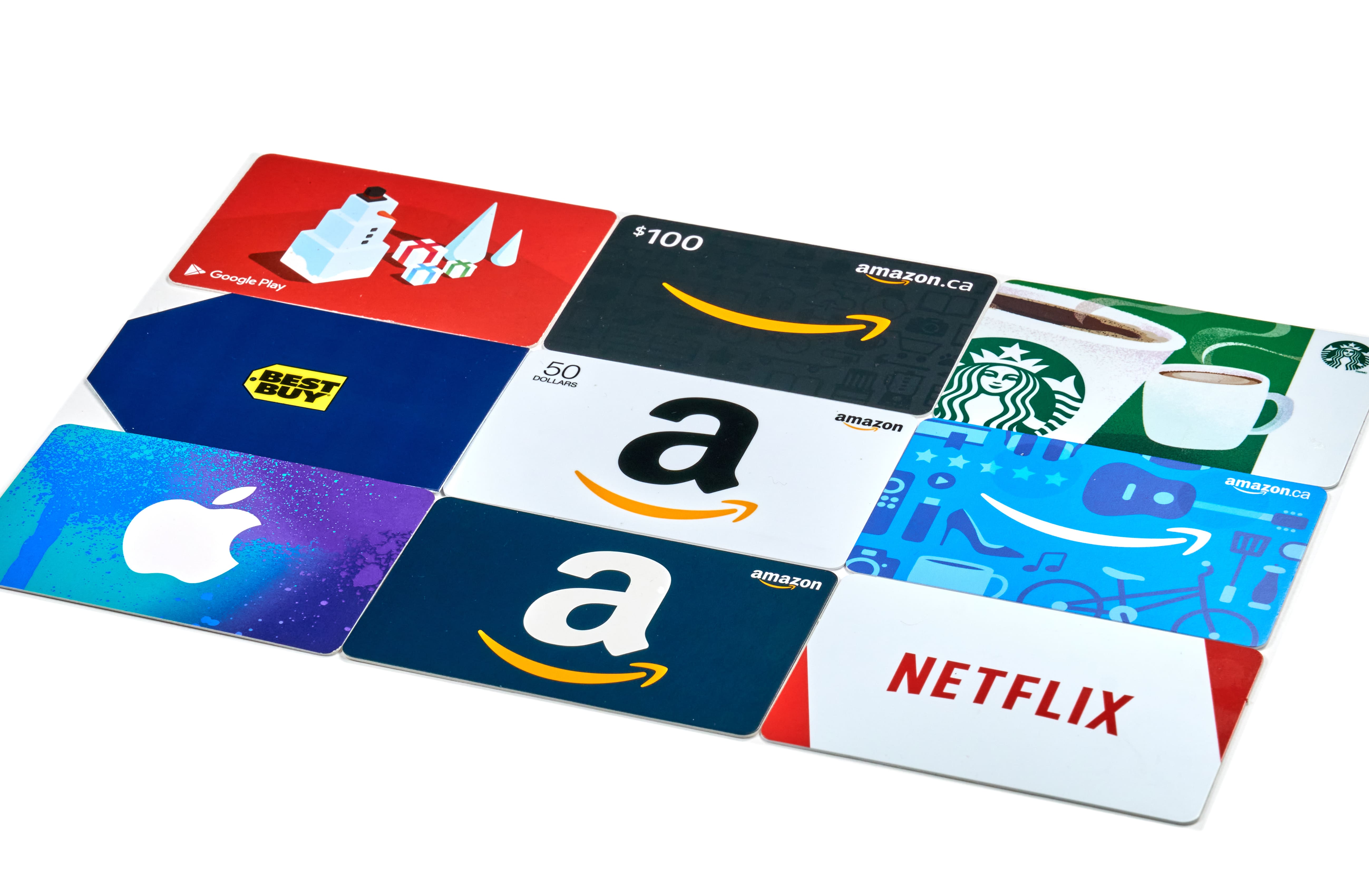
Types of Gift Cards for Employee Programs
Not all employee gift cards are the same, and the format you choose directly impacts how meaningful and practical your program feels to employees. Understanding the options helps you match the right type of card to the right recognition moment.
Digital vs. physical gift cards
Digital gift cards are delivered by email or through a recognition platform and can be redeemed instantly. They're ideal for remote teams, same-day recognition, and programs that need to scale without manual fulfillment. Physical gift cards still have a place, particularly for formal milestones like service anniversaries, where the tangibility of the reward adds to the occasion, but for most day-to-day incentive programs, digital is more practical and faster.
Single-retailer vs. multi-retailer gift cards
Single-retailer gift cards (e.g., a Starbucks card or an Amazon gift card) are simple but limiting. Not every employee shops at the same places, and a reward that doesn't fit someone's lifestyle can feel tone-deaf. Multi-retailer gift cards, where employees choose from a broad catalog of brands, solve this by giving genuine choice. The employee chooses what matters to them, making the reward feel personal even when it's distributed across a large team.
Reloadable prepaid cards for ongoing recognition
Reloadable prepaid cards function more like a recognition account than a one-time reward. HR or managers can add funds over time, making them well-suited for ongoing spot recognition programs where the goal is frequent, low-friction appreciation rather than a single annual reward. They work particularly well when paired with a points-based system.
International and remote-friendly options
For companies with distributed teams across multiple countries, standard gift cards can create an uneven experience. A Canadian retailer card means nothing to an employee in the UK. Look for platforms that offer region-specific gift card options or globally redeemable alternatives so remote employees have the same quality of choice as their in-office counterparts.
Custom-branded gift cards
Some vendors offer gift cards with your company's branding: your logo, colors, and a custom message on the card itself. These work well for formal programs, onboarding gifts, or company-wide recognition moments where reinforcing the employer brand is a goal. For informal spot recognition, the message's personalization typically matters more than the card's visual branding.

How to Build a Gift Card Reward Program
A gift card program without structure is just ad-hoc spending with extra steps.
The companies that get real engagement lift from gift card programs are the ones that design them intentionally, defining what they're rewarding, how often, at what value, and how managers are expected to participate. Structure is what turns a one-off gesture into a consistent cultural practice.
Define what you're rewarding
Start by clarifying the occasions and behaviors your program is meant to recognize. Common categories include:
- Milestone recognition: work anniversaries, promotions, project completions
- Performance-based rewards: hitting targets, going above and beyond on a deliverable
- Peer-to-peer recognition: colleagues nominating each other for everyday contributions
- Spot recognition: managers reward in-the-moment effort without waiting for a formal review cycle
Each of these calls for a slightly different program design. Milestone programs are typically formal and scheduled. Spot recognition is informal and immediate. A well-rounded incentive program includes both.
Set your budget and cadence
Determine how much you're allocating per employee, per occasion, and per year, and how often recognition should be happening. A common starting point for scaling SMBs is a modest per-employee annual budget split across milestone and spot recognition. The exact number matters less than making it predictable and accessible to managers, so recognition doesn't stall because someone isn't sure if they have budget approval.
Choose your delivery method
This is where many companies underinvest. Manual gift card distribution (buying cards individually, tracking spreadsheets, emailing codes one by one) works when you're recognizing a handful of people. It breaks down at 50 employees, and it becomes a liability at 100+. The administrative drag alone is enough to cause programs to go dormant.
A recognition platform automates delivery, tracks who's been recognized and when, and gives managers a simple interface to send a reward without going through HR for every transaction. For teams at the 75–200-employee stage, this is usually the inflection point at which moving from manual to platform-based delivery pays off immediately.
Decide on personalization
Set clear expectations for how managers should accompany a gift card reward. At a minimum, the message should name the specific contribution, connect it to a company value or team goal, and feel as if it were written for that employee. Not copy-pasted from a template. The gift card is the tangible signal. The message is what makes it stick.
Roll it out to managers
A program that only HR knows about won't move culture. Managers need to understand what the program is, how to use it, and what a good recognition moment looks like. A short enablement session, even a single Teams call, paired with clear guidelines and easy access to the platform, is usually enough to drive adoption if the tool itself is low-friction.
What this means for HR leaders: The most common reason gift card programs underperform isn't budget. It's that managers don't use them consistently because the process feels like work. Removing that friction is the single highest-leverage thing you can do to improve participation.

Tax Implications of Employee Gift Cards in Canada
Gift cards occupy a specific and important place in Canada Revenue Agency (CRA) tax rules, and getting this wrong creates payroll compliance problems. The short answer: most employee gift cards are considered taxable benefits in Canada, which means they need to be tracked, reported, and in many cases included in the employee's income.
Are employee gift cards taxable?
Under CRA guidelines, gift cards are classified as "near-cash" gifts, meaning they function essentially like cash because they can be exchanged for goods of the employee's choice. Near-cash gifts are taxable regardless of the amount. This is different from non-cash gifts (like a physical item), which may qualify for a tax exemption under the CRA's gifts and awards policy up to a certain annual threshold.
The key distinction:
- Non-cash gifts (a physical item): may be non-taxable up to the CRA's annual threshold
- Near-cash gifts (gift cards, gift certificates): taxable in full
For the most current thresholds and rules, refer directly to the Government of Canada page on gifts, awards, and long-service awards. This is the authoritative source and is updated when CRA rules change.
Provincial considerations
While the CRA rules apply federally across Canada, provincial payroll tax implications can vary. HR leaders in Alberta and Quebec, in particular, should confirm how taxable benefits are treated under provincial payroll tax rules, as the reporting and remittance requirements may differ from the federal baseline. Consult your payroll provider or a Canadian tax professional to confirm current provincial requirements.
What to track for payroll compliance
For any gift card given to an employee that is classified as a taxable benefit, you'll need to:
- Record the value and date of each gift card issued
- Include the value in the employee's T4 as a taxable benefit
- Ensure source deductions (CPP, EI, income tax) are calculated on the grossed-up amount where applicable
A recognition platform that logs all reward transactions by employee and amount makes this significantly easier at tax time, especially for companies running frequent spot recognition programs where individual transactions are small but cumulative values add up.
What this means for HR leaders: Don't let tax complexity delay building a program. The compliance piece is manageable, but it does require a tracking system. Manual spreadsheets work at a small scale; a platform solves it automatically.

What to Look for in an Employee Gift Card Platform
For HR teams at scaling companies, the right platform isn't just a gift card vendor. It's the infrastructure that makes a recognition program sustainable. A good employee gift card platform removes manual work, provides managers with a tool they'll actually use, and gives HR visibility into whether the program is working. Here's what to evaluate.
Gift card selection and employee choice
The breadth of the gift card catalog directly affects how meaningful the reward feels to employees. Look for a platform that offers a wide range of retailers across categories (dining, retail, entertainment, travel) so employees at every life stage and lifestyle can find something relevant. A catalog of five options isn't a choice; it's a shortlist.
Bulk purchasing and distribution at scale
For teams of 75 employees or more, the ability to send rewards in bulk or to give managers individual sending access without requiring HR to process every transaction is non-negotiable. Evaluate how the platform handles high-volume distribution and whether it supports automated delivery triggers (e.g., work anniversary dates).
Remote and hybrid workforce support
Digital-first delivery, region-specific gift card options, and a platform that doesn't require employees to be in the office to receive or redeem rewards are table stakes for hybrid teams. Confirm that remote employees have the same quality of experience as in-office employees.
Customization and personalization
The best platforms let managers attach a personal message to every reward — and make it easy enough that they actually do it. Some platforms also allow custom reward amounts, branded notifications, and program-level messaging that reinforces company values alongside the reward.
Reporting and program visibility
HR needs to see who's being recognized, how often, by whom, and at what cost. Reporting gives you the data to demonstrate program ROI to leadership, identify teams where recognition is falling through the cracks, and adjust your approach over time.
Integration with existing tools
Adoption rises sharply when recognition happens inside the tools employees already use. Platforms that integrate with Microsoft Teams, where many SMB teams already spend their workday, remove the friction of logging into a separate app to send or receive recognition. Look for native integrations rather than workarounds.

Common Mistakes to Avoid
Even well-intentioned gift card programs fall flat when the execution misses on a few key dimensions. These are the most common patterns that undermine program impact, and they're all avoidable.
Sending gift cards without a message
A gift card with no accompanying recognition message is a transaction, not an expression of authentic appreciation. Employees notice the difference. If the card arrives without any acknowledgment of what they did or why it mattered, the reward loses most of its motivational value. Every gift card in an employee recognition program should come with a specific, genuine message — this is the difference between checkbox recognition and recognition that actually changes how someone feels about their work.
One-size-fits-all amounts
Giving the same gift card value for a five-year work anniversary as for a quick Friday shoutout signals that your program doesn't differentiate effort or tenure. Build a tiered structure: larger values for formal milestones, smaller amounts for frequent spot recognition. The calibration matters because it communicates what the company values.
Inconsistent distribution across teams
When recognition depends entirely on a manager's personality, with some managers celebrating every win while others never say a word, it creates visible inequity across the organization. Employees notice when one team gets regular recognition, and another goes months without acknowledgment. Consistent programs require consistent structure, not just consistent managers.
Ignoring tax compliance
As covered above, gift cards are near-cash taxable benefits under CRA rules. Failing to track and report them properly creates payroll compliance risk. Build your record-keeping process before you scale the program, not after.
Treating the program as "set it and forget it"
Launching a gift card program and then never reviewing participation data, manager usage, or employee feedback is how programs quietly die. Build a quarterly check-in into your calendar to review what's working, which teams are underusing the program, and whether the reward amounts and occasions still match your company's culture and growth stage.
.png)
How a Recognition Platform Streamlines Your Employee Gift Card Program
At a certain point, managing a gift card program manually stops being a minor inconvenience and starts being a real liability. If you're buying cards individually, tracking redemptions in a spreadsheet, chasing managers to send rewards, and manually logging transactions for T4 reporting, you've already hit that point.
A dedicated employee recognition platform changes the equation entirely.
Instead of HR owning every step of every transaction, the platform handles the infrastructure: reward delivery, manager access, compliance tracking, and reporting.
When you know you're ready for a platform
The signs tend to show up around the same time:
- You have 75 or more employees, and recognition is still manager-dependent. Some teams are celebrated constantly, others go invisible
- You're spending meaningful hours each month on gift card logistics instead of strategic HR work
- Remote or hybrid employees are getting a worse recognition experience than in-office staff
- You can't easily answer the question "how much did we spend on recognition last quarter, and who received it?"
- You've launched a recognition initiative before that quietly died because the process was too manual to sustain
If any of those feel familiar, the problem isn't your managers' intentions. It's the absence of a system.
What the right platform gives you
Beyond just handling gift card delivery, a recognition platform built for HR teams provides:
- Automated program management: milestone recognition (work anniversaries, birthdays, promotions) triggers automatically, so nothing falls through the cracks
- Manager enablement: Managers can send spot recognition directly through the platform or through Microsoft Teams, without routing every request through HR
- A real gift card catalog: employees choose from a broad selection of retailers rather than receiving a card they'll never use
- Compliance-ready reporting: every transaction is logged by employee, amount, and date, making T4 reporting straightforward instead of a Q4 scramble
- Visibility across the organization: HR can see which teams are being recognized and which aren't, and address gaps before they show up in engagement scores
Qarrot is built specifically for HR teams at this stage of growth: scaling companies that need a complete recognition and incentive program, not a single-program tool. Whether you're formalizing what you've been doing informally or building a recognition ecosystem from scratch, Qarrot gives you the structure to make it sustainable.
