
Recognition & Rewards


Law 27 Québec: How Recognition Can Support Workplace Well-Being and Compliance

When we think of workplace harm or injury, we often think of workers in a manufacturing facility or in a labor-intensive environment. In recent years, it has become clear that occupational health and safety are not limited to immediate physical injuries.
Office and knowledge workers are just as vulnerable to workplace harm— risk factors such as overwork, lack of autonomy, harassment, and lack of recognition all take their toll on the body and mind. In other words, work stress isn’t just about feeling unhappy or unproductive; it has real and tangible consequences.
Psychosocial risks are real
Research has shown that unmitigated work stress can lead to a myriad of physical and mental health issues, such as cardiovascular disease, metabolic disease, and mental health consequences, including depression, anxiety, and insomnia.
An Act to Modernize the Occupational Health and Safety System, commonly referred to as Law 27, requires Quebec-based employers to safeguard not only employees' physical safety but also their psychological health.
The legislation marks a significant step toward recognizing mental health as an occupational risk. For forward-thinking companies, it’s also an opportunity, not only to stay compliant but also to strengthen workplace empathy, morale, retention, and performance through meaningful well-being initiatives.
.jpeg)
What Is Quebec’s Law 27?
Law 27 was initially passed in Quebec in 2021 and is currently being implemented in phases. Employers must be prepared to fully integrate psychosocial risk prevention by no later than October 6, 2025
In short, employers are now legally required to provide a work environment that protects employees from psychological harm, just as they must protect them from physical injury.
How to comply with Law 27 in Quebec
Employers must now demonstrate that they are taking tangible, documented steps to mitigate psychosocial risks and promote psychological well-being.
To comply with Law 27, Québec employers must have the following in place:
- Identification and analysis of psychosocial risks (e.g., workload, autonomy, recognition, workplace violence).
- Prevention program with an action plan addressing psychosocial risks.
- Appointing a health and safety manager, depending on the size of the company
- Documentation of all prevention efforts: evaluations, training records, committee decisions, monitoring reports, etc.
Practical initiatives to support law 27 compliance
While Law 27 sets a legal baseline, employers who want to go beyond compliance should focus on embedding well-being into everyday culture. Here are some practical initiatives that support both compliance and stronger employee engagement:
1. Foster a culture of recognition
Acknowledging contributions helps employees feel seen and appreciated. Recognition strengthens a sense of belonging, reduces stress, and fosters trust between colleagues and leaders.
2. Monitor psychosocial risk indicators
Include regular monitoring of psychosocial risk indicators (e.g. surveys, turnover, sickness absence) as part of your health & safety metrics.
3. Promote flexibility and work-life balance
Allowing employees to manage workloads and schedules realistically helps prevent burnout.
4. Train and support managers
Leaders play a key role in shaping psychological safety. Equip them with emotional intelligence training and resources to handle sensitive issues effectively.
These initiatives create the kind of positive, resilient culture that Law 27 envisions—one where employees thrive and organizations perform better.
How Qarrot helps employers meet the spirit of Law 27
This is where employee recognition and engagement tools like Qarrot can make a real difference. Recognition isn’t just a “nice-to-have,” it’s one of the most effective ways to support mental well-being and build a psychologically safe workplace.
Here’s how Qarrot supports compliance and culture under Law 27:
- Promotes positive peer-to-peer recognition and interaction: Qarrot enables employees to celebrate one another’s achievements, fostering a sense of appreciation and community.
- Builds psychological safety: Recognition is not just about money. Authentic recognition reinforces key pillars of psychological health, such as respectful behavior and inclusion.
- Provides measurable data: By tracking recognition and engagement metrics, HR can use this data as part of the employer’s documentation of preventive efforts under Bill 59.
- Encourages consistent communication: Regular recognition helps maintain connection and morale, especially in hybrid or remote teams where isolation can be a risk factor.
By implementing a recognition platform like Qarrot, employers can demonstrate proactive, ongoing efforts to support employee well-being and help them stay aligned with the expectations of Law 27 while boosting overall employee engagement and retention.
Turning Legal Obligation Into Lasting Advantage
Law 27 may feel like a new compliance challenge, but it’s ultimately an opportunity for Quebec businesses to lead with empathy and purpose.
The strongest work cultures are built not only on effective policies but on a tangible sense of safety, fairness, and belonging in the workplace. Employees feel valued, supported, and safe to do their best work.
A program like Qarrot embeds recognition and well-being into everyday culture, enabling organizations to meet the demands of new legislation while unlocking the benefits of higher morale, lower turnover, and greater productivity.
Learn how Qarrot can help you improve employee well-being and stay compliant with Law 27? Book a demo.

37 Employee Reward Ideas For Every Budget
Recognition budgets are rarely unlimited.
Most HR leaders building or refreshing a rewards program aren't choosing between good and great. They're choosing between what they can actually approve and what has to wait for next quarter. The good news is that some of the most effective employee rewards cost nothing at all. What makes a reward land isn't the price tag. It's whether it feels intentional, specific, and human.
This guide organizes reward ideas into four tiers based on spend, so you can build a recognition approach that works within your reality today and scales as your program matures. Whether you're starting from scratch or filling gaps in an existing employee recognition program, there's something here for every budget.
Why Tangible Rewards Belong in Your Incentive Program
Tangible rewards work because they create a concrete, memorable signal that someone's contribution was noticed.
Unlike verbal praise alone, a physical or monetary reward gives employees something they can point to: a moment where the company put something real behind its appreciation. That specificity is what drives the behavior change most incentive programs are designed to create.
This matters especially for scaling companies where recognition tends to be inconsistent across teams. A well-designed incentive program that pairs clear goals with meaningful rewards gives managers a repeatable framework and gives employees a reason to believe the program is real, not just HR wallpaper.
If you're still building out the structure of your incentive program, our guide to employee incentive programs walks through how to design one from the ground up. The reward ideas below are meant to slot into that structure, organized by budget so you can build something that works within your reality today.

Everyday Appreciation (No Spend)
Free rewards are only ineffective when they're generic. A handwritten note from a manager who clearly noticed the work hits differently than a mass "Happy Work Anniversary" email. The ideas in this tier work best when they're specific, timely, and personal, which means they require thought, not money.
Use these as the foundation of your recognition ecosystem: the informal, everyday moments that make appreciation feel like part of your culture rather than a scheduled event.
Handwritten thank-you notes
A personal note from a manager or peer, specific to what the employee did and why it mattered, is one of the highest-impact, lowest-cost recognition tools available. Keep notecards on hand and encourage leaders to make it a weekly habit.
Public shout-outs in team meetings
Dedicate five minutes at the start of a weekly meeting to recognize a team member by name. Keep it specific: name the contribution, not just the person. This sets a positive tone and models the kind of recognition behavior you want managers to build.
Peer-to-peer recognition
Give employees a structured way to acknowledge one another, whether through a dedicated Slack channel, a recognition board, or a platform like Qarrot. Recognition from colleagues who understand the day-to-day often lands harder than praise from above.
Personal note from leadership
A direct message or handwritten note from a founder, VP, or CEO carries outsized weight, especially at companies under 200 people where senior leaders are still visible. Make sure your leaders know about standout contributions and give them a low-lift way to respond.
Employee spotlight in the company newsletter
A short feature on a team member (their role, a recent win, something personal) makes the recipient feel seen and gives the rest of the team a reason to engage with internal communications. Rotate the responsibility across departments to keep it fresh.
Extra flexibility for a day
Offering a late start, an early finish, or a no-meeting afternoon as a spontaneous reward signals that you trust your people and value their time. No formal policy change required, just a direct message from a manager.
"Win of the week" Slack post
Create a standing Friday post that highlights one team or individual accomplishment from the week. Keep it brief, keep it specific, and invite others to add their own. Low effort, high visibility.
Lunch with a senior leader
An informal one-on-one lunch or virtual coffee with a founder, VP, or director gives high performers access and visibility they wouldn't otherwise have. For many employees (especially earlier in their careers) this kind of access is genuinely motivating.
Work anniversary acknowledgment
Marking a one-, three-, or five-year anniversary with a personal message from a manager costs nothing but tells the employee their tenure is noticed. Automate the reminder with a tool like Qarrot so no one falls through the cracks.
Volunteer time off
Let employees take a half or full day to volunteer with an organization they care about. It costs you one day of productivity and signals that you value what they value outside of work.

Small Gestures (Low Spend)
This tier covers rewards in roughly the $10–$50 range: small enough to approve without a formal budget request, meaningful enough to feel like a genuine gesture. These work well as spot recognition tools — fast, personal, and tied to a specific moment.
The key at this tier is personalization. A $20 gift card to a coffee shop the employee actually goes to is more memorable than a $50 Amazon card picked by a system.
Gift cards
Digital gift cards are one of the most flexible and appreciated reward formats: fast to deliver, easy to personalize, and universally valued. Let employees choose from a curated list of options, or ask managers to match the card to the employee's interests. Qarrot makes it easy to automate gift card delivery tied to specific recognition moments.
Houseplant
A low-maintenance plant (a succulent, a pothos, a small cactus) is a tangible, lasting reminder of appreciation. Add a handwritten card with care instructions and the reason for the gift. Works well for in-office teams or as a desk upgrade for hybrid employees.
Personalized stickers, mugs, or desk accessories
Custom items printed with an inside joke, a team motto, or even the employee's own design make for unexpectedly memorable rewards. Services like Sticker Mule make small-batch custom orders accessible and affordable.
Surprise treat delivery
A coffee and pastry delivered to someone's desk, or a DoorDash credit sent to a remote employee, is a small gesture that lands well when it's tied to a specific achievement. The surprise element matters: unannounced appreciation often hits harder than scheduled recognition.
Book of their choice
Ask the employee what they've been meaning to read (business, personal development, or pure fiction) and order it for them. The act of asking and then following through demonstrates genuine attention to who they are, not just what they produce.
Donation to their charity of choice
A $25–$50 donation to a cause the employee cares about turns a recognition moment into something that extends beyond the office. Ask them to name the organization; the specificity makes it meaningful.
Branded swag (done well)
Company swag works when it's something people actually want to wear or use. A well-designed hoodie, a quality water bottle, or a useful tote outperforms a logo-on-a-mug every time. If you're going to invest in swag, invest in the design.
Streaming or app subscription
A one-month subscription to Spotify, Audible, a meditation app, or a meal kit service is a practical, personal gift that touches the employee's life outside of work. Poll your team periodically on what services they actually use.

Meaningful Moments (Mid-Range Spend)
This tier covers roughly $50–$200, the range where recognition starts to feel like a real investment in the employee as a person. These rewards work best tied to notable achievements: a project completed under pressure, a strong performance review period, or a significant milestone.
At this tier, the organizing principle shifts from speed to intentionality. The employee should feel like someone thought about them specifically, not just clicked through a rewards catalog.
Experience-based rewards
Concert tickets, cooking classes, pottery sessions, escape rooms, or museum passes are rewards employees remember long after a gift card balance is spent. Partner with local vendors for discounted rates, or use a platform that offers curated experience options.
Team outing
A shared experience (a group dinner, an afternoon at a brewery, an escape room, a cooking class) rewards the team collectively and strengthens social cohesion. Works especially well after a major launch or a stretch of heavy workload.
Spa or wellness voucher
A massage, a float session, or a day at a local spa is a meaningful reward after a high-pressure project. It communicates that you see the cost the work took on the person, not just the output they delivered.
Professional development opportunity
Cover the cost of an online course, a certification program, a conference ticket, or a workshop aligned with the employee's career interests. Learning and growth consistently rank among the top drivers of employee engagement, and this reward signals investment in their future, not just their present performance.
Learning stipend
Rather than choosing a specific course, offer a quarterly stipend (even $100–$150) that employees can apply toward any professional development of their choosing: Udemy, Coursera, MasterClass, books, or industry events. The autonomy is part of the reward.
Ergonomic workspace upgrade
A quality desk mat, a wireless charger, noise-canceling headphones, or an ergonomic keyboard is a practical reward that improves daily work life. Especially meaningful for hybrid or remote employees who have invested in their own home setups.
Subsidized gym or wellness membership
Covering part or all of a gym membership, yoga studio, or ClassPass subscription shows investment in the employee's physical and mental health and has downstream benefits for focus and resilience at work.
Extra paid time off
A bonus day or half-day of PTO, granted specifically in response to exceptional work, is one of the most valued non-cash rewards available. Time is finite; giving some back carries real weight.
Catered team lunch
Organize a catered lunch or food truck experience for the team, not as a default perk, but as a deliberate recognition moment tied to a win. The specificity matters: we're doing this because of what you accomplished lands differently than a standing Friday lunch.

Milestone-Worthy (Larger Investment)
This tier is for the moments that deserve more: multi-year anniversaries, exceptional performance over a full year, a promotion milestone, or a contribution that materially changed the business. Rewards in this range ($200 and up) should feel proportionate to the weight of what's being recognized.
These are also the rewards most likely to be remembered and talked about. Used well, they become part of your employer brand.
Service anniversary awards
A personalized gift tied to a one-, three-, five-, or ten-year anniversary, accompanied by a message from leadership that names specific contributions, communicates that loyalty is seen and valued. Use a tool like Qarrot to automate milestone tracking so every anniversary is caught, not just the ones managers happen to remember.
Travel or destination experience
For high performers or long-tenured employees, a travel experience (a weekend away, a flight to visit remote colleagues, or an Airbnb experience in a city they've been wanting to visit) creates a memory that outlasts any physical gift.
High-value gift card bundle
A curated set of gift cards totaling $150–$300, selected to reflect the employee's actual interests, signals the kind of personalized attention that distinguishes meaningful recognition from checkbox recognition.
Professional conference or retreat
Sponsor an employee's attendance at a major industry conference, travel, accommodation, and registration included. Beyond the recognition, it's a professional development investment that compounds over time.
Student loan contribution
For Millennial and Gen Z employees carrying student debt, even a one-time contribution of $200–$500 toward loan repayment is a materially meaningful reward, and one that very few employers offer. If budget allows, consider building this into your formal recognition program.
Home office upgrade budget
Offer a meaningful home office budget ($300–$500) to a high performer or long-tenured remote employee. Let them choose what to invest it in: a monitor, a standing desk, better lighting, a quality chair. The autonomy signals trust; the upgrade improves their daily work life.
Custom recognition award
A trophy, plaque, or custom piece of artwork that commemorates a specific achievement, designed thoughtfully rather than ordered off a template, can be a lasting symbol of appreciation when it reflects genuine specificity. This works best at the team or company level (e.g., an annual award) rather than as a standalone gesture.
.png)
Turning Reward Ideas Into a Recognition Practice
Having a strong list of reward ideas is a good start. But the companies where recognition actually sticks aren't just choosing better gifts, they're thinking about appreciation as something that happens at multiple touchpoints throughout the year, not a one-time gesture reserved for annual reviews or the occasional standout moment.
That's the difference between a reward and a recognition ecosystem. When employees are appreciated consistently recognition becomes part of how your culture operates rather than something HR has to remind managers to do.
A platform like Qarrot makes that consistency possible without adding to your team's administrative load. Instead of managing spreadsheets, chasing down gift card logistics, or hoping managers remember to follow through, you get a single system that supports your entire recognition program:
- Automated milestone tracking so work anniversaries and service awards never get missed
- Peer-to-peer recognition that gives every employee a voice, not just managers
- Program-level reporting so you can see what's working and make the case to leadership
If you're ready to move from a list of ideas to a program that runs, book a demo and we'll show you how Qarrot fits into the recognition ecosystem you're building.

Creating an Effective Employee Recognition Budget
You already know recognition matters. You've seen what happens when it's inconsistent — certain teams get celebrated while others go unnoticed, and engagement scores reflect that imbalance. The question isn't whether to invest in recognition. It's how to build a budget that's defensible, realistic, and structured enough to actually deliver results.
If you're newer to this role, or inheriting a recognition program that's been running on ad hoc manager decisions and manual gift cards, that's a common starting point. This article breaks down what a realistic recognition budget looks like, how to structure your spend, and how to build a program that doesn't fall apart six months after launch.
How Much Should You Allocate?
There's no single number that works for every company. Budget ranges vary based on company size, industry, and where you are in building out your people programs. That said, there are widely referenced benchmarks that can give you a credible anchor when you're making the case to leadership.
Most HR practitioners recommend allocating 0.5% to 3% of your total payroll toward toward employee recognition. For organizations that prefer a per-head model, a common range is $150 to $300 per employee per year, though where you land within that range typically depends on the scope of your program and how formal your recognition structure is.
For a company of 100 employees with an average salary of $60,000, 1% of payroll puts you at roughly $60,000 annually or $600 per employee. That's meaningful budget to work with, and it goes further than most HR leaders expect when it's allocated strategically across program types rather than spent reactively.
The more important principle: the exact number matters less than making sure recognition is frequent, meaningful, and tied to real work. A $300-per-employee budget spent on generic anniversary emails and one annual party is a poor investment. The same budget allocated across a mix of milestone, peer, and manager-driven recognition is a very different program.

Essential Components of an Employee Recognition Budget
Your budget should support a mix of formal and informal recognition that covers both individual and team achievements. A single program type won't be enough. Here's how most strong recognition budgets break down:
1. Formal Recognition Programs
These structured initiatives help reinforce key values and long-term employee commitment:
- Years of Service Awards: Recognize employees at 1, 5, 10+ years with meaningful gifts.
- Employee of the Month/Quarter: Publicly highlight outstanding performers.
- Performance Bonuses: Monetary rewards for hitting key performance indicators.
2. Peer-to-Peer Recognition
Encourage a culture of appreciation with a peer driven recognition platform:
- Recognition Softwares: Invest in tools where employees can give kudos so that no good deed goes unnoticed.
- Small Monetary Incentives: Allow employees to nominate peers for spot bonuses or gift cards.
3. Onboarding Recognition
First impressions matter! Budget for:
- Welcome Kits: Branded merchandise (company merch like caps, hoodies, stickers or mugs), personal notes, and office essentials.
- Mentorship Programs: Pair new hires with seasoned employees for guidance.
4. Team and Company-Wide Celebrations
Foster camaraderie and company spirit through:
- Company Achievements: Reward teams for milestones like product launches or hitting revenue goals. The rewards can range from a profit-sharing (bonus) scheme, a company retreat, or a massive gala dinner.
- Holiday Parties & Special Events: Celebrate birthdays, cultural holidays, and team outings.
5. Professional Development Incentives
Invest in your employees’ growth with:
- Training and Certifications: Cover costs for industry-related courses. Professional development opportunities can be a budget-friendly option (like Coursera, Udemy, or Amazon book budget).
- Conference Stipends: Help employees attend relevant events.
6. Personal Milestone Recognition
Employees have lives outside of work! Acknowledge them with:
- Life Events: Gifts for weddings, new babies, or major personal achievements.
- Wellness Initiatives: Support mental and physical health through gym memberships or wellness stipends.
How to Phase Your Budget If You're Starting from Scratch
One of the most common mistakes new HR leaders make is trying to launch everything at once.
The instinct makes sense; you want to show impact quickly, and a comprehensive program sounds more impressive than a modest one. But recognition programs that overextend in year one tend to collapse under the weight of their own complexity. Participation drops, managers disengage, and the program becomes another thing HR is chasing people to use.
A phased approach lets you build structural foundations first, then layer in additional programs once early ones are running well. Here's a practical framework:
Phase 1: Foundation (months 1–3)
Focus on one or two high-visibility programs that are easy to launch and easy for managers to adopt. A peer recognition program and a years of service structure are the typical starting point, they address the most visible gap (inconsistency) without requiring significant IT lift or budget commitment.
At this stage, your goal isn't breadth. It's proving that recognition can happen consistently when there's a system behind it.
Phase 2: Expansion (months 4–9)
Once your foundation is stable and participation is building, introduce a second layer. This might mean adding manager-driven spot recognition, formalizing performance-based rewards, or building out onboarding recognition for new hires. You're adding programs your employees have already demonstrated an appetite for not guessing.
Phase 3: Optimization (month 10+)
By now you have data: which programs are driving engagement, which rewards employees actually redeem, where participation is lagging. Use that data to refine your budget allocation, sunset what isn't working, and make the case to leadership for sustained or increased investment in what is.
The phased model also gives you a more defensible budget conversation. Asking for $300 per employee to run three programs simultaneously is a harder sell than showing early results from a $150-per-employee foundation phase and proposing to expand from there.

Common Budgeting Mistakes HR Leaders Make
Even well-intentioned recognition budgets can underdeliver if the structure isn't right. These are the patterns that tend to cause the most problems:
Funding programs before building structure
The most common mistake: launching recognition initiatives before establishing the framework that makes them sustainable. You can't build habitual recognition inside a vacuum. If managers don't have a clear system — when to recognize, how to do it, what tools to use — participation will be inconsistent no matter how generous the budget is. Structure has to come before consistency. The budget funds the programs; the structure is what makes them run.
Concentrating spend on one program type
Allocating the bulk of your budget to a single program — usually an annual gala or a top-performer award — leaves most of your workforce unrecognized most of the year. High-performing recognition programs distribute spend across formal milestones, informal peer recognition, and manager-driven moments. Employees shouldn't only feel seen on their work anniversary or when they win employee of the quarter.
Underbudgeting for manager enablement
Managers are the most important variable in whether a recognition program actually lands. If they don't understand how to use the tools, what good recognition looks like, or why it matters, the program stalls at the manager layer. Budget for some form of manager onboarding or enablement — even a simple guide and a brief rollout session — or plan to spend the back half of the year wondering why adoption is low.
Skipping the review cycle
Recognition budgets that get set in January and never revisited tend to drift. Spending patterns shift, programs underperform, and you end up with unspent budget in one area and gaps in another. Build in a mid-year check so you can adjust before the program drifts too far off course.
Build a Recognition Program Worth Budgeting For
If you've made it this far, you're probably not someone who needs to be convinced that recognition matters. You already know it does. What you need is a number you can bring to leadership with confidence, a structure that won't fall apart after the first quarter, and a program your managers will actually use.
That's a reasonable ask, and it's more achievable than it might feel right now. The companies that get recognition right aren't necessarily spending more. They're spending with more intention: starting with a clear structure, phasing in programs as adoption builds, and resisting the urge to fund everything at once just to show early momentum.
The budget conversation with leadership gets easier when you can point to a plan, not just a line item. A phased approach, grounded in realistic benchmarks and tied to clear program outcomes, is a much stronger pitch than a wish list, and it gives you a foundation to build on as results come in.

Employee Recognition Programs: 10 Real-World Examples
If you've been tasked with building or overhauling your company's employee recognition program, you probably already know the stakes are real.
Recognition directly affects whether people stay, how hard they work, and how they feel about the organization they're part of. Get it right, and you build something that genuinely changes your culture. Get it wrong, and you've invested time, budget, and goodwill in something nobody uses. Or worse, something that actively breeds cynicism and eventually falls flat.
That pressure is exactly why most HR leaders don't want to start from scratch.
They want to see other program examples; what's working at other companies, understand why it's working, and adapt those ideas to their own context. Not copy-paste, but learn and translate. That's what this article is for. We've pulled together 10 companies whose employee recognition programs are genuinely worth studying.
And unlike most lists like this, we've gone back to primary sources to verify how these programs actually work, not just what they claim to do. The goal is to give you enough concrete detail that you leave with real ideas you can act on, not just inspiration you'll forget by Monday.

10 Companies with The Best Employee Recognition Programs
The Walt Disney Company
Disney's approach to recognition is a masterclass in building a full ecosystem. Rather than relying on a single type of program, the company has layered multiple forms of recognition on top of each other formal awards, peer-to-peer appreciation, milestone celebrations, and public shoutouts, so that employees at every level can both give and receive recognition in different ways.
The Walt Disney Legacy Award is the company's most prestigious honor, reserved for Parks, Experiences & Products employees who go above and beyond in extraordinary ways. It's intentionally rare: fewer than 1% of employees receive it, which makes it genuinely meaningful rather than just ceremonial.
But Disney doesn't rely only on top-down, formal recognition. The #CastCompliment initiative allows anyone to formally recognize a cast member by tagging them on social media. Those shoutouts are recorded and forwarded to senior leadership, ensuring that great work gets visibility at the highest level.
There are also years-of-service programs, special pins, and peer-to-peer recognition channels that keep appreciation flowing throughout the year.
What to take away: A recognition ecosystem isn't a single program that does everything. It means multiple programs that work together, each catering to fulfill a different psychological need.
Google's recognition philosophy is built on two core ideas: make it easy, and make it visible. The company has several interlocking programs, but the most widely documented is the peer bonus program, which allows any Google employee to nominate a colleague for a small monetary bonus with no management approval required.
The peer bonus is designed to surface contributions that managers might never see. As one Googler described it: a typical example might be recognizing someone who coded a custom SQL query that saved their team hours of work. This is exactly the kind of everyday excellence that rarely makes it into performance reviews.
Layered on top of this is gThanks, Google's internal recognition tool, which allows employees to post kudos publicly to a shared feed. The public visibility is intentional: Google SVP of People Operations, Laszlo Bock, has argued that recognition is amplified when others can see it. It reinforces values, inspires others, and makes appreciation part of the daily workflow rather than a quarterly event.
Google also runs a Spot Bonus program for managers to recognize employees in real time, and a no-name program for executives to recognize entire teams. The layering is deliberate: different programs for different moments, different contributors, and different scales of impact.
What to take away: Peer recognition catches what manager recognition misses. Build both into your program from the start.
Zappos
Zappos has turned recognition into something that feels genuinely fun. The company's programs are anchored in its 10 core values, so every recognition moment reinforces not just that someone did good work, but why it mattered.
The centerpiece is the Coworker Bonus Program: every employee gets $50 per month to award to a peer who has "WOWed" them — one of Zappos' defining cultural values. The nomination includes a written explanation, so recognition is always specific rather than generic.
Zappos also has its own internal currency, Zollars, which employees earn and can spend on branded swag, movie tickets, charitable donations, or raffle entries for bigger prizes. The Hero of the Month award comes with a $250 gift card or experiential reward, a reserved parking spot, and (yes) an actual hero cape. The three "Sidekicks" each receive $50 gift cards and sidekick capes.
Service anniversaries are celebrated loudly and publicly, complete with custom "license plates," a quirky Zappos tradition that makes milestone recognition feel like a genuine cultural moment rather than a checkbox.
What to take away: Recognition tied to company values isn't just good branding, it's how you make appreciation feel authentic rather than performative.
Cisco
Cisco's Connected Recognition program is one of the most cited examples in the industry, and one of the few where the company has publicly shared its investment level. The program is funded at 1% of payroll, a deliberate budget decision that signals organizational commitment rather than treating recognition as an afterthought.
Built in partnership with Workhuman, Connected Recognition is a global peer-to-peer and manager-to-employee platform aligned with Cisco's core values. Employees can nominate colleagues at any time for awards of varying sizes, with the rewards accumulating so that employees can save up for something meaningful.
One Cisco employee, David Faik, shared in a company blog post that he saved his Connected Recognition rewards over time to help fund a seven-day resort stay in Thailand and then posted about it on social media, prompting friends to ask how they could get a job at Cisco. That's recognition creating organic employer brand advocacy.
Cisco's own careers page describes the program simply: "Show appreciation for the people you work with by nominating one of your co-workers for a monetary award."
What to take away: Recognition is an investment, not an expense. Treating it like one with a real budget and a real platform sends a message to employees that appreciation isn't just talk.
Southwest Airlines
Southwest Airlines has woven recognition into the fabric of how its people communicate every day. The company's recognition program is called SWAG — Southwest Airlines Gratitude. It lives on a platform that makes peer-to-peer appreciation as frictionless as sending a message.
Using SWAG, employees can send each other notes of gratitude called "Kick Tails" or nominate a peer for a formal award that comes with SWAG Points. Those points can be redeemed for gift cards or experiences, or converted into Rapid Rewards points, making the reward uniquely meaningful for airline employees. In 2021, Forbes named Southwest one of America's Best Employers for the sixth consecutive time.
SWAG also celebrates career milestones, ensuring that long-term loyalty gets recognized alongside day-to-day contributions.
What to take away: The best recognition programs meet employees where they are, with rewards that are actually meaningful to them, not just convenient for HR.
Salesforce
Salesforce anchors its recognition culture in a concept borrowed from Hawaiian tradition: Ohana, meaning family. The company's Ohana Awards program celebrates employees who embody Salesforce's core values and relies on peer nominations to surface those stories.
Employees nominate colleagues by describing how they demonstrated one of these values in a specific, meaningful way. Winners receive recognition and rewards, but the program's public storytelling aspect is equally important: by sharing how someone exemplified a value, the program teaches the entire organization what those values look like in action.
Salesforce also uses its own platform (Work.com) to bring recognition into daily workflows, integrating peer kudos, goal tracking, and manager feedback in one place. The result is recognition that's embedded into how people work.
What to take away: When recognition is tied to specific values and specific behaviors (not just the final result), it reinforces the culture you're actually trying to build.
Patagonia
Patagonia doesn't have a traditional employee recognition program. It has something more powerful: a culture that embeds recognition into the company's identity.
The company's Environmental Internship Program allows employees to take up to two months of fully paid leave to volunteer with a grassroots environmental organization anywhere in the world. This includes full salary, benefits, and a travel stipend. Between 100 and 150 employees participate each year. This isn't a perk. It's a recognition that employees are whole people with values that extend beyond their job descriptions.
Patagonia also offers employees paid time off for voting and peaceful protesting, on-site childcare at headquarters, and flexible scheduling that explicitly accommodates outdoor pursuits — surfing, skiing, and climbing. The founder's ethos, captured in the employee handbook title Let My People Go Surfing, makes clear that the company's recognition of employees extends beyond what they produce to who they are.
The result? Patagonia consistently reports turnover rates below 4% in some years. This is a staggering number for a retail and manufacturing business.
What to take away: Recognition doesn't have to look like a trophy or a bonus. Recognizing employees as full human beings is one of the most powerful things a company can do.
Apple
Apple's recognition approach reflects its broader culture: performance-driven, design-conscious, and deeply tied to the company's identity.
The company's formal recognition programs include performance-based cash bonuses and stock awards, as well as perks like discounted or free products and additional time off. But Apple's most iconic recognition moment is the 10-Year Award, a physical piece given to employees who have been with the company for a decade. The award is considered so meaningful that when one recipient put theirs up for auction on eBay, it sold for $35,000.
Apple also builds public recognition into its culture through announcements and celebrations across the organization, ensuring high performers get visibility.
What to take away: Recognition that's rare, physical, and deeply tied to the company's brand can carry far more weight than its monetary value.
Unilever
With operations in more than 190 countries, Unilever has the challenge of building a recognition culture that feels local and personal at scale. Their approach: localized programs for day-to-day recognition, with a single powerful global anchor—the Unilever Heroes Award.
The Heroes Award honors employees who have made an outstanding contribution to the company over the past year. It's not a plaque in the mail. Recipients are invited to the Change Leaders Conference, an exclusive annual gathering of approximately 400 Unilever senior managers, where their contributions are celebrated in front of the company's most senior leaders.
The event's exclusivity transforms the award from a transactional recognition moment into a genuine career milestone. It signals to the entire organization: this level of contribution gets seen at the highest level.
What to take away: For global organizations, a prestigious centralized award can create a powerful north star, a level of recognition that employees across every region and function aspire to.
Typeform
Typeform has gamified peer recognition in a way that's both simple and sticky. Each month, employees receive a budget of "typecoins." This is an internal currency administered through Bonusly to recognize colleagues for specific contributions. Typecoins can be converted to Amazon, Uber, or Starbucks gift cards, giving the reward real, immediate value.
What makes Typeform's approach notable is the monthly reset: employees are prompted to actively recognize someone every month, which builds recognition into the rhythm of the work rather than leaving it to whenever someone remembers.
Typeform also has a cultural ritual called Spontaneous Applause, the whole office joins in clapping whenever someone calls it out for a job well done. It's low-tech, high-impact, and unmistakably Typeform. In a world of software-driven recognition programs, it's a reminder that the best recognition moments are often the most human ones.
What to take away: Rituals matter. Finding a recognition practice that's uniquely yours is worth more than any platform feature.
.png)
What Separates the Best Employee Recognition Programs From the Rest
Look across the 10 programs above and a few patterns emerge, not as a checklist, but as a way of thinking about what recognition actually requires.
They're ecosystems, not single programs
None of the companies above relies on one program. Disney has formal awards, peer-to-peer notes, milestone celebrations, and public shoutouts. Zappos offers peer bonuses, Zollars, a Hero of the Month, and service-anniversary traditions. Google has spot bonuses, peer bonuses, a manager recognition program, and gThanks.
That breadth isn't accidental. A single recognition program will always have gaps — moments, contributions, and people it misses. A recognition ecosystem is designed to ensure appreciation flows from multiple directions and at multiple frequencies, capturing the full range of contributions.
They're tied to values, not just performance
The companies that stand out don't recognize employees for hitting numbers in isolation. They recognize employees for how they work; the values they embody, the behaviors they model, the culture they reinforce. Salesforce names the value. Zappos names the core principle. Cisco builds its nominations explicitly around company values.
This matters because recognition that's tied to values teaches the whole organization what good looks like. It's the difference between recognition that creates a moment and recognition that builds a culture.
They make it easy to give recognition, not just receive it
Southwest's SWAG platform. Google's gThanks tool. Zappos' coworker bonus structure. Typeform's monthly typecoin budget. In every case, the company has deliberately removed friction from the act of giving recognition.
This is the piece most programs miss. You can have the most beautifully designed award in the world, but if recognizing someone requires navigating a cumbersome process or waiting for a manager to initiate it, recognition won't happen often enough to matter.
Structure comes before consistency
Here's a pattern worth noting: the companies on this list don't have strong recognition cultures because their managers are more naturally appreciative than others. They have strong recognition cultures because they have built the structure that enables consistent recognition.
Consistency doesn't create structure. Structure creates consistency.
When employees have a clear framework (e.g., monthly budgets, regular nomination cycles, established rituals, and accessible platforms), recognition stops being something people have to remember and becomes part of the regular workflow and operations.
.png)
Building Your Own Recognition Ecosystem
You don't need to be Disney or Google to build something that works. The principles above apply at any size.
Start by building a structural skeleton. It doesn’t need to be set in stone. It can and will likely evolve. So think simple.
Define which recognition events or programs you’d like to celebrate, and put the scaffolding in place before you ask people to be more consistent.
Then build outward. Introduce new layers over time. Test what resonates. The recognition ecosystem at Disney didn't appear overnight; it was built over decades.
Ready to start building a recognition ecosystem at your organization? Book a demo with Qarrot to see how our platform supports the full spectrum of recognition — from structured programs to everyday appreciation.

Peer-to-Peer Recognition Program Guide: Tips & More
At some point, many HR leaders start to notice a pattern in recognition within their organization.
Managers do their best to thank employees for good work, but appreciation is inconsistent. Some teams celebrate wins regularly, while others rarely acknowledge them. Great work is happening across the company every day, but a lot of it goes unnoticed.
That’s often when organizations begin to explore implementing other types of employee recognition programs, including peer-to-peer recognition programs.
But like any recognition initiative, the impact really depends on how the program is designed. A peer-to-peer recognition program shouldn’t feel like another box employees are expected to check. The goal is to support a culture where appreciation happens naturally and frequently across the organization.
In this guide, we’ll walk through how peer-to-peer recognition programs work, why they can be especially effective for growing organizations, and how to implement one that actually strengthens your culture.

What is Peer-to-Peer Recognition?
Peer-to-peer recognition is a practice where employees express appreciation for one another's work contributions, efforts, results, and achievements.
With peer-to-peer recognition, team members can really create a positive work atmosphere, strengthen team relationships, and and nurtures a culture of respect and appreciation. For employers, it decentralizes the responsibility of employee recognition from managers to all team members, fostering a sense of shared accountability for a positive work environment.
One thing to understand is that peer-to-peer recognition isn’t a substitute for traditional recognition by managers; it’s an enhancement.
While a traditional recognition program is often tied to appraisals and awards, usually given once or twice a year, a peer-to-peer recognition program focuses on daily wins. This immediacy ensures efforts are acknowledged in real time, making recognition more impactful and fostering a culture where employees feel valued every day.
When your employees recognize each other, it builds a strong social fabric in your work environment and creates a bond that can’t easily be broken, thus improving wellbeing, retention, and satisfaction at work.
Peer-to-peer recognition programs can really work wonders in your workplace and this article will guide you through implementing them with success. But first, let’s take a look at the benefits (and some numbers) that will explain why peer-to-peer recognition matters.
Why Peer-to-Peer Recognition Matters
Peer-to-peer recognition is one of several ways organizations can show appreciation for employees’ contributions. Unlike formal recognition, such as years-of-service programs, peer recognition is typically more informal and happens in the moment when colleagues notice great work.
In fact, peer recognition is often considered informal, focusing on everyday moments of appreciation rather than on structured milestones.
Case in point: a recent study from CPHR Alberta found that most employers report having a recognition program in place, but fewer than 30% rate those programs as highly effective. Notably, 83% of organizations focus primarily on milestone-based recognition, with far fewer offering real-time or behaviour-based appreciation.
This finding suggests that focusing on a single program, especially when employees have to wait long periods before being recognized, might not yield the results organizations are looking for.
On the other hand, when employees are empowered to recognize one another, appreciation becomes more frequent, more visible, and more embedded in the organization's culture.
Improves engagement & retention
Employee engagement is a massive problem in the workplace today. The percentage of employees that are engaged in the workplace barely budged in the last 20 years (it moved by only a couple of points) despite significant investment in engagement programs.
Peer-to-peer recognition programs can bridge this gap. When employees feel appreciated by their peers, they’re more likely to stay engaged and committed to their roles. The higher the employee engagement, the better the retention numbers, and the less you have to spend on recruiting new employees. All of this saves A LOT of money and provides better results by retaining experienced staff who understand their roles and the company culture.
Fosters a collaborative work environment
Employees should work together for a common goal; you know, like a sports team. However, this isn’t a reality for many company teams and departments. The employees are pitted against each other, overshadowing collaboration. However, peer-to-peer recognition flips this narrative, creating a supportive environment where teamwork thrives and building a culture where "Together Everyone Achieves More."
Empowers Employees
Empowering employees means giving them autonomy, freedom, responsibility, and accountability for their actions. They’re not just a cog in a wheel— they’re an autonomous unit whose actions (or inactions) affect the entire system. This is the mindset that your employees need to have because they can (and do) affect everything that happens in the workplace. Peer-to-peer recognition shifts some responsibility for fostering a positive workplace to employees, giving them a voice in appreciating their colleagues’ efforts. This empowerment not only boosts morale but also strengthens the sense of accountability within teams.
5 Key Elements of a Successful Peer-to-Peer Recognition Program
In practice, successful programs tend to share a few common characteristics. They’re clearly supported by leadership, introduced with enough internal promotion that employees understand why the program exists, and backed by training so people feel comfortable using the tools and giving meaningful recognition.
The program's design also matters. Some organizations keep recognition informal, focusing on verbal appreciation or public shout-outs. Others use structured platforms like Qarrot that allow employees to recognize one another through a shared system, often supported by points redeemable for rewards such as gift cards.
Regardless of the format, the most effective peer-to-peer recognition programs are designed to make appreciation easy, visible, and meaningful across the organization.
The following elements tend to play an important role in helping these programs gain traction and deliver lasting impact.
1. Visible support from leadership
For any recognition initiative to succeed, employees need to see that leadership genuinely believes in it.
If a peer-to-peer recognition program is introduced purely as an HR initiative, participation often remains limited. But when leaders actively support the program, talking about it in company meetings, reinforcing its purpose, and even participating themselves, it signals that recognition is truly valued by the organization. When employees see leaders recognizing others, it sets the tone for the entire company.
2. Strong internal launch and promotion
Successful organizations treat the launch of a peer recognition program almost like an internal campaign. They explain the purpose of the initiative, share examples of what recognition should look like, and build early momentum to encourage employees to participate. That initial visibility helps the program feel like a meaningful part of company culture rather than just another tool or policy.
3. Training employees to give meaningful recognition
Recognition becomes much more impactful when employees understand what good recognition looks like.
Many organizations assume appreciation will occur naturally once a program is in place. In reality, a bit of guidance can make a big difference, especially for managers who often help model the behavior for the rest of the team.
Training can cover simple ideas such as:
- recognizing specific actions or behaviors
- connecting recognition to company values
- explaining why someone’s contribution mattered
This helps make your employee recognition messages feel more genuine and less transactional.
4. Making the Program Easy to Use
Participation drops quickly if the recognition process feels complicated or time-consuming.
That’s why many organizations use peer-to-peer recognition software designed specifically for peer recognition. Tools like Qarrot, for example, make it easy for employees to send recognition, celebrate colleagues publicly, and track appreciation across the organization.
Even when the software is intuitive, a short onboarding session or demonstration can help employees feel comfortable using the platform. Removing friction makes it far more likely that recognition becomes a regular habit.
5. Choosing the Right Type of Rewards (If Any)
Not every peer recognition program needs rewards, but many organizations choose to include them.
Some programs focus purely on verbal or public recognition. Others use point-based systems in which employees can redeem points for rewards such as gift cards or other perks.
The key is to make sure rewards support the program's purpose rather than overshadow it. Recognition should still feel genuine and meaningful, with rewards acting as an additional layer of motivation rather than the sole reason employees participate.

How to Implement a Peer-to-Peer Recognition Program
A peer-to-peer recognition program can’t simply be announced in an email and expected to run on its own. Like any culture initiative, it needs a bit of structure, communication, and ongoing support to become part of everyday work.
For growing organizations, the goal isn’t to create something overly complicated. It’s about designing a program that feels easy to participate in and is clearly aligned with the culture the company wants to build. That usually means thinking through a few practical questions upfront: how employees will give recognition, how the program will be introduced internally, and what kind of tools or rewards (if any) will support participation.
The following steps outline a simple framework many organizations use when implementing peer-to-peer recognition programs.
Assess your needs
You first need to determine your organization’s goals for the program. This is where you reverse-engineer the process; what kind of end results do I want and what kind of actions do I need to take today to make that vision a reality? Are you aiming to boost morale, improve retention, or enhance collaboration? Defining these objectives will guide your planning.
Involve employees
Since your employees will do most of the work when it comes peer-to-peer recognition, it's good to gather their input during the planning process. Employees can have really valuable insights that can help shape a program that resonates with the team and addresses their specific needs. So make sure not to skip this step— it can be the difference between a successful peer-to-peer recognition program and a flop.
Choose the right platform
Once you understood your needs and consulted with your employees, it’s time to choose a employee recognition platform that aligns with your goals and simplifies the process of giving and receiving recognition. You don’t have to reinvent the wheel here— many tools are available to streamline peer-to-peer recognition programs.
Set clear expectations
This is the meat of the peer-to-peer recognition program. At this step, you’re developing clear policies, guidelines, and rules on how the recognition program works, including what behaviors are recognized and how rewards are distributed.
Pilot & refine
This is the beta version testing phase, where you put the program in front of a small group of people to get feedback on it and identify areas for improvement. This will be super helpful to smooth out the rough edges before a company-wide rollout.
Launch & promote
The last step is launching the program and promoting it to all of your employees, teams, and departments. The success of the project will depend on the company-wide usage of the peer-to-peer recognition program so make sure to emphasize its importance and regularly remind teams about it to encourage participation to ensure its success.
11 Peer-to-Peer Recognition Ideas
Peer-to-peer recognition can take many forms, depending on the organization's culture and the tools used. Here are a few practical ideas for how employees can recognize and celebrate each other’s contributions
Point-Based System
Your platform collects and stores points that your employees earn when participating in a peer-to-peer recognition program. The employees can accumulate these points to later exchange them for rewards. You need to ensure that there’s a list of rewards already in place so that the employees know what they’re pursuing.
Public LinkedIn Endorsements
LinkedIn endorsements are a great way to establish authority and visibility of the employee’s profile. So you could have your employees give their colleagues LinkedIn recommendations to boost their profiles.
Digital Shout-Outs
Shout-outs to publicly acknowledge achievements can happen in person, but today the more common option is the digital shout-out through one of the communication channels such as Teams or Slack.
Thank You Cards
A personal, handwritten note can be a powerful reward that your employees can give to each other. A thank you card specifies what an employee did to receive that kind of a gift and can make a lasting impression.
Award Certificates
Awards are awesome, but what’s even better is getting a certificate for an award that an employee can proudly display.
Employee Spotlight on a Podcast
An employee did something extraordinary? Feature their stories on your company podcast.
Professional Development Opportunities
A professional development opportunity, like training or conference attendance, can be a massive motivational factor for many employees to participate in a peer-to-peer recognition program.
Peer Bonuses
Bonuses shouldn’t only be given by managers; let your employees nominate peers for monetary rewards.
Work Anniversary Celebrations
You should track when your employees have joined the company so that you can share this information with their coworkers and celebrate milestones with team recognition.
Free Coffee or Lunch
Treating an employee with a coffee or lunch is a great peer-to-peer recognition idea that you can implement in the program. This can even be a weekly thing, where your employees decide which one of their peers deserves this kind of award.
“Extraordinary Acts”
Even though you want a structured peer-to-peer recognition program, you still want the liberty to notice, address, and reward exceptional contributions. This is why you should have a special “something extraordinary” category of awards that you would use sparsely and only for special occasions.

Tips for Ensuring Success with a Peer-to-Peer Recognition Program
Launching a peer-to-peer recognition program is an important first step, but the real impact comes from how the program is used over time.
The most successful programs focus on helping employees give meaningful recognition and keeping participation natural rather than forced. A few simple practices can help ensure the program continues to feel genuine and valuable for everyone involved.
1. Keep Recognition Authentic
Recognition works best when it feels genuine.
Employees shouldn’t feel obligated to give recognition just to meet a quota or because the program exists. The goal isn’t to create constant recognition — it’s to encourage appreciation when someone’s actions truly deserve it.
Helping employees understand which contributions warrant recognition can make a big difference. When recognition highlights specific actions, effort, or behaviors that align with company values, it feels much more meaningful for both the giver and the recipient. In other words, the priority should always be authenticity. Recognition that feels sincere will always have a stronger impact than recognition given simply to go through the motions.
2. Teach Employees How to Give Meaningful Recognition
Not everyone instinctively knows how to give impactful recognition.
A quick “great job” can be nice to hear, but recognition becomes much more powerful when it explains why someone’s contribution mattered.
For example, effective recognition often includes:
- The specific action the person took
- How it helped the team or organization
- The value or behavior it reflects
Providing simple guidance or examples of recognition messages can help employees feel more confident in recognizing their peers. Over time, this raises the overall quality of recognition across the organization and helps employees feel more thoughtful and personal.
3. Monitor Participation and Look for Patterns
Like any culture initiative, it’s helpful to occasionally step back and look at how the program is being used.
HR leaders can monitor participation trends to ensure recognition is happening across teams and departments. This isn’t about policing recognition, but about understanding how the program is evolving and identifying opportunities to encourage broader participation.
Many organizations use recognition platforms or software, which make it easy to see participation patterns and understand how appreciation is spreading across the organization.
Regularly reviewing these trends can help ensure the program continues to support a culture where recognition is visible, inclusive, and meaningful.
.png)
Turning Peer Recognition Into a Lasting Part of Your Culture
Peer-to-peer recognition programs give employees the opportunity to celebrate each other’s contributions and make appreciation more visible across the organization. But like any culture initiative, the impact doesn’t come from simply launching a program. It comes from how recognition is encouraged, modeled, and practiced day to day.
When employees understand what meaningful recognition looks like, when leaders actively support the program, and when participation feels natural rather than forced, peer recognition can quickly become a powerful part of everyday work.
For many growing organizations, recognition platforms like Qarrot help make this easier by giving employees a simple way to celebrate great work, reinforce company values, and share appreciation across teams. At its best, peer-to-peer recognition isn’t just another HR initiative. It becomes part of how people show appreciation for the work happening around them every day.
Ready to take the next step? Book a demo with us today to discuss your specific needs.
.jpeg)
7 Impactful Employee Recognition Program Examples
Imagine a workplace where employees feel regularly appreciated, where effort is noticed, and where recognition is part of how work happens every day.
For many HR leaders, that’s exactly the goal behind launching an employee recognition program. But once the decision is made to introduce recognition, a practical question quickly follows:
What should the program actually look like?
There is no single blueprint for employee recognition. Organizations recognize employees in many different ways, ranging from informal thank-you messages to structured award programs or points-based reward systems. The key is choosing recognition initiatives that fit your organization's culture, workforce, and goals.
In this article, we’ll explore several common employee recognition program examples that organizations use to build a culture of appreciation. But first, it’s important to understand one key idea: most organizations don’t rely on a single recognition initiative. Instead, they combine several programs that reinforce appreciation in different ways.
.png)
Why the Best Companies Build a Recognition Ecosystem
At their core, employee recognition programs are systems to acknowledge and reward employees for their hard work, achievements, and contributions to the organization.
These programs can take many forms, from formal awards ceremonies to casual and informal thank-you notes and everything in between. The main goal is to make employees feel valued and appreciated, which can have a ripple effect on the entire workplace.
In recent years, recognition programs have become increasingly common. Yet many organizations still struggle to see meaningful cultural impact from them.
A recent study from CPHR Alberta found that while most employers report having a recognition program in place. Interestingly, fewer than 30% rate those programs as highly effective. Notably, 83% of organizations focus primarily on milestone-based recognition, with far fewer offering real-time or behavior-based appreciation.
This suggests that relying on a single recognition program—especially one that occurs infrequently—may not deliver the results organizations expect.
That’s why it helps to zoom out and look at employee recognition programs from a broader perspective. If we do that, we can see that all recognition falls into two main types: formal and informal.
More “formal” programs usually involve initiatives like:
- Years of service awards
- Milestone programs
- Performance awards
- Birthday celebrations
- Employee of the month
- Nomination programs
More “informal” programs usually involve initiatives like:
- Shoutouts in meetings
- Organizing paid outings or events
- Peer-to-peer recognition
- Thank you letters
- Offering small gifts for a job well done
If you're looking to launch your company’s first recognition initiative, you might wonder:
“What type of program should we implement?”
There isn’t a single correct answer. The right approach depends on factors such as your budget, employee preferences, and work environment. However, one principle consistently holds true: if you want recognition to feel genuine rather than transactional, it needs to be embedded in your culture, not treated as a single program people feel quietly obligated to participate in.
Building Your Recognition Ecosystem
Employees contribute to their organizations in many different ways and at many different moments. Some achievements deserve immediate recognition, while others reflect long-term loyalty or alignment with company values.
A single recognition initiative cannot capture all of those contributions.
That’s why many organizations build a broader recognition system composed of multiple initiatives that acknowledge different types of contributions throughout the employee experience.
For example:
- Milestone awards celebrate long-term commitment
- Peer-to-peer recognition highlights collaboration
- Spot awards acknowledge exceptional effort in real time
- Values-based recognition reinforces company culture
A recognition ecosystem is a collection of complementary recognition initiatives that work together to reinforce appreciation throughout the employee experience. Instead of relying on a single program, organizations combine multiple recognition practices to create an environment where appreciation is visible year-round.
7 Impactful Employee Recognition Program Examples
The next step is understanding what employee recognition programs actually look like in practice.
Below are several employee recognition program examples that organizations commonly implement. Each one serves a distinct purpose, from reinforcing day-to-day behaviors to celebrating long-term milestones. Many companies use a mix of these initiatives to build a recognition ecosystem that keeps appreciation visible, consistent, and meaningful throughout the year.
1. Spot recognition programs
Spot recognition programs reward employees immediately for going above and beyond in their work.
Instead of waiting for formal awards or annual reviews, managers can acknowledge exceptional effort the moment it happens. This immediacy makes spot recognition particularly impactful because it directly connects appreciation to the action that inspired it.
Managers or team leaders give recognition when employees demonstrate behaviors the organization values. Recognition may include public praise, small bonuses, gift cards, or company-wide announcements.
Example
A customer support representative resolves a complex issue that prevents a major client from canceling their contract. A manager recognizes the employee during the next team meeting and awards a small bonus or gift card.
Spot recognition works best in environments where employees regularly solve problems, collaborate across teams, or deliver exceptional service.
2. Employee of the month or quarter programs
Employee of the Month or Employee of the Quarter programs provide a structured way to highlight outstanding contributions.
These programs typically involve nominations from managers or peers, followed by a selection process that identifies employees who have demonstrated exceptional performance.
Recognition may include a trophy, certificate, public announcement, or reward.
Example
An employee who consistently exceeds performance goals and helps onboard new team members may be nominated by colleagues and selected as Employee of the Quarter. Their achievement might be announced during a company meeting and shared internally through newsletters or communication platforms.
These programs are effective because they create a consistent, highly visible recognition moment within the organization.
3. Peer-to-Peer recognition programs
Peer-to-peer recognition programs allow employees to recognize one another for contributions, teamwork, or support.
Unlike traditional recognition programs that rely solely on managers, peer recognition empowers employees to acknowledge the colleagues they work with daily. Employees can send thank-you messages, digital badges, or recognition points through internal tools or recognition platforms.
Example
A marketing employee receives recognition from a colleague in product development for helping refine messaging during a product launch. The recognition message highlights how the collaboration improved the campaign outcome.
Peer recognition programs help build a stronger sense of community and encourage employees to actively appreciate one another’s contributions.
4. Points-based recognition programs
Points-based recognition programs allow employees to accumulate points for achievements or contributions that align with company goals.
Employees can later redeem these points for rewards such as gift cards, merchandise, or experiences.
Managers or peers award points when employees demonstrate behaviors the organization wants to encourage, such as collaboration, innovation, or customer service excellence.
Example
An employee earns points for helping a colleague meet a deadline, participating in a company initiative, or achieving performance milestones. Over time, those points can be redeemed for rewards through a catalog.
Points systems are popular because they create an ongoing recognition experience rather than isolated moments of appreciation.
5. Service anniversary and milestone programs
Service anniversary programs celebrate employee loyalty and long-term commitment to the organization.
These recognition initiatives acknowledge the time employees have invested in the company and reinforce a sense of belonging.
Example
Employees may receive recognition at milestones such as 1, 5, or 10 years of service. Rewards may include personalized gifts, experiences, or public recognition during company events.
Milestone recognition works particularly well when organizations want to reinforce long-term retention and celebrate employees who have contributed to the company’s growth.
6. Social recognition programs
Social recognition programs make appreciation visible across the organization.
Rather than recognizing employees privately, these programs highlight their contributions in public settings, such as company meetings, internal communication channels, or social platforms.
Example
An employee who successfully leads a major project may be recognized during an all-hands meeting or highlighted on the company’s internal communication platform.
Public recognition increases visibility and reinforces behaviors the organization wants to encourage.
7. Experience-based recognition programs
Experience-based rewards recognize employees through memorable experiences rather than traditional financial incentives.
These rewards often create a stronger emotional impact because they provide something unique and personally meaningful.
Example
Employees might receive concert tickets, travel experiences, or professional development opportunities as recognition for exceptional performance.
Experience-based recognition works well for organizations that want to create meaningful moments of appreciation that employees remember long after the recognition occurs.
Challenges With Recognition Programs (and Tips to Overcome Them)
At Qarrot, we’ve helped countless companies launch successful employee recognition and rewards programs. Over time, we have learned some lessons about designing, launching, and maintaining a successful program.
Let’s discuss some of the most common challenges HR professionals and leaders face when launching employee rewards and recognition programs. And most importantly, we’ll cover some simple strategies and tactics you can implement to mitigate these issues and prevent your recognition program from falling flat.
1. Lack of participation or enthusiasm
Employee enthusiasm and participation are big concerns if you dedicate a budget to this new program. Of course, you want this to be a success! We have found some simple and effective strategies that can help alleviate this concern and maximize program participation.
- Create a strong internal promotion: Building hype and buzz around a new initiative is important. It's time to remove your HR hat and put on your marketing hat. The key to success is repetition; people must hear things multiple times for the information to stick. Don't just plan for one announcement right before launching; plan a rollout schedule that involves several announcements over multiple touch-points like email, in-person announcements, manager meetings, etc
- Ensure company leadership stands behind it: Rewards and recognition programs are more successful when employees see the company's senior leadership support them. This encourages employees to get involved and participate. Ensuring leaders are involved is as simple as having them contribute to creating the buzz around the program and proactively participating in recognition giving, for example.
- Training and empowering managers: Managers set the tone for the company and employees; if managers don't initiate recognition, neither will employees. So, getting buy-in from them and getting them properly trained and educated on the program's components is critical.
Recognition programs rarely fail because of a lack of interest. They lose momentum when expectations aren’t clear and participation isn’t modeled from the top.
2. Budget Constraints
If you work in HR, you know that getting even a tiny slice of the budget for extra initiatives can be difficult. Executives are often wary of investing in programs with ambiguous ROI. Of course, HR teams will have difficulty launching recognition or reward programs if they don't have buy-in from senior leadership.
We suggest you approach this conversation more logically to make the hurdle of getting financial buy-in easier. In short, you want to build a business case for employee recognition. To achieve this, you must first prove to leadership that a problem in the business needs to be addressed.
For example:
- High turnover
- Low morale
- Low satisfaction
- Low average tenure
Pro tip: You'll build an even stronger case if you can put a hard price tag on how much money the business loses due to these challenges. Hopefully, with more strategic conversations, you can free up a budget to help fuel your recognition and rewards initiatives.
3. Ensuring Fairness
A common worry among leaders when launching a recognition program is whether employees will get jealous of each other or will people feel it’s unfair.
While this is a normal worry, the reality is that when recognition is genuinely earned and given in a sincere and personalized way, other employees are rarely jealous. In fact, they get behind the appreciation message because they see their peer working hard, too!
In other words, here are a few ways to ensure fairness and avoid biases in recognition giving.
- Train managers on what actions and accomplishments deserve recognition. This will ensure everyone gets a chance to receive it.
- Make sure recognition messages are personalized and highlight employees' efforts.
- Ensure peers know they can recognize each other, too.
If you notice jealousy among your employees, a deeper cultural issue is usually at play that is simply being brought to the surface due to the employee recognition program being implemented.
4. Sustaining Momentum
Like most things in life, excitement fades over time. That’s human nature. Even if your recognition program was initially well received and widely adopted, you may find that employee enthusiasm and participation fade over time. This is normal!
With a few simple strategies, you can easily mitigate this issue and ensure that people are always excited and eager to get involved.
- Monitor participation: First, make sure you’re monitoring participation in the program. If you use a recognition tool like Qarrot, these analytics features are integrated into the platform. This way, you’ll always have your finger on the pulse of program involvement.
- Give a refresher: When new employees and managers join the company, they might be told about the program, but if they’re not exposed first-hand, participation might dip. Occasionally, hosting refresher sessions for those new employees or leaders can help keep the program's momentum up over time.
- Embed appreciation into your culture: Consider making “recognition” or “appreciation” a part of your core cultural values. Have your executive and senior leaders stand behind this effort. Ensure these new cultural values are visually and verbally promoted and visible at various touchpoints, such as company meetings, website, social media, and office walls.
When recognition is consistently reinforced and integrated into company rituals and values, it becomes far easier to sustain momentum long term.
Leveraging the Power of Technology to Support Recognition Programs
While combining multiple recognition programs can create a more meaningful and consistent employee experience, it also introduces new challenges around coordination, visibility, and ongoing participation.
Without the right structure in place, even well-designed recognition initiatives can lose momentum. Technology can help bridge that gap by making recognition easier to manage, more visible, and more integrated into daily workflows.
A recognition software like Qarrot marks the shift from intention to infrastructure. It provides a centralized way to support both informal appreciation and more structured recognition initiatives. Instead of relying on isolated programs, a platform helps organizations build a layered system in which recognition occurs throughout the year.
When thoughtfully implemented, an employee recognition platform can help address common challenges:
Consistency: Recognition no longer depends solely on individual managers. Structured systems make appreciation predictable and accessible across teams.
Visibility across departments: Recognition becomes company-wide, reinforcing shared values and reducing silos.
Support for multiple recognition types: From milestone awards to peer shout-outs to nomination programs, a platform enables layered initiatives rather than a single event.
Specific, values-based praise: Recognition can be tied directly to company values or strategic priorities, encouraging meaningful acknowledgment rather than generic praise.
360° participation: Peer-to-peer models allow everyone to both give and receive recognition, not just those with leadership visibility.
Administrative efficiency: Tracking participation, milestones, rewards, and budgets is centralized rather than managed manually.
Scalability: As headcount grows or teams become distributed, recognition remains structured without becoming bureaucratic.
Importantly, a platform alone does not make recognition sincere. It creates the infrastructure that makes sincerity easier to practice consistently and at scale.
Final Thoughts
Launching a successful recognition program may seem daunting, but with a clear understanding of your team's needs, you can implement an initiative that makes a difference. In this article, we've explored seven examples of recognition programs, each designed to help foster a strong culture of appreciation in your organization. Our best advice is to start small, remain flexible, and continually refine your approach to ensure long-lasting impact.
As always, the main challenge for HR professionals is determining which type of program will best serve their organization. The key is to understand your workforce and their unique needs. By considering factors like employee demographics and the nature of your work environment, you can design a recognition program that will resonate with your teams. And don't be afraid to seek employee feedback and make adjustments as necessary. By committing to a thoughtful and strategic approach, you can create a recognition program that not only improves day-to-day employee satisfaction but also moves your organization toward greater long-term success
.jpeg)
Types of Employee Recognition (With Examples of Each)
If you've ever tried to build an employee recognition program from scratch, you know the first question that comes up is also one of the hardest: where do we even start? There are so many ways to recognize employees, from spontaneous shoutouts to structured award ceremonies, and it can be genuinely overwhelming to know what to prioritize.
Here's what we've learned after working with organizations of all sizes: the reason most recognition efforts fall flat isn't that companies choose the wrong type of recognition. It's that they rely on only one type and expect it to fulfill all their employee’s psychological needs.
In this guide, we'll walk through the two foundational categories of employee recognition — formal and informal — and break down the specific program types that fall under each. Understanding this framework will help you build a recognition strategy that's comprehensive, sustainable, and actually meaningful to your people.
.png)
The Two Core Pillars of Employee Recognition
Before diving into specific program types, it helps to understand that virtually every form of employee recognition falls into one of two categories: formal or informal. This isn't just an academic distinction; it has real implications for how you budget, plan, and sustain a culture of appreciation over time.
Think of these two categories as working in tandem. Formal recognition provides the structural foundation. These are the recognition events employees look forward to and count on. On the other hand, informal recognition fills in the daily gaps, providing the steady stream of appreciation that keeps motivation alive between those bigger moments.
Neither works particularly well without the other. A company that only does formal recognition leaves employees feeling unseen on a day-to-day basis. A company that only does informal recognition may feel warm and collegial, but lacks the structure needed to drive meaningful engagement or retention.
Formal Recognition: The Foundation of Appreciation
Formal recognition programs are structured, planned, and usually tied to a budget. They're the type of recognition that HR teams typically design and roll out company-wide. They carry extra weight precisely because of their official, ceremonial nature.
These programs tend to be top-down: leaders and executives recognize employees on behalf of the organization. They're also predictable by design; employees know these moments are coming, which gives them something concrete to work toward.
Let's look at the main types of formal recognition and what each one is designed to accomplish.
1. Milestone and Years-of-Service recognition
This is one of the oldest and most universally practiced forms of formal recognition: celebrating employees at key tenure milestones — one year, five years, ten years, and so on. Work anniversary programs signal to employees that their loyalty matters and that the organization notices longevity.
Done well, milestone recognition goes beyond handing someone a plaque. The most effective programs personalize the moment. They include things like a handwritten note from a senior leader, a team celebration, or a reward that reflects the employee's specific contributions over time. The goal is to make the employee feel genuinely seen, not just counted.
Common examples include:
- Work anniversary awards (1, 5, 10, 15, 20+ years)
- Retirement recognition events
- Project completion milestones
- Promotion ceremonies
2. Performance-based awards
Performance-based recognition ties appreciation directly to results — hitting targets, exceeding KPIs, delivering exceptional work. This category includes non-monetary awards like Employee of the Quarter or annual excellence awards.
Monetary recognition is a powerful motivator, but research suggests it is most effective when combined with genuine personal acknowledgment. According to Gallup, employees who receive a combination of recognition and tangible rewards report higher levels of engagement than those who receive either alone. The message matters as much as the money.
Points-based rewards systems have become increasingly popular as a flexible alternative to one-size-fits-all gifts, allowing employees to redeem recognition for experiences, gift cards, or items that are personally meaningful to them.
Common examples include:
- Annual performance awards
- Employee of the Month/Quarter awards
- Points-based reward redemption systems
3. Structured nomination programs
Nomination programs invite managers and employees to actively identify and submit colleagues who have demonstrated exceptional work or embodied company values. These programs create a structured channel for recognition that might otherwise go unnoticed, particularly for employees who do important work behind the scenes.
One of the key advantages of nomination programs is that they distribute the responsibility for distributing recognition beyond senior leadership. When peers can nominate each other, it democratizes appreciation and surfaces contributions that managers might not have direct visibility into.
Common examples include:
- Values-based recognition awards
- Peer-nominated excellence programs
- Leadership recognition nominations
- Innovation or impact awards
The pros & cons of formal recognition
Benefits:
- Consistent and predictable: employees know what to expect and have a clear goal to work toward.
- High-impact: the formal, ceremonial nature of these moments gives them real weight.
- Inclusive: Most formal programs are open to everyone, which promotes fairness.
- Motivates longer-term performance: when employees know a big milestone is coming, it sustains motivation over time.
Drawbacks:
- Infrequent: employees may go weeks or months between formal recognition events.
- Resource-intensive: formal programs require planning, budget approval, and logistics.
- Risk of feeling generic: if everyone receives the same gift or award, it can feel impersonal.
.jpeg)
Informal Recognition: The Day-to-Day Glue
If formal recognition is the foundation, informal recognition is everything built on top of it. It's the spontaneous, unscheduled moments of appreciation that keep employees feeling valued between the big ceremonies. Informal recognition is flexible, low-cost, and has an outsized impact on morale and engagement.
Research by Dr. Paul White, a psychologist who has studied workplace appreciation for over a decade and surveyed more than 400,000 employees, consistently finds that "words of affirmation" are the most desired form of recognition at work. More than rewards. More than gifts. People fundamentally want to hear that their work is seen and valued.
Informal recognition doesn't require a budget. It requires intention. Let's look at the specific types that fall within this category.
4. Manager-to-employee verbal recognition
The most fundamental form of informal recognition is a manager telling an employee that their work made a difference. This sounds simple, but it's consistently underused. Many managers default to constructive feedback in one-on-ones and forget to balance it with genuine acknowledgment of what's going well.
The keyword here is specific. Vague praise like "great job this week" lands very differently than "the way you handled that client situation on Tuesday was exactly the kind of problem-solving we need more of." Specificity tells the employee not just that they did something right, but what they did right and why it mattered — which reinforces the behavior going forward.
Common examples include:
- Specific praise in one-on-one meetings
- Shoutouts during team meetings
- Thank-you notes or messages (written or digital)
- Personalized recognition in performance check-ins
5. Peer-to-Peer Recognition
Peer recognition is one of the most powerful and most underutilized tools in a recognition strategy. When colleagues acknowledge each other's contributions, it creates a fundamentally different dynamic than top-down recognition.
Peers often notice contributions that managers simply don't have visibility into: the team member who stayed late to help someone debug a problem, the person who quietly improved a process, the colleague who made a new hire feel welcome. Peer recognition surfaces these invisible contributions and makes them visible to the broader team.
A 2021 SHRM report found that peer recognition programs can increase employee engagement by up to 35%. And importantly, when peer recognition becomes a habit, it helps build a culture where appreciation is the norm rather than the exception.
Common examples include:
- Recognition boards (physical or digital)
- Peer-nominated shoutouts in team channels
- Recognition platforms with peer-to-peer features
- "Kudos" or appreciation messages shared with the team
6. Social Recognition
Social recognition is the practice of making appreciation visible by sharing it publicly so the broader team or organization can see and celebrate it together. It's distinct from private praise because the audience matters: when recognition happens in a public forum, it validates the employee in front of their peers and amplifies the impact of the acknowledgment.
Social recognition can happen in low-tech ways, such as a shoutout during an all-hands meeting, a post in an internal communication channel, or through dedicated recognition platforms that provide employees with a shared feed of appreciation moments. The latter has become increasingly common as distributed and remote teams look for ways to maintain a sense of connection and shared culture.
Social recognition also has a secondary benefit that's easy to overlook: it models recognition-giving behavior. When leaders publicly recognize employees, it signals to the rest of the organization that this is what we do here, and it encourages others to do the same.
Common examples include:
- All-hands meeting shoutouts
- Internal Slack or Teams recognition posts
- Company newsletter spotlights
- Recognition feeds on employee engagement platforms
7. Team Recognition
Most recognition focuses on the individual, and for good reason, people want to feel personally valued. But some of the most meaningful work happens collaboratively, and recognizing teams as a unit is an important part of a well-rounded recognition strategy.
Team recognition celebrates collective wins, such as a product launch, a challenging quarter delivered, or a cross-functional project completed under pressure. It reinforces the idea that success is shared, builds cohesion, and acknowledges the reality that many contributions are inherently collaborative.
The informal version of team recognition can be as simple as a manager organizing a team lunch after a big delivery or sending a heartfelt thank-you to the whole group. The key is that the recognition feels genuine and proportional to the effort the team put in.
Common examples include:
- Team lunches or dinners after major milestones
- Group shoutouts in all-hands meetings
- Team awards (e.g., "Project of the Quarter")
- Organized team events or experiences as a thank-you
The pros & cons of informal recognition
Benefits:
- Frequent and flexible: recognition can happen any time, not just at scheduled events.
- Low or zero cost: verbal recognition, a thank-you note, or a team shoutout requires no budget.
- Feels personal: Appreciation from a peer or direct manager tends to feel more genuine than recognition from an organization-level leader.
- Specific: Informal recognition can be tied directly to a particular action or contribution, which reinforces the right behaviors.
Drawbacks:
- Inconsistent: without structure or habits in place, informal recognition can be sporadic or manager-dependent.
- Lower perceived impact: casual recognition can feel less weighty than a formal award.
- Risk of favoritism: managers may inadvertently repeat recognition of the same people, creating the perception of bias.
How Formal and Informal Recognition Work Together
Here's a useful way to think about it: formal recognition sets the ceiling; it represents the biggest, most meaningful acknowledgments your organization can offer. Informal recognition fills in everything below that ceiling, day after day.
Imagine if the only time your closest friends acknowledged you was on your birthday. You'd be glad they remembered, but you'd probably feel pretty invisible the other 364 days of the year. The same dynamic plays out at work. Annual performance awards and service milestones matter, but they can't carry the weight of recognition on their own.
Research consistently supports this. A study published in Harvard Business Review found that employees who receive regular recognition are more productive, more engaged, and significantly less likely to leave their organization.
The most effective recognition strategies deliberately use both: a formal structure that employees can count on, layered with an informal culture of appreciation that runs continuously in the background. The specific program types are the tools. Formal and informal are the framework that tells you when and how to use them.
Getting Started: Practical Steps for HR Professionals
Understanding the types of employee recognition is one thing, but translating that into a real program is another. Here are a few practical steps to help you move from framework to action.
Ask employees how they want to be recognized
Before building anything, survey your workforce. Ask: Do you currently feel appreciated at work? What kind of recognition matters most to you? When have you felt most valued in your career? The answers will shape your strategy far better than any benchmark alone. Preferences can very. For example, some employees love public recognition, while others find it uncomfortable. Some value monetary rewards; others place more weight on flexible time or personal development opportunities.
Build a business case for investment
If you need executive buy-in, lead with business impact. Turnover is expensive; industry estimates typically put the cost of replacing an employee at 50–200% of their annual salary, depending on their role. Low engagement costs organizations in productivity, absenteeism, and quality of work. Recognition is one of the most cost-effective levers HR has to move these numbers. Make that case concretely, with your own organization's data if you have it.
Embed recognition into your culture, not just your calendar
Recognition programs fail when they're treated as events rather than habits. The organizations that do this best make appreciation a daily practice. Managers recognize contributions in real time, peers have easy ways to acknowledge each other, and formal programs reinforce a culture that's already warm rather than trying to create warmth from scratch. Consider adding recognition as an explicit company value, and make sure senior leaders model it visibly and consistently.
Get leadership visibly involved
Programs gain credibility when employees see senior leaders actively participating, not just endorsing in an email, but actually giving recognition. When a VP takes two minutes to acknowledge someone's contribution in a team meeting, it signals to the entire organization that this is genuinely valued here. That signal is hard to manufacture through program design alone; it has to come from the top.
Final Thoughts
Employee recognition isn't a single program, it's a broader system. And like any system, it works best when the parts are designed to complement each other.
Formal recognition gives employees something to aspire to and celebrates their biggest contributions with the weight they deserve. Informal recognition keeps the energy going in between, building a culture where appreciation isn't an event but a way of working.
The specific programs you implement will depend on your organization's size, culture, and budget. But the framework remains constant: lead with both formal and informal recognition, use the right program types for each, and ensure recognition is specific, timely, and genuine. That combination is what moves the needle, not just on engagement scores, but on how people feel when they show up to work every day.
.jpeg)
12 Best Peer-to-Peer Recognition Software For Celebrating Employees
Choosing the right employee recognition platform can be a challenge for HR professionals.
As businesses increasingly understand the critical role of employee recognition in fostering engagement and productivity, the demand for recognition software solutions has skyrocketed. Yet, with a myriad of providers out there, it's easy to feel lost in the sea of options.
In this article, we've curated a complete guide tailored specifically for HR professionals looking to implement peer-to-peer recognition software for their business. We’ll outline the core features and unique offerings of some of the top recognition platforms in the market. From intuitive user interfaces to robust analytics capabilities, each platform has something distinctive to offer.
By highlighting their strengths and areas of expertise, we help you make informed decisions that align with your organization's goals. Whether you're leading a small startup or managing a large enterprise, this article is your compass in the quest for the right software provider.
.jpeg)
12 Best Peer-to-Peer Recognition Software For Celebrating Employees
Qarrot
Number of G2 Reviews: Qarrot has received over 200 reviews on G2. Read Qarrot reviews.
Pricing: Qarrot offers simple pricing for businesses of every size. The most popular "pro" plan costs $4/user per month ($3.60/user if billed annually) and includes all of Qarrot's features and pro services, like comprehensive onboarding. Custom pricing is also available upon request, and you can always try Qarrot risk-free for up to 30 days for unlimited users.

Core Features: Some of Qarrot's core features include incentive campaigns, peer-to-peer recognition, recognition points, automated milestone awards and a global digital rewards catalog. The platform supports both manager-to-peer and peer-to-peer recognition, offering a points-based system for rewards. It's equipped with analytics for tracking recognition and engagement and integrates seamlessly with HRIS systems, Slack, and Microsoft Teams.
Unique Aspects: What sets Qarrot apart is its focus on strengthening workplace culture and driving employee motivation through its peer-to-peer recognition and incentive campaigns. Incentive campaigns leverage the power of gamification to incite employee motivation. Employees are given clear objectives to meet and automatically offered rewards and recognition for completing their stated objectives. This feature can help establish healthy competition within your team by allowing participants to track their progress toward objectives and compare their performance to others. Plus, they can see when others earn campaign rewards and congratulate one another.
100% of reviewers are planning to renew with Qarrot
Source: SoftwareReviews
Award Co.
Number of G2 Reviews: Awardco has received over 1,500 reviews on G2.
Pricing: Detailed pricing for Awardco is not publicly available and requires contacting the company for a demo or quote.

Core Features: Award Co’s platform core features include peer-to-peer recognition, recognition points, service awards and milestones, and incentive campaigns. As Amazon's only featured rewards and recognition partner, Awardco offers a large selection of rewards across various categories, ensuring employees have the power of choice in their rewards, supplemented by zero markups and free shipping on rewards.
Unique Aspects: Awardco's unique selling proposition is its status as Amazon's exclusive rewards and recognition partner, offering a vast and varied rewards catalog. This integration provides employees with a wide array of reward options, making the recognition experience more personalized and appreciated.
Bonusly
Number of G2 Reviews: Bonusly has received over 2,700 reviews on G2.
Pricing: Bonusly's Core plan is priced at $3 per user per month. The Pro plan is available at $5 per user per month. Both plans include their core peer-to-peer recognition feature. Custom pricing options are available for mid-sized to large organizations, tailored to their specific needs. Bonusly also offers a 14-day free trial with no credit card or commitment required.

Core Features: The Bonusly platform's core features include peer-to-peer recognition, a points-based recognition system, a rewards catalog, automated milestone awards, and incentive campaigns.
Unique Aspects: Bonusly is primarily a recognition platform, and it stands out for its extensive catalog of digital rewards, including gift cards to popular brands, cash options, and charity donations. This flexibility ensures employees receive meaningful recognition. Its custom rewards feature also lets employers add unique rewards, creating a tailored experience for their teams. Popular custom rewards include company branded swag, subscription services, and charitable giving options.
WorkTango
Number of G2 Reviews: WorkTango has over 400 G2 reviews.
Pricing: WorkTango's specific pricing details are not publicly disclosed. However, their pricing plan offers three subscription tiers—one for the employee survey module, one for the recognition and rewards module, and one that offers both modules. To learn more about pricing structures, you must request a demo or contact the company directly.

Core Features: WorkTango’s core features include peer-to-peer recognition, recognition points systems, a rewards catalog, incentives, and award nominations. It also has a surveys and insights module, so you can conduct various types of employee surveys and view results on dashboards for insights and action planning.
Unique Aspects: WorkTango provides a more robust and holistic employee experience platform. It combines recognition and rewards, engagement surveys and insights, and goals and feedback into one platform, offering HR professionals a suite of employee engagement tools in one cohesive platform instead of several.
Kudos
Number of G2 Reviews: Kudos has received over 1,100 G2 reviews.
Pricing: Pricing details are not readily available on their website. If you’re interested in learning more, you are encouraged to request a demo for specific pricing information.

Core Features: The Kudos platform includes core features such as peer-to-peer recognition, a recognition points system, a reward catalog, awards and nominations, milestone awards, people analytics dashboards, and pulse surveys.
Unique Aspects: The Kudos platform takes a more holistic approach by incorporating employee engagement features like pulse surveys and analytics dashboards. All these engagement tools are combined into one platform, so HR professionals have one centralized tool to help drive forward their employee engagement and cultural efforts.
Nectar
Number of G2 Reviews: Nectar has garnered over 3,800 G2 reviews.
Pricing: Nectar's pricing is divided into a Standard plan at $2.75 per user/month ($3.00 if billed monthly) and a Plus plan at $4.00 per user/month ($4.50 if billed monthly), with volume discounts for organizations exceeding 500 users.

Core Features: The Nectar platform boasts a suite of core features, such as peer-to-peer recognition capabilities, service and milestone awards, and the “challenges” module. Through its Amazon Business integration, it also offers an extensive rewards catalog.
Unique Aspects: Nectar is primarily focused on employee recognition. It differentiates itself through its integration with Amazon Business and significantly expanded rewards catalog, providing a variety of redemption options. Additionally, Nectar stands out for its ease of use, sleek design, and user-friendly interface.
Motivosity
Number of G2 Reviews: Motivosity has received over 800 G2 reviews.
Pricing: Motivosity’s basic plan starts at $2 per month per user. Additional features can be added at an extra price. For example, the Recognition and Rewards, Manager Development, and Employee Insights modules can be added for an additional $2 per month per user for each module.

Core Features: The Motivosity platform's core features include peer-to-peer recognition, manager development and 1:1s tools, and employee insights and surveys.
Unique Aspects: Motivosity's approach is unique from other platforms in that it doesn’t use a recognition points system. Instead, its recognition system operates with a “ThanksMatter” card. Employees earn and accumulate cash rewards on their ThanksMatter Visa card, which gives employees the flexibility to spend their earned rewards however they want to!
Guusto
Number of G2 Reviews: Guusto has garnered over 4000 5-star reviews.
Pricing: Guusto offers several pricing tiers, starting from a free tier for single-user accounts with unlimited users. Their paid plans include the Lite plan at $40.00/month, Essential at $120.00/month for 30 seats (additional seats at $6/mo), and Premium at $400.00/month for 80 seats (additional seats at $7.5/mo). They also provide an enterprise option with volume discounts.

Core Features: Guusto’s core features include peer-to-peer recognition, milestones and service awards, as well as a wide range of reward options such as gift cards, company swag, charity donations, and custom rewards.
Unique Aspects: Guusto is distinct for its inclusivity and flexibility, catering not just to office employees but also to frontline workers across various industries like healthcare, retail, and hospitality. Recognition can be delivered by SMS, TV display, and even printed out. Print shoutouts and rewards can be delivered in person. The recipient can use the QR code or link to redeem the reward for their merchant of choice. The platform also eliminates the need for recognition point systems, allowing rewards to be sent to anyone without requiring all employees to create accounts.
Vantage Circle
Number of G2 Reviews: Vantage Circle has received over 5,500 reviews on G2.
Price: Pricing for the Vatange Circle platform starts with a basic rewards and recognition “grow” plan priced at $2.69 per user per month. They offer an upgraded pricing tier, “transform,” which includes additional rewards and recognition features priced at $3.89 per user per month. They also provide an enterprise option with volume discounts.

Core Features: Core features of the Vantage Circle platform include Vantage Rewards for recognition, Vantage Pulse for employee feedback, Vantage Perks for corporate discounts, and Vantage Fit for wellness.
Unique Aspect: The platform offers an all-in-one suite for holistic employee engagement. It is one of the few recognition platforms that includes an employee wellness module called “Vantage Fit.” This module helps motivate employees with easy-to-use wellness challenges and actionable health insights.
Achievers
Number of G2 Reviews: Achievers has over 200 reviews on G2.
Pricing: Achievers doesn’t publicly post its pricing. If you’re interested in learning more about the platform, you can book a demo or request a proposal on their website.

Core Features: The Achievers platform offers an entire suite of employee engagement features. These core modules include peer-to-peer recognition, points-based recognition, a reward catalog, employee listening tools, a connect module to help employees have “water cooler moments,” and service award programs.
Unique Features: Achievers is known for its comprehensive employee recognition software that empowers employees to live out shared core values every day. Achievers enable easy recognition through a desktop platform or mobile app, integrating with tools like Slack and Microsoft Teams for convenient appreciation in the flow of work. It offers a points-based recognition system, allowing employees to redeem points in a global rewards marketplace. The platform supports meaningful rewards aligned with company values, emphasizing its uniqueness in creating a culture of recognition
HeyTaco
Number of G2 Reviews: HeyTaco has over 400 reviews on G2.
Pricing: HeyTaco costs $3 per person per month. They also offer a 30-day free trial, no credit card required.

Core features: HeyTaco is, first and foremost, an employee recognition tool. It integrates into work tools like Slack and allows employees to offer each other fun and unique “kindness currency” – tacos – which helps build stronger connections, boost morale, and increase overall team happiness. The tool also offers a custom rewards catalog, where admins can add items like company swag that employees can trade with their earned Tacos. HeyTaco also offers a feedback survey module, so you can send employees quick employee surveys and gather information on employee sentiment.
Unique Aspects: One of HeyTaco’s main differentiating factors is that instead of the recognition points system, they use Tacos as a “kindness currency.” The tool is also designed to integrate with work tools like Slack, so employees don’t have to switch to a different platform to exchange recognition and appreciation with each other.
Reward Gateway
Number of G2 Reviews: Reward Gateway has over 2500 reviews on G2.
Pricing: Reward Gateway doesn’t publicly post its pricing. If you’re interested in learning more about the platform, you can book a demo or make further inquiries on their website.

Core features: Reward Gateway offers a comprehensive employee engagement platform that boasts several core features, including a recognition and rewards module, employee communications, employee surveys, a discount program, employee analytics, and employee wellness.
Unique Aspects: Reward Gateway is a robust engagement tool that offers a suite of features to help HR professionals with all their engagement and culture goals. Each feature has some unique functionalities and perks that make it stand out. For example, the recognition and rewards models offer personalized, custom eCards that reflect your culture and values. The platform also offers integration with the Amazon marketplace for your rewards catalog, and rewards are provided at market pricing—no markups, ever
Matter
Number of G2 Reviews: Matter has a 4.7/5 rating on G2.
Pricing: Matter offers a Free Forever plan covering core kudos recognition, plus paid Basic and Pro tiers (with a Surveys add-on available on either). Billing is based only on members in your Matter-connected Slack or Teams channel, not your entire workspace, and reward costs are billed separately when an admin approves a redemption. A 14-day free trial with no credit card is available.
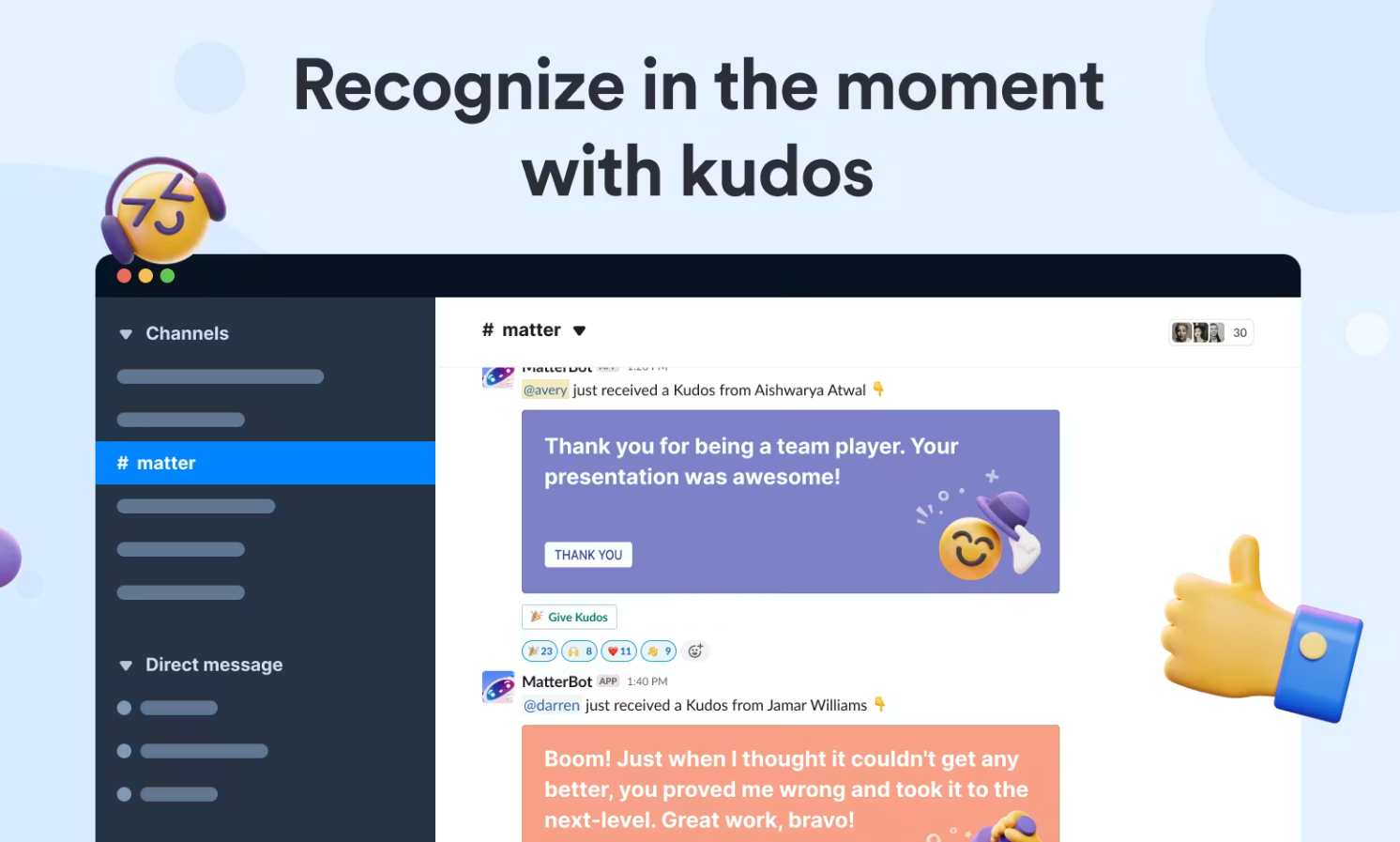
Core Features: Matter's core features include peer-to-peer kudos tied to company values; automated birthday and anniversary celebrations; a rewards catalog (gift cards, donations, custom company rewards) powered by Matter coins; pulse and eNPS surveys; challenges and incentives; and analytics dashboards. It integrates natively with Slack, Microsoft Teams, and a wide range of HRIS systems.
Unique Aspects: Matter's signature feature is "Feedback Friday," an automated weekly prompt that nudges the whole company to pause and recognize one another in a shared moment. This ritual-based approach tackles the most common point of recognition failure directly: consistency. Rather than hoping managers remember to recognize, Matter builds a recurring, low-friction habit into the workweek, making it a strong fit for hybrid teams that live in Slack or Teams.
Mo
Number of G2 Reviews: Mo has a limited presence on G2, so review volume is thinner than the larger platforms on this list.
Pricing: Mo doesn't publish its pricing publicly. To get a quote, you'll need to reach out to their employee culture experts, who will tailor a price based on your goals and company size.
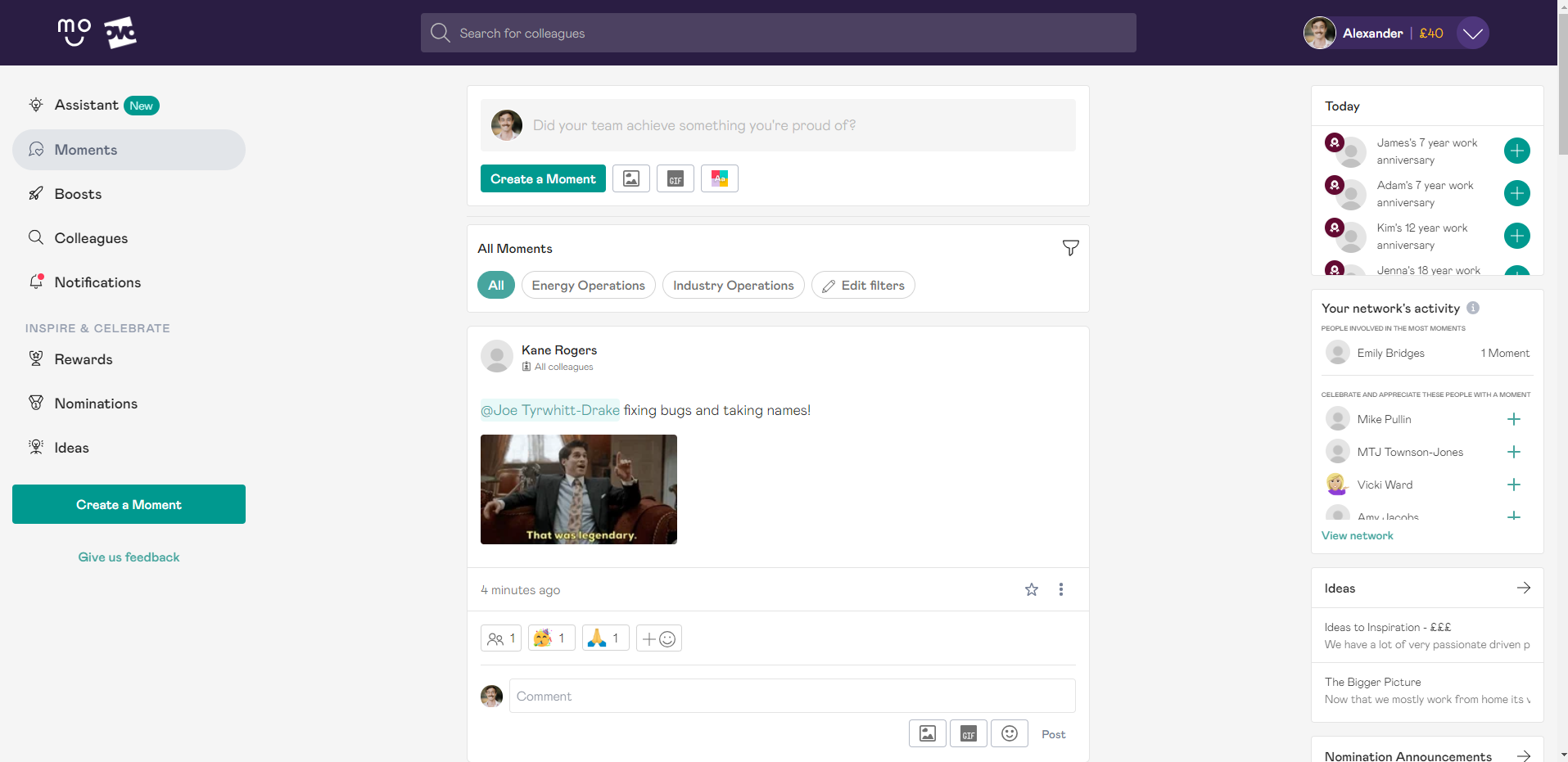
Core Features: Mo's core features center on two concepts: "Moments," a social recognition feed where employees celebrate wins, milestones, and personal events, and "Boosts," automated prompts that nudge teams to recognize behaviors tied to company goals. The platform also includes peer-to-peer nominations, a customizable rewards catalog with gift cards and custom rewards, and an Assistant that surfaces engagement insights for managers. Mo supports 12 languages.
Unique Aspects: Mo's differentiator is its emphasis on prompted, ritual-driven recognition through Boosts, which are particularly well-suited to recurring cadences such as weekly sprint wins or quarterly awards. Its multilingual support and mobile-first design make it a strong option for distributed and internationally spread teams. It's worth noting Mo is a focused recognition-and-rewards point solution rather than a full engagement suite, so teams wanting built-in performance management or deep survey tooling may need to look elsewhere.
Empuls (by Xoxoday)
Number of G2 Reviews: Empuls has received over 1,000 reviews on G2, with a rating in the 4.6–4.7/5 range.
Pricing: Empuls doesn't publish its pricing publicly. To get a quote, you'll need to book a demo and speak with their team, who will tailor a plan based on your needs and organization size.
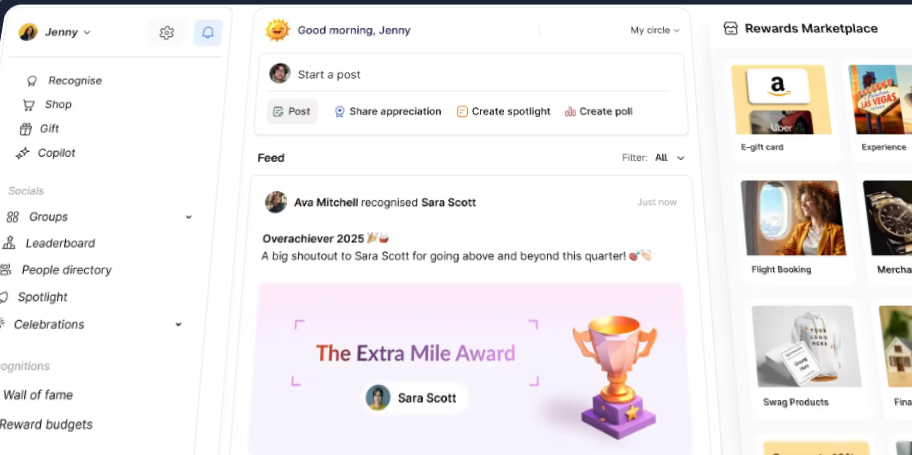
Core Features: Empuls combines four areas into one platform: recognition and rewards (peer-to-peer, manager-to-employee, value badges, approval-based awards), employee surveys and feedback (pulse, lifecycle, eNPS), a social intranet for company-wide communication, and a perks and benefits marketplace. It offers an extensive global rewards catalog, white-labeling options, an AI engagement bot, and integrations with Slack, Microsoft Teams, major HRIS systems, and SSO tools.
Unique Aspects: Empuls positions itself as a comprehensive engagement suite tailored for SMBs, rather than a single-purpose recognition tool. What sets it apart is how far its rewards reach extends, into wellness, financial benefits, and a broad perks marketplace, alongside an AI bot ("Em") that nudges participation and automates routine HR tasks. For an HR leader who wants recognition, surveys, communication, and perks under one roof at transparent pricing, Empuls offers breadth that narrower point solutions don't.
.jpeg)
5 Pro Tips for Choosing The Right Employee Recognition Software
At Qarrot, we've helped many companies launch and implement successful employee recognition and reward programs within their organizations.
We know that picking the right employee recognition software can take time. With all the options on the market and having to get buy-in from your decision-makers, this process doesn't happen overnight--it takes a lot of work!
Since we've advised many companies on this journey, we wanted to share some pro tips for HR professionals who are comparison shopping for recognition vendors or software providers. By following these tips, you can pick the software provider that best suits your business's short- and long-term needs.
1. Define Your Dealbreakers
Before you explore options, determine what's important to your organization. For example, determine whether you're seeking a more “pure” peer-to-peer recognition program or additional features to enhance the impact of employee engagement, like Pulse Survey and employee analytics features. Understanding your dealmakers and dealbreakers will help you choose a software solution that perfectly matches your company's needs and goals.
2. Establish a Realistic Budget
While employee recognition is invaluable, it's essential to have a clear budget in mind when selecting a software provider. Assess your financial resources and create a realistic budget that meets your organization's needs. Keep in mind that while some providers offer comprehensive packages with advanced features, others may offer more budget-friendly options tailored to small or medium-sized businesses.
3. Consider The Type of Rewards Employees Will Prefer
The success of a recognition program heavily relies on the rewards offered. Take the time to understand what motivates your employees and what type of rewards they would most appreciate. Whether it's gift cards, tangible goods, experiences, or even cash rewards, different software vendors offer various types of reward options for all types of employees. Selecting a software provider that offers a diverse range of rewards will ensure you can cater to the varying preferences of your workforce.
4. Evaluate Customization and Flexibility
Every organization operates differently, and your employee recognition program should reflect your unique company culture and values. Look for a software provider that offers customization options, allowing you to tailor the program to suit your specific requirements. Scalability and integration with existing systems are crucial to accommodating future growth and changes within your organization.
5. Seek User-Friendly Interface and Support
Ensure your employee recognition program has a user-friendly interface to ensure widespread adoption. Choose a software provider that offers intuitive and accessible platforms, making it easy for both administrators and employees to navigate and utilize the system effectively. You should also prioritize providers that provide reliable customer support and training resources to help you maximize the benefits of the software and resolve any issues that arise.
Final Thoughts
If you’re looking to launch an employee recognition program in your company, the abundance of software options can leave many HR professionals feeling perplexed. You’re certainly not alone!
This article is meant to ease that burden by providing a curated list of some of the best employee recognition platforms on the market. And most importantly, doing some of the leg work for you and highlighting their price point, key features, and unique capabilities.
We hope this knowledge and information will help you clarify your goals, narrow your options, and ultimately choose the recognition software provider that best matches your organization's needs.
Related: Choose the right recognition software solution with this 5-Step Buyer's Guide
.jpeg)
6 Impactful Employee Recognition Letter Samples To Celebrate Your Team
In this digital age of instant messaging and non-stop emails, there’s something special about receiving a real, tangible letter. If you’re a leader looking to express recognition or appreciation to your employees, writing or typing out a personalized letter might be the most simple and cost-effective way to share your gratitude for their hard work.
As we mentioned in our article on how to give better employee recognition, taking the time to vary your recognition efforts is crucial to offering impactful recognition.
For example, if you’re accustomed to only offering verbal “good jobs” at the end of the week, taking the extra time to actually write out a recognition letter for those noteworthy achievements is a great way to show your gratitude for those extra big goals.
In spite of that, we know that as a leader, you are likely extremely busy. Writing a letter from scratch and coming up with the exact right words can be tough. So, we wanted to help you out by providing employee recognition letter templates you can use as a jump-off point. Remember: these letters are most impactful to the receiver when tailored to them. In short, be sure to add some extra words of your own to truly acknowledge and appreciate your employees.
.jpeg)
6 Impactful Employee Recognition Letter Samples For Every Occasion
At work, many opportunities arise to offer employees a written note of recognition, encouragement, well wishes, or even condolence. It is always a wonderful gesture to take the time to write something personal. That said, here are a few employee recognition letter samples that help provide a jump-off point for most situations that may arise in the workplace.
Recognition letter template for an employee work anniversary
Dear [Employee Name],
I can’t believe how fast time flies! It’s been [years] since you came on board, and I can’t believe everything we’ve been through together. It’s been such a pleasure getting to know you over the years, and I couldn’t imagine the team without you!
Your [insert unique qualities or skills of employee] are just some qualities that have made you a pleasure to work with and an asset to this team.
The past year, in particular, has been full of amazing wins and accomplishments. We are so proud of all the hard work you’ve put into [insert specific accomplishments]
All your hard work and dedication have allowed us to achieve some of our biggest goals as a company, and we cannot express our gratitude for your hard work.
We hope the year to come is just as successful, and we look forward to working together and achieving even more!
Sincerely,
[Manager’s name]
Recognition letter template for an outstanding accomplishment
Dear [Employee Name],
I wanted to take the time to write this letter to personally thank you for all your hard work on [insert accomplishment]. It’s been a long road to achieving this goal, but we finally made it! Your perseverance and hard work have allowed us to overcome many obstacles and reach this big win.
Most importantly, your skills in [insert employee’s specific skills] were indispensable for us to accomplish this objective, raise the bar, and stand out against the competition.
It’s been such a pleasure working with you on this project, and I do not doubt that we will continue to accomplish great things together.
Sincerely,
[Manager’s Name]
Recognition letter template for initiative and extra effort
Dear [Employee Name],
I wanted to write this letter to let you know I appreciate all the extra work and initiative you've been taking lately. Don't think all this additional work and effort has gone unnoticed!
The work and initiative you've taken towards [insert project, event, etc] is truly admirable and demonstrates just how valuable you are to our team. I see you care about our company and team's success, and we are lucky to have someone like you who is always willing to raise the bar and go the extra mile.
Your willingness to learn, take risks, and do something new is something I really admire, and I just wanted to take a moment to thank you for that.
Sincerely,
[Manager's Name]
Recognition letter template for promotion or new role
Dear [Employees Name],
I want to take a moment and commend you on your new position as [insert the new title.]
In your past role as [insert former title], you were a true asset to our team and achieved some of the major goals and accomplishments like [insert key accomplishments], of which we are proud.
We are eager to see what you’ll bring to the table in this new role, and we wish you the best for the future as you continue to grow at [company name.]
All the best,
[Manager’s Name]
Recognition letter template for when times are tough
Dear [Employee Name],
I wanted to take a moment to express my gratitude for the dedication you've demonstrated lately.
Recognizing the challenges you've been facing, particularly with [mention the specific challenge], I can only imagine how demanding it must be for you at this time. Despite this, I've been truly inspired by your dedication and unwavering effort.
Remember, my door is always open to you. Please don't hesitate to reach out if you ever feel stressed or need support. We're here for you every step of the way.
Warm regards,
[Manager’s Name]
Recognition letter template for departing employees
Dear [Employee Name],
On behalf of everyone at [Company Name], I wanted to take this chance to thank you for everything that you have done during your time here, as well as wish you all the best as you embark upon this new chapter of your life.
Looking back, it’s amazing how much you’ve accomplished and how much your contributions have made an impact. It was a pleasure having you on our team!
We wanted to take a moment to highlight the achievements we are particularly grateful for. Your work on [a specific project the employee played an important role in], as well as [another specific project the employee played an important role in], contributed significantly to our long-term success.
I hope that you’ll keep in touch, and always feel welcome to collaborate with us again in the future. We do not doubt that you will continue to accomplish great things, and your future looks bright.
All the best,
[Your Name]
3 Tips for Leaders to Offer Impactful Recognition
1. Be Specific
Impactful recognition is always personal. A good test to see if your recognition message is personalized enough is to ask yourself, “Could this message be written about anyone?” If the answer is yes, your message is too generic and should be customized a bit.
You can personalize a recognition message in the following ways:
- Emphasize a specific accomplishment
- Highlight some specific qualities or skills you admire
- Bring attention to the impact of the employee's work on the business.
Your employee recognition letter can be spiced up by including these specifics and personalizing it for the recipient. Writing a more personal message will make a significant difference in how much your appreciation is felt. So, take a moment to reflect on what makes this person special and incorporate those thoughts into your message.
To make your recognition truly impactful, consider the employee's personality. A reserved individual might appreciate a more understated, sincere tone. On the other hand, if they enjoy humor and a lighthearted approach, infuse your letter with a few playful elements. This thoughtful tailoring ensures your gratitude resonates deeply, making the employee feel genuinely seen and appreciated.
By aligning your message with their unique traits, you not only acknowledge their achievements but also celebrate their individuality. This personal touch amplifies the authenticity of your appreciation, transforming a simple note into a memorable gesture.
2. Show your appreciation in other ways
Remember that words of recognition, in other words, verbal recognition are just one way to show your employee appreciation. As described in Dr. Paul White’s book The 5 Languages of Appreciation in the Workplace, there are several other ways leaders can show appreciation to their employees.
For example:
- Quality time
- Acts of service
- Gifts
In other words, if you’re giving the same old "good job team" in a meeting week after week, you might start to sound like a broken record. And your "good job" will not have the desired impact on your team's morale. So, be sure to incorporate some of these different ways of showing appreciation to your employees.
3. Ask for feedback from your employees
A major factor contributing to employee turnover is feeling underappreciated at work. And although appreciation and recognition are relatively simple to offer, sadly, many leaders tend to fall short in this area.
So what can leaders do? We recommend asking your staff how they feel. Yes, it might seem a bit weird initially, especially if you’re not used to asking for feedback about your leadership skills. But this conversation will be an important icebreaker and show employees that you really care about them and their opinions.
You can ask:
- Do you feel appreciated and recognized for your work?
- How would you prefer we show you appreciation (i.e. verbal recognition, team lunch, etc.)
- Can you give me an example of a time you felt appreciated for your accomplishments?
Maintaining communication with your staff on these topics is crucial to preventing employee turnover due to unappreciation. Giving your employees appreciation is truly a low-effort and high-impact action in the workplace. Managers should be doing their best to ensure that employees are feeling fulfilled and satisfied in this area.
How Can Recognition Letters Encourage Continued Excellence?
Recognition letters play a crucial role in fostering an environment where excellence is both appreciated and expected to flourish. Here's how they can be leveraged to encourage ongoing success:
1. Reinforce Positive Behavior
Acknowledging specific achievements helps employees understand what actions are valued. It's important to highlight specific behaviors or outcomes that exemplify excellence. This not only celebrates current success but sets a clear standard for future performance.
2. Inspire Future Efforts
Including forward-looking statements in your recognition letters can serve as a powerful motivator. Phrases such as, "I am eager to see your future accomplishments," can keep employees inspired to strive for continuous improvement and growth.
3. Cultivate a Growth Mindset
Encouraging words like “keep up the great work” can instill a growth mindset, reminding employees that their potential is limitless. This mindset encourages them to embrace challenges and persist in their efforts.
4. Foster a Sense of Belonging
Recognition letters also strengthen the sense of belonging and loyalty within a team. When employees feel valued and recognized, their commitment to maintaining high standards often increases, leading to a more cohesive and motivated workforce.
By focusing recognition letters not just on past achievements, but also on future possibilities, you empower employees to continue aiming high and excelling in their roles.
How Can Recognition Letters Connect to Company Values?
Recognition letters offer a powerful way to align individual achievements with the core values of an organization. Here's how these letters can effectively create a connection:
1. Reinforcing Core Values:
By highlighting how an employee’s actions reflect the company’s principles, recognition letters can serve as a tangible reminder of these values. Whether it’s innovation, teamwork, or customer service, linking these principles to specific achievements showcases their importance within the organization.
2. Personalized Acknowledgment:
Tailoring recognition to fit the distinct contributions of an employee helps in illustrating their role in upholding the company’s values. For instance, acknowledging a team member’s creativity in a project emphasizes the value of innovation.
3. Storytelling:
Crafting a narrative around an employee’s success story can integrate the company’s mission and broader goals. This storytelling approach not only highlights individual contributions but also illustrates how they contribute to the company's higher purpose.
4. Motivation and Engagement:
By connecting recognition to company values, employees can see the bigger picture of how their work contributes to the organization’s mission. This can boost motivation and engagement, making them feel more invested in their roles and the company’s success.
5. Encouraging a Value-Driven Culture:
Regularly using recognition letters as a tool to highlight core values helps in fostering a culture that prioritizes and rewards those principles. Over time, this can strengthen the overall organizational culture and align employees’ efforts with strategic objectives.
In conclusion, when crafted thoughtfully, recognition letters can do more than just appreciate contributions—they can weave the organization's values deeply into its everyday operations.
Final Thoughts
Taking the time to write or type a letter or card might take a little more effort than saying “Good job,” but the effort will be well worth the impact it will have on your team morale. By using these employee appreciation letter examples as a jump-off point, you won’t have to start writing everything from scratch.
Remember: It's not just about the words on paper; it's about the sentiment and effort behind them, creating a meaningful connection between leaders and their teams. By investing in these small gestures of appreciation, leaders can cultivate a thriving culture of recognition and support, ultimately leading to greater job satisfaction and employee engagement.
