
Recognition & Rewards

.jpeg)
6 Tips for Giving Better Employee Recognition at Work

Picture this: you've got a fantastic team. They're putting in the hours, hitting targets, and excelling at their jobs. But when it comes to acknowledging their efforts, you've hit a roadblock. As a leader, the idea of recognition may raise some common questions and concerns.
For example:
- Will others get jealous?
- Will this sound cheesy and not genuine?
- What types of actions or accomplishments am I supposed to be recognizing?
One thing you know for sure: your team deserves more than a surface-level "good job." They deserve personalized, timely, and memorable recognition that keeps them motivated and feeling valued. But you're still not quite sure how to get started.
You're not alone! Mastering the art of consistent and impactful recognition can be a struggle for many leaders. The good news is learning how to give recognition at work is a management soft skill that can be mastered, and we're here to help!
Why Giving Recognition Feels Hard (Even When You Care)
Most managers who struggle with recognition aren't struggling because they don't care. They care deeply. The problem is structural.
Here's what typically happens: a leader decides they want to recognize their team more consistently. They make a mental note to do better. For a week or two, they do. Then things get busy, priorities shift, and recognition slips back to special occasions only — a work anniversary here, a big win there.
This is the consistency trap. And it's not a motivation problem, it's a structure problem. In other words, consistency doesn't create structure. Structure creates consistency.
When recognition is left entirely to memory and goodwill, it will always compete with the hundred other things on a manager's plate and often lose. The managers who give the most reliable recognition aren't necessarily the most naturally appreciative people. They're the ones who've built recognition into the rhythm of their leadership.
This might mean carving out five minutes at the end of each week to think about who on their team deserves a shoutout. It might mean using a platform like Qarrot to make recognition easy to give in the moment. Or it might mean building a mix of formal and informal recognition touchpoints so that appreciation isn't dependent on any one person remembering to do it.
The bottom line: if recognition keeps falling through the cracks, don't just try harder. Build a better home for it.
Mastering employee recognition
At Qarrot, we help companies implement official recognition programs and also help their leadership become better at giving recognition. Through our experience working with organizations, we have noticed a few employee recognition best practices that lead to appreciation having a greater impact on happiness and motivation and, of course, the overall success of their recognition programs.
This article will explore these best practices and uncover tips to help avoid your recognition efforts from falling flat. With these tips, you'll be equipped to offer your employees impactful recognition that truly energizes a team. Our goal is to take you from the place of doubt into clear victories marked by a sense of accomplishment.
.jpeg)
8 Tips for Giving Better Employee Recognition at Work
1. Offer frequent recognition (at least monthly!)
One of the biggest challenges for leaders is getting into a habit of giving recognition at regular intervals. A lot of leaders are great at giving recognition for those big, shiny accomplishments that happen a few times per year. But where they lack consistency is sharing their appreciation for the smaller everyday efforts that happen behind the scenes. In other words, all the steps and work that lead up to the big accomplishment.
Now, we're not necessarily implying you need to give recognition every single day. But ideally, you want to be aiming for more than a few times per year. Workplace studies have demonstrated that the frequency of recognition directly correlates with satisfaction at work. The more frequent the recognition, the more satisfaction increases.
Many leaders might say, "But my employees don't achieve big accomplishments that frequently; what am I supposed to recognize between these bigger wins?
Well, once again, one of the best ways to make sure to give frequent recognition is to focus on praising employees' "behind-the-scenes efforts," not only the big final accomplishment. Praising employees' smaller efforts not only results in more frequent recognition but also more genuine recognition. Ultimately, it will have a greater emotional impact on the employee as they will feel personally appreciated and valued.
2. Focus on one specific goal or accomplishment
What type of recognition do you think sounds more impactful to an employee?
- "Great job on everything you've done this week."
- "Thank you for your standout efforts in dealing with client X this week. They were being particularly difficult, and you did an amazing job at de-escalating the situation."
If there is one recognition tip to remember, it is that impactful recognition is specific. In other words, it focuses on one specific accomplishment or achievement. Of course, the occasional "great job on everything you've done" is acceptable. As we always say, giving some recognition is better than none. But if you want to deliver recognition that really makes an employee feel deeply valued and appreciated, take the time to point out a specific win, especially one that you know they've worked so hard to achieve.
That said, leaders and managers sometimes can be unsure which accomplishments deserve official praise or recognition. We recommend identifying achievements that align with the organization's goals or demonstrate exceptional skills.
For instance, recognizing an employee's ability to deal with challenging clients, as in the second example, acknowledges their effort and highlights a crucial skill — de-escalation. Recognition like this not only boosts morale but also demonstrates what skills or behaviors are valued. Remember, the key is to be genuine and specific in your recognition, showing that you not only notice their efforts but also understand their unique contributions to the team.
3. Highlight the impact of the employee's work on the organization
People want to go to work and feel like they are making a difference. It feels great to know that your contributions are impacting not just your team but the entire organization.
That’s why impactful recognition will always take it a step further and highlight how the employees' work impacted the big picture. Bonus points if it can be quantified. Adding extra words that speak to these finer details will go a long way to instill in the employee a sense of accomplishment for their hard work.
For example, note the stark difference between the following two examples:
- “Thanks for all your hard work on closing the deal with Company X. Your hard work and dedication have been an asset to our team!”
- “Thanks for all your hard work on closing the deal with Company X. Because of your hard work, we will surpass our quarterly quota by over 10%! Amazing job.”
This detailed acknowledgment instills a profound sense of pride and reinforces the understanding that every individual contribution is crucial in steering the entire organization toward success
4. Speak your employee's language of appreciation
Every employee is unique. For example, it’s important to remember that not everyone will enjoy receiving public praise and recognition. Some people don’t particularly enjoy being the center of attention and having the spotlight on them. Keep in mind that this doesn’t mean that they don’t want to be recognized for their work at all. It just means that they may prefer to have recognition delivered privately or in a more personalized way.
Workplace expert Dr.Paul White explains this idea in his book The 5 Languages of Appreciation in the Workplace. We often think verbal appreciation is the only way leaders can share recognition with their teams. But in this book, White explores the many ways leaders can share their appreciation for their team and why just saying “thank you” at work isn’t always enough.
A popular example: is quality time. If a busy manager makes time to give an employee their undivided attention by sharing a meal or booking a time to talk about their career goals, that can be a genuine way of showing appreciation for your employee.
The bottom line is don't limit yourself to verbal "good jobs" or "thanks yous." Of course, you can make that one slice of the pie, but you can also share your appreciation in other ways, like giving your employees a helping hand or making quality time for them.
5. Use a variety of recognition methods
In a similar vein, varying your recognition methods is critical to giving effective recognition to your employees. For example, you might give verbal "good jobs" or shout-outs in meetings. That's what you find the most practical and effective at showing appreciation for your team's work.
However, giving the same "good job team" in a meeting week after week, you might start to sound like a broken record. And your "good job" will not have the desired impact on your team's morale. In this case, you might want to consider switching things up.
You could, for example:
- Offer your employees a written note or letter of appreciation for bigger accomplishments.
- Organize a team event or outing like a paid lunch.
- Offer a small gift or personalized token of your appreciation and verbal recognition.
There are many ways to show employees you care about them and appreciate their hard work. Sometimes, it's beneficial to make an extra effort to do something special and unique, especially when you wish to acknowledge the biggest goals and accomplishments.
6. Build recognition into your routine, don't leave it to chance
This tip is the structural counterpart to tip #1. Knowing you should recognize more often is one thing. Making it happen consistently is another.
The managers who give the most consistent recognition tend to have one thing in common: they've made it easy. They've removed the friction. This might look like:
- A weekly five-minute reflection at the end of each Friday: Who on my team did something worth acknowledging this week?
- Using a recognition platform that lets you send appreciation in the moment, without extra steps
- A standing agenda item in team meetings for peer or manager shoutouts
- A formal program — peer nominations, spot recognition — that creates natural recognition touchpoints throughout the year
Recognition isn't just a personal habit. It's a practice that benefits from structure. When you build the right mix of formal and informal recognition into how your team operates, consistency stops being something you have to force it becomes part of your culture.
7. Address jealousy head-on with specificity
One of the most common concerns leaders have about giving recognition is the worry that it will create jealousy — that spotlighting one person will make others feel overlooked or resentful.
Here's the good news: specific recognition is the antidote to jealousy.
When you recognize someone for a vague, general accomplishment — "great job this week!" — it can feel arbitrary to everyone watching. But when you name exactly what someone did and why it mattered, something different happens. Team members who witnessed that effort usually agree with the recognition. They saw the hard work too. Specific recognition doesn't make others feel left out; it helps the whole team understand what great work looks like — and signals that their own contributions will be noticed with the same attention.
The key is making recognition a regular practice, not a rare event. When appreciation is distributed consistently and specifically across the team over time, there's no single spotlight to fight over. Everyone gets seen.
8. Ask for feedback
Feeling underappreciated at work is a major reason for employee turnover. A Gallup report shows that a lack of recognition remains one of the most common reasons employees leave an organization. In other words, although appreciation is relatively simple to offer (and highly cost-effective), so many leaders tend to fall short in this area.
So what can leaders do? We recommend simply asking your staff how they feel. Yes, it might seem a bit weird initially, especially if you’re not used to asking for feedback about your leadership skills. But this conversation will be an important icebreaker and show employees that you really care about them and their opinions.
You can ask:
- Do you feel appreciated and recognized for your work?
- How would you prefer we show you appreciation (i.e. verbal recognition, team lunch, etc.)
- Can you give me an example of a time you felt appreciated for your accomplishments?
Keeping connected with your staff on these questions is critical to reducing potential employee turnover due to feeling unappreciated. Giving your employees appreciation is truly a low-effort and high-impact action in the workplace. Managers should be doing their best to ensure that employees are feeling fulfilled and satisfied in this area.
Structure First, Habits Follow
Learning how to give recognition at work isn't about becoming a different kind of leader. It's about building better habits and a better structure around something you likely already care about.
The worries are real: Will this sound cheesy? Will someone feel left out? We hear these concerns often, and our consistent finding is that specific, thoughtful recognition disarms both. When your recognition is tied to real effort and real impact, it doesn't sound hollow. And when it's distributed consistently and fairly over time, it doesn't create resentment; it creates a culture where people feel genuinely seen.
Recognition isn't a program you launch once and walk away from. It's a practice. And like any practice, it gets better with structure, intention, and time.

42+ Impactful Employee Recognition Messages to Inspire Your Team
Recognition and appreciation are foundational elements of all strong relationships. This applies to our work life just as much as our home life.
And employee recognition isn’t just about money. We’re talking about the simple act of sharing your verbal appreciation for employees and their hard work. This practice–which is virtually free–can have a huge impact on employee engagement. In fact, a recent Harvard Business Review study showed employees who said their managers were great at showing positive recognition were 40% more engaged than those with managers who didn’t show the same level of recognition. That’s just simple verbal appreciation!
Since recognition and appreciation are so vital, we assume that giving it should be natural and straightforward, right? Just go up to someone and let them know that you appreciate them.
In reality, giving impactful recognition isn’t always so simple and effortless; it’s a management soft skill that can take practice to develop. So if you’re one of those leaders who struggles with sharing your appreciation, don’t worry too much, as you’re far from being alone.
Growing a culture of recognition
At Qarrot, we’re here to support you! We’ve helped numerous companies get started on growing culture of recognition in their workplace, and a common challenge for leaders is not being exactly sure what to write when it comes time to craft that first recognition message. They get a recognition writer's block, so to speak…

First off, we want to say: Don’t overthink this.
Giving ANY recognition is always better than giving none at all. And as you get more accustomed to giving frequent recognition, this habit will become second nature.
Whether your company is implementing an official recognition platform or program or you’re just looking to spread a little more informal appreciation in your workplace, we’ve put together an extensive list of recognition message examples that will help you get started on the right foot.

45 Employee Recognition and Appreciation Message Examples
Recognition messages for achievements & contributions
- "Congratulations on surpassing expectations! Your dedication and innovative approach have significantly elevated our team's performance. Thank you for your outstanding contributions."
- "Your hard work and commitment haven't gone unnoticed. Your exceptional achievements have made a lasting impact, setting a high standard for excellence."
- "Your relentless pursuit of excellence shines through in your work. Your accomplishments are a testament to your skill and dedication. Well done!"
- "Fantastic job! Your exceptional performance and commitment to excellence make a significant difference. Your contributions are truly appreciated."
- "A big thank you for your work! Your dedication and exemplary achievements have not only met but exceeded expectations. Your contributions are invaluable to our success."
- "Your hard work and achievements have not only impressed but inspired the entire team. Your commitment to excellence is truly commendable."
- "Your remarkable contributions have played a key role in our success. Your dedication and hard work are truly appreciated. Thank you for going above and beyond."
- "Your exceptional achievements have not only made a positive impact but have set a new standard for excellence. Thank you for your outstanding contributions."
- "Congratulations on a job exceptionally well done! Your hard work, creativity, and dedication have not only met but exceeded our expectations. Thank you for your outstanding efforts."
- "Thank you for your outstanding contributions to our team's success. Your hard work and commitment have not only made a difference but have set a benchmark for excellence."
Recognition messages for positive attitudes & other soft skills
- "Your ability to articulate ideas and actively listen contributes immensely to a harmonious and efficient work environment. Well-deserved recognition!"
- "Your positive approach to challenges is admirable. Your optimism and willingness to push through any obstacles make you a standout team member. Thank you for your resourceful and industrious spirit!"
- "We are consistently amazed by your communication skills. Your ability to convey ideas clearly and foster a collaborative environment has improved our team dynamics and made us more productive than we thought possible. Well done!"
- "Your positive attitude is a true asset to the team! Your cheerful demeanor and optimism create a welcoming environment, uplifting the entire team. Thank you for spreading positivity."
- "Your ability to communicate effectively and maintain a constructive approach in all situations is commendable. Thank you for your impactful contributions."
- "Kudos on spreading positivity! Your infectious optimism and support contribute greatly to team morale. Thank you for creating a positive and motivating work environment for everyone."
Recognition messages for work anniversaries
- "Congratulations on reaching this [X year] work milestone! Your dedication and hard work over the years have been instrumental to our success. Thank you for your outstanding contributions."
- "Happy work anniversary! Your commitment and achievements during this time have made a lasting impact. Here's to many more years of success together."
- "Cheers to your work milestone! Your consistent excellence and dedication have been key to our achievements. Thank you for your invaluable contributions to the team."
- "Congratulations on your work anniversary! Your unwavering commitment and exceptional contributions have been pivotal. Here's to celebrating your accomplishments and the journey ahead."
- "Happy milestone achievement! Your hard work and dedication have set a high standard. Thank you for your significant contributions to our team's success."
- "Congratulations on reaching this work milestone! Your dedication and passion have greatly contributed to our achievements. Here's to more years of collaboration and success."
- "Happy work anniversary! Your commitment to excellence and continuous efforts are truly commendable. Thank you for your valuable contributions to the team."
- "Congratulations on your work anniversary! Your unwavering dedication and positive impact on the team are truly appreciated. Here's to celebrating your accomplishments and the years ahead."
Recognition messages for taking initiative & great ideas
- "Kudos for your innovative spirit! Your initiative and fresh ideas consistently propel our team forward. Thank you for driving positive change and contributing to our success."
- "Congratulations on your proactive approach! Your initiative and creative ideas are invaluable. Thank you for constantly bringing innovation to the table."
- "Your proactive mindset and innovative ideas have truly set you apart. Thank you for taking the initiative and contributing to our team's success."
- "Cheers to your inventive contributions! Your initiative and forward-thinking ideas have been instrumental. Thank you for being a catalyst for positive change."
- "Your proactive approach and creative ideas enhance our team's dynamism. Thank you for driving innovation and contributing to our success."
- "Your initiatives have been an asset to our team! Your innovative ideas consistently elevate our projects. Thank you for your forward-thinking contributions to our team's success."
- "Thank you for consistently bringing fresh ideas to the table. Your initiative and innovative approach add tremendous value to our team."
- "Your initiative and innovative ideas have been a driving force in our success. Thank you for consistently bringing fresh perspectives to our projects."
Recognition messages for the embodiment of company values
- "Congratulations on embodying our core values! Your commitment to integrity, teamwork, and excellence shines through in your work. Thank you for setting a stellar example for the entire team."
- "Kudos for consistently living our company values! Your dedication to innovation and collaboration is truly commendable. Thank you for being a true ambassador of our core principles."
- "Your commitment to customer satisfaction and teamwork is outstanding. Thank you for upholding the essence of our company in everything you do."
- "Cheers to you for exemplifying our core values! Your dedication to integrity and excellence is truly inspiring. Thank you for being a living testament to our company's principles."
- "Your commitment to diversity, collaboration, and excellence is remarkable. Thank you for being a beacon of our company's core principles."
- "Bravo for living our values! Your dedication to integrity, accountability, and teamwork is admirable. Thank you for being a true embodiment of what our company stands for."
- "Thank you for consistently representing our core principles. Your commitment to excellence, collaboration, and customer satisfaction is truly commendable."
Recognition messages for teamwork & collaboration
- “Outstanding teamwork! Your collaborative spirit has greatly contributed to our recent success. Your ability to work seamlessly with others is truly commendable. Thank you for fostering a positive and cooperative environment.”
- “Your dedication to collaboration has significantly elevated our collective achievements. Your commitment to working effectively with colleagues is inspiring.”
- “Thank you for being such an amazing collaborator. Your teamwork has not only enhanced project outcomes but also fostered a supportive work atmosphere. We value your positive influence and cooperative attitude as valuable contributions to the success of our team.”
- “You're awesome at collaborating! Your ability to work effectively with diverse team members has been instrumental in achieving our goals. Thank you for consistently embodying the spirit of teamwork and collaboration.”
- “Recognizing your outstanding collaboration! Your teamwork has been a driving force behind our achievements. Your willingness to collaborate and support your colleagues has not gone unnoticed. Thank you for being a crucial part of our success.”
- “Applauding your team spirit! Your collaborative mindset has played a pivotal role in our accomplishments. Your ability to work cohesively with others is truly commendable. Thanks for being a dedicated team player and contributing to our success.”
Pro Tip For Giving Impactful Recognition
Hopefully, some of these employee appreciation messages can help you get started on the path to growing a culture of recognition within your team. Yet, we urge you to use these as a jump-off point.
In other words, don’t just copy-paste; try to add your own personal touch as well. Sincerity is one of the most important factors of impactful recognition. And the best way to deliver sincere recognition is by ensuring that your recognition is personalized.
What are some concrete ways to make your recognition more personal?
- Ensure your message highlights a specific accomplishment. (i.e. “Great job on closing this deal/account.”)
- Ensure your message highlights the impact of the employee's work on your team or organization. (i.e. “Because of your hard work, we surpassed our quota by 10%!”)
- Your message highlights the unique qualities and traits of the employee. (i.e. “Your persistence and dedication are admirable.”)
Being specific will ensure that your recognition message is not generic but rather a personalized reflection of your employees' unique accomplishments and qualities. In turn, the message will be most impactful and energizing for employees to see and read. In other words, a genuine, personalized message will be more likely to result in eliciting those positive emotions that lead to greater engagement, motivation, and happiness.

How to Build a Business Case for Employee Recognition Software
Most internal pitches for recognition programs fail for the same reason: they lead with the wrong argument.
HR leaders tend to frame recognition as a culture investment; something that will improve morale, boost engagement scores, and make people feel more connected to the company. All of that is true. But to a CFO or COO who is weighing competing priorities, "culture investment" can easily read as discretionary spending. Something to revisit when things calm down.
The business case that actually lands reframes the conversation entirely. The question isn't whether you can afford to invest in recognition. It's whether you can afford to keep absorbing the cost of not having it. Disengagement, turnover, and inconsistent manager behavior all carry measurable price tags — and in most organizations, those costs are already on the books. They're just not being attributed to anything.
Getting leadership buy-in starts with helping them see the problem they already have.

What Poor Recognition Is Actually Costing Your Organization
Before you build a case for what recognition software will do, you need to quantify what the absence of it is already costing.
This is the section of your business case that speaks directly to finance-minded stakeholders. The numbers don't need to be perfectly precise; they need to be directionally credible and clearly attributable to something leadership cares about.
A few areas to build your cost picture around:
Turnover costs. Replacing an employee costs a significant multiple of their annual salary when you factor in recruiting, onboarding, and lost productivity during ramp-up. If recognition is a meaningful driver of retention, then even a modest reduction in voluntary turnover represents real savings.
Disengagement drag. Disengaged employees aren't just unhappy; they're measurably less productive. Gallup's research shows that highly engaged business units achieve a 17% increase in productivity compared to their least-engaged counterparts, along with a 41% reduction in absenteeism. Across a team of 75 to 200 people, that gap adds up quickly.
Manager inconsistency. When recognition depends entirely on an individual manager's personality, some teams feel constantly seen, while others go months without acknowledgment. That inconsistency doesn't just hurt morale; it creates real equity gaps that erode trust in leadership over time. Research shows that employees who receive feedback and recognition from their manager at least once a week are 61% engaged, significantly higher than the 38% engagement rate among employees who receive feedback frequently but recognition less often.
These aren't speculative costs. There are things that are happening in your organization right now. The business case just needs to give them a number.
How to Frame the ROI Argument for Leadership
Here's something worth saying plainly: the ROI of recognition is genuinely hard to pin down with precision. Anyone who tells you otherwise is oversimplifying.
The impact of recognition compounds across retention, productivity, culture, and manager behavior — and isolating its contribution from everything else happening in your organization simultaneously is difficult. Experienced finance leaders know this, and if you walk in claiming a perfectly clean ROI calculation, you're more likely to lose credibility than gain it.
The stronger move is to acknowledge the complexity upfront, then shift the framing.
Why ROI is hard to pin down
Rather than promising a specific return, position your business case around cost reduction and risk mitigation. You're not asking leadership to fund a new initiative on faith; you're asking them to address a problem that is already costing the organization money. That reframe alone changes the nature of the conversation.
The cost-of-inaction case
Work backward from what you know.
What is your current voluntary turnover rate? What does it cost to backfill a role at your average salary? How many people left in the last 12 months, citing lack of recognition or growth as a factor? Even rough estimates, built transparently, carry more weight than precise figures that look manufactured.
The goal isn't to predict exactly what recognition software will save you. It's to make the current status quo look expensive.
What world-class companies already know
One of the most effective tools in a business case isn't a number; it's a precedent or standard that already exists in the real world.
Companies like Disney, Apple, and Salesforce have built recognition into their operating architecture, not as a perk but as a deliberate driver of culture and performance.
For leadership skeptics, this matters. It shifts the question from "is this proven?" to "why aren't we doing what the best companies are already doing?" That's a much easier conversation to have.

The Four Components of a Credible Business Case
A strong internal pitch for recognition software doesn't need to be a 40-slide deck. It needs to be clear, grounded in real numbers, and honest about what you know and what you don't.
Here's a simple framework to build from.
Quantify the current cost of disengagement
Start with what's already measurable in your organization: turnover rate, average replacement cost, engagement survey scores, absenteeism, and any exit interview data that points to recognition as a factor. You don't need perfect data; you need enough to establish that the problem is real and ongoing.
Define the program scope and expected investment
Be specific about what you're proposing. A vague ask for "a recognition platform" is easy to defer. A defined program with a clear scope — peer recognition, manager-to-team spot awards, a years-of-service component — backed by a per-employee monthly cost is much harder to dismiss. At the $3–$6 per employee per month range that most platforms operate in, the investment is often modest relative to the cost of even a single unwanted departure.
Project measurable outcomes with a realistic timeline
Resist the urge to overpromise. Instead, identify two or three metrics you'll track in the first six months: participation rate, recognition frequency, voluntary turnover, or engagement score movement. Frame these as leading indicators, not guaranteed outcomes. Leadership appreciates honesty about what takes time.
Identify a 90-day win to validate early ROI
This is often the piece that closes the deal. Propose a pilot. For example, a single team, department, or program type with a defined success metric and a review date. A 90-day pilot reduces perceived risk significantly and gives you a concrete proof point to build on. It also signals that you're confident enough in the outcome to be held accountable for it.
What to Look for in a Recognition Platform
Since you're already solution-aware, this isn't about explaining why software beats spreadsheets. It's about knowing what to look for so your pitch is specific, and your evaluation is defensible.
A few things worth building into your requirements:
Support for multiple program types. A recognition platform that only does one thing will limit you. A recognition ecosystem that actually moves the needle needs formal and informal programs running in parallel. Look for a platform that supports all of it without requiring you to stitch together multiple tools.
Manager enablement, not just HR administration. Recognition consistency lives or dies at the manager level. The best platforms make it easy for managers to recognize their teams directly, without routing everything through HR. If adoption depends on behavior change from 15 different people managers, the tool needs to make that behavior as frictionless as possible.
Reporting that connects to your business case. You made commitments when you got this approved. Make sure the platform provides the data you need to report back on them: participation rates, recognition frequency by team, redemption activity, and engagement trends over time.
Integration with the tools your teams already use. For hybrid workforces running on Microsoft Teams, a platform that lives inside Teams isn't a nice-to-have; it's the difference between adoption and abandonment.
Qarrot is built to support all of this: multi-program flexibility, manager-level recognition, Teams integration, and reporting that gives you something real to bring back to leadership.
Anticipating Leadership Pushback
Even a well-built business case will hit objections. Here are the ones you're most likely to encounter, and how to address them.
"We already do recognition informally"
Informal recognition is better than nothing, but it's not a program. When recognition depends entirely on individual manager personality, it creates inconsistency across teams, and inconsistency is exactly what drives the engagement gaps you're trying to close. The goal of a platform isn't to replace genuine appreciation; it's to give it structure so it happens consistently, across every team, not just the ones with naturally expressive managers.
"We can't measure this"
You can measure more than leadership thinks. Participation rates, recognition frequency, voluntary turnover, engagement scores, and absenteeism are all trackable. You won't have a clean input/output ROI formula in year one, but you can establish baselines and demonstrate movement. A pilot with defined success metrics is the clearest answer to this objection.
"The timing isn't right"
This one is worth pressing on gently. The cost of disengagement doesn't pause while timing gets better. If your engagement scores are slipping, turnover is above the industry average, or your hybrid team is showing signs of disconnection, waiting six months to address it comes at a real cost. The business case should make that cost visible.
Bringing It All Together
The strongest business cases for recognition software aren't built on enthusiasm for recognition. They're built on a clear-eyed look at what poor recognition is already costing the organization, a realistic projection of what structured programming can change, and a willingness to be accountable for the outcome.
If you're ready to see what that looks like in practice, book a demo with Qarrot, and we'll walk you through how other companies at your stage have built the case and made it stick.
.png)
Why Employee Recognition Programs Fail (And How to Make Sure Yours Doesn't)
You've made the case internally. Leadership is on board. There's budget, there's buy-in, and there's genuine enthusiasm for building something meaningful. Now comes the part no one really prepares you for: actually making it work. Understanding why employee recognition programs fail is one of the most valuable things you can do to set your program up for lasting success.
The reality is that most employee recognition programs don't fail because of bad intentions. They fail because of a handful of predictable, avoidable execution gaps that quietly undermine even the most well-designed initiatives. And for HR leaders at growing companies, where resources are lean, and there's little margin for a costly reset, getting it right the first time matters.
The problem isn't usually a lack of effort
Many HR professionals launching a recognition program for the first time face the same challenge: they know what they want the outcome to look like, but the road between here and there feels uncertain. What are the real risks? Where do programs typically lose traction? And how do you build something that actually sticks?
The good news is that the most common failure points are well-documented, which means they're preventable. Once you know what to watch for, the path forward becomes much clearer.
Here are six reasons why employee recognition programs fail, and exactly what you can do to make sure yours doesn't.

Why Employee Recognition Programs Fail (And How to Make Sure Yours Doesn't)
1. The program launches without real onboarding
One of the most common reasons recognition programs stall has little to do with intention and everything to do with implementation. Even when employees are genuinely excited about the idea of recognition, change requires effort. People need to learn new expectations, new behaviors, and sometimes new tools. And without clear guidance, many default back to old habits.
Organizations that invest in a structured rollout see significantly higher participation rates. Training sessions, clear communication about the program's purpose, and visible leadership involvement all make a meaningful difference. The format of your program matters far less than the clarity and enthusiasm behind how it's introduced.
How to avoid it:
- Plan a structured internal launch across multiple touchpoints: email, team meetings, internal channels
- Run dedicated onboarding sessions that explain the program's purpose, expectations, and mechanics
- Give employees a clear first action (for example, encouraging everyone to recognize one colleague in the first week)
- Ensure managers model participation early and reinforce it consistently
- Have senior leaders publicly endorse the program. When executives visibly participate, it signals that recognition is part of how the organization operates, not just another HR initiative
Recognition programs rarely fail because employees don't care. They fail because no one clearly showed them how to engage.
2. Recognition feels performative or obligatory
Everyone wants to feel appreciated, but not all appreciation is created equal. Recognition loses impact quickly when it becomes routine, generic, or expected. When programs are poorly designed, they can create an appreciation that feels automatic rather than earned. At worst, employees feel pressured to give recognition simply to meet a quota, and that's when it becomes purely transactional.
Workplace psychologist Dr. Paul White draws a clear distinction between traditional recognition and authentic appreciation, noting that recognition often feels impersonal and contrived when it focuses on task completion rather than the individual behind the work. The principle holds: when recognition lacks specificity or emotional sincerity, employees disengage. It starts to feel like going through the motions rather than a meaningful acknowledgment.
How to avoid it:
- Train managers on how to give detailed, behavior-based recognition. What was done, why it mattered, how it contributed
- Tie recognition to real outcomes and company values, not just activity metrics
- Avoid making recognition feel mandatory or quota-driven
- Reinforce that quality and sincerity matter more than volume (i.e. quantity)
- Make space for recognition that is specific to the individual, not just the accomplishment
3. Rewards don't actually feel rewarding
There's nothing particularly inspiring about the same cookie-cutter reward for every employee and every milestone. People are motivated by different things, and a one-size-fits-all approach signals that the organization hasn't really thought about what makes each person tick.
When employees can choose their own rewards from a meaningful selection, recognition lands differently. It feels personal rather than procedural. It also gives HR teams real-time insight into what motivates different people across the organization. Information that's genuinely useful for engagement strategy going forward.
How to avoid it:
- Offer a selection of reward options rather than a single predetermined gift
- Use flexible formats (like gift cards) that give employees genuine choice
- Align reward value with the significance of the contribution being recognized
- Revisit your reward catalog periodically to ensure it stays relevant and appealing
4. The program isn't connected to real goals or behaviors
A recognition program that exists in isolation, disconnected from the work your team is actually doing, quickly feels hollow. The goal of recognition isn't just to make people feel good in the moment. It's to reinforce the specific behaviors, values, and contributions that drive your organization forward.
If your program can't reflect what success looks like for your specific team, it can't do its job. Recognition that isn't tied to meaningful outcomes becomes background noise, present, but not impactful. The most effective programs are built to capture what your organization actually cares about, whether that's collaboration, innovation, customer service, or hitting performance milestones.
How to avoid it:
- Define what behaviors and outcomes you want recognition to reinforce before launching
- Build your program around your company's mission, values, and performance goals
- Allow for customization. Whether that's branded recognition moments, campaign-based incentives, or team-specific criteria
- Regularly assess whether the program is driving the behaviors it was designed to encourage
- If recognition and organizational goals feel out of sync, treat that as a signal to recalibrate, not a reason to abandon the program
5. Over-reliance on a single type of recognition
One of the most common design mistakes is assuming that launching one recognition initiative is enough to shape culture. An organization might introduce a years-of-service program and consider recognition "covered," but milestone awards, while meaningful, are inherently infrequent. They acknowledge tenure, not the day-to-day effort that actually keeps your team motivated.
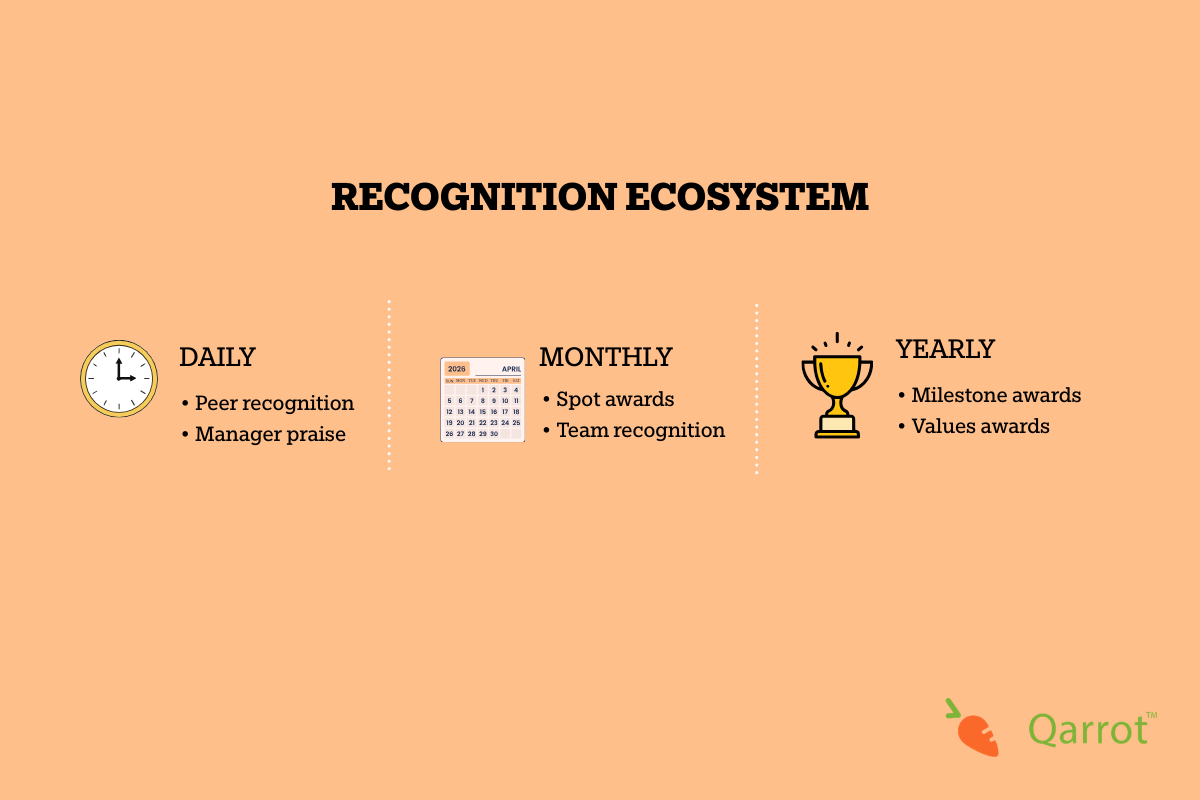
Different types of recognition serve multiple psychological needs. Employees want to feel that their loyalty is valued, but they also want their effort, creativity, and collaboration to be seen in real time. A single program can't address all of those dimensions. The result is a program that exists on paper but doesn't meaningfully influence how people feel about their work. A strong recognition culture requires a recognition ecosystem, a balanced mix of formal and informal programs that ensures employees feel seen all year round, not just on milestone dates.
How to avoid it:
- Audit your current recognition efforts: are you covering both formal milestones and everyday appreciation?
- Layer your approach. Combine structured programs (milestone awards, peer nominations) with informal, peer-to-peer recognition
- Ensure managers have easy tools to recognize their teams spontaneously, not just during formal review cycles
- Build in visibility at multiple levels: individual, team, and company-wide
- Think of recognition as an ecosystem, not a single program
6. The program loses momentum over time
Many recognition programs launch with energy and enthusiasm and then fade. Participation declines, new hires aren't introduced to the program, and leadership attention shifts elsewhere. What started as a meaningful initiative becomes another forgotten initiative.
This is where structure becomes essential. Consistency doesn't create itself. When recognition is treated as a one-time launch rather than an ongoing rhythm, it's only a matter of time before it loses visibility. Research consistently shows that while recognition programs are widespread, only about one in three employees receive recognition regularly, and nearly half want more frequent acknowledgment. The gap between intention and experience is almost always structural.
How to avoid it:
- Monitor participation rates and recognition frequency on an ongoing basis
- Share program highlights in company meetings and internal communications to keep it visible
- Reintroduce the program during onboarding so new hires are part of the culture from day one
- Periodically refresh messaging or run themed campaigns to re-engage the organization
- Integrate recognition into broader cultural moments, values communication, internal events, and team rituals
- Treat recognition as infrastructure, not a campaign. It should be embedded in how your organization operates, not layered on top of it
Recognition isn't a mystery; it's a practice
If this list felt familiar, that's a good thing. It means you're already thinking about the right problems. and that puts you ahead of most organizations that launch a recognition program and hope for the best.
None of these failure points is inevitable. They're patterns, and patterns are preventable.
The HR leaders who build recognition programs that actually stick aren't doing anything radically different. They're deliberately applying the fundamentals.
- They launch with structure, not just enthusiasm.
- They build a recognition ecosystem that covers the full range of employee needs, not just infrequent milestone moments.
- They resist the urge to chase consistency before they've built the structure that makes consistency possible.
- And they treat recognition as an ongoing practice, not a one-time initiative that gets checked off the list.
The road ahead isn't as uncertain as it might feel right now. The challenges are knowable. The solutions are practical. And you don't have to figure it all out from scratch.

How Qarrot makes remote work easy
Although the future of the workplace remains uncertain, one thing is for sure - flexible and remote work options have become the new normal. In our unforeseen pandemic reality, companies are faced with redefining the notion of “business as usual” - as business activities are now happening at dining room tables and living room couches. Although remote work is nothing new, the number of companies that perform business operations outside of the traditional office has skyrocketed.
While the shift towards remote work is a learning curve for both employers and employees alike, with the right tools in tow, work can happen just about anywhere. In addition to being productive, keeping employees motivated and engaged can also be achieved while working from home. For example, Qarrot let’s managers and colleagues recognize great work no matter where they’re working. Plus, our automation makes it easy to keep your program running even when you’re not all under the same roof. So, you’ll be well-armed to keep both your employees and business thriving in our new remote reality.
Foster a digital workplace culture
The task of creating a workplace culture is no longer constrained to office parties or casual Fridays. Instead, companies now have to craft the same experience, digitally - a culture that can exist without geographical limits. Luckily, with Qarrot, you can create a recognition rich environment that encompasses every member of your team near and far. A collective approach to rewards and recognition is a sure-fire way to keep your employees engaged while fostering a supportive work culture. During these unfamiliar times, streamlining internal communications and transparency is imperative. Qarrot also features custom badges and rewards you can create to further solidify your organization's unique core values.
Related Article: Customize your rewards and recognition process with Qarrot
Reward employees instantly
Celebrating employees when they achieve goals both big and small is a great way to boost confidence and morale. When it comes to choosing a rewards and recognition process, the most effective ones will deliver rewards promptly. If there is a lag time between recognizing and rewarding an employee, there is a loss in momentum that can sidetrack future employee motivation. When employees redeem their points earned in the Qarrot reward catalog, digital gift cards are immediately sent to their email. If they are redeeming a company-provided reward, the details are instantly sent to the appropriate contact who is responsible for reward distribution. You can also update your rewards catalog and budget at any time. Qarrot makes rewarding your employees easy and instant - no office required.
Incentivize employees with objective-driven campaigns
Qarrot makes keeping track of multiple incentive campaigns and teams a breeze - no matter how widely dispersed. You can create incentive campaigns that measure whatever objective you like and award your employees with both points and badges. Campaigns are conveniently enabled with gamification features - so employees can keep score with their colleagues through the leaderboard and see each others’ campaign awards and recognitions. Managers can easily create incentive campaigns for their own teams, and team members can upload their own results.
Related Article: 6 mistakes that kill employee motivation
Monitor campaign and employee progress
Keeping track of your employees’ progress - whether that's individual accomplishments or campaign performance - can also be done remotely with Qarrot. Admins and Team Leads in charge of automatic campaigns can view both the progress reports and results of their respective campaigns. They also have the option to export that information to Excel. You can review all points and badges earned by an employee through an employee's activity history, or by generating a points/badges earned report. No matter how many employees, teams, or incentive campaigns you may be juggling, Qarrot makes it easy to monitor everyone's progress. Plus, keeping an eye on employee activity means you can learn exactly what motivates your team members and drives performance.
Discover how your team can benefit from peer-to-peer recognition - book a demo with Qarrot today!
.png)
Customize Your Rewards and Recognition Process With Qarrot
Rewarding and recognizing employees is both a powerful tool for reinforcing desirable behaviors and for strengthening company values and culture. Celebrating those individuals who exhibit favorable attitudes boosts both workplace culture and internal communications. From increasing employee morale to organizational loyalty, every member of your team can benefit from working in a recognition-rich environment.
But how can you ensure that your recognition process packs a punch? Offer your employees a process that accurately reflects the goals, vision, and core values of your organization. Tailoring your process to fit your company's unique needs fosters engaged employees—who may otherwise be unresponsive to a more generic approach. The opportunity to create and customize your own program also gives managers the ability to learn what does—and what does not— motivate their teams.
Related Article: Signs it’s time to automate your rewards and recognition program
One size rarely fits all—and the same can be said for employee recognition platforms. Here at Qarrot, we believe in rewarding and recognizing your people on your own terms. As a manager or supervisor, you should be able to customize and update your recognition process as you see appropriate. Here are a few ways that Qarrot enables a custom, unique rewards and recognition solution tailored specifically to your team.
Custom Badges

Badges can be attached to recognitions or used as campaign awards. Admins can create badges based on any theme —so your creative license can run wild! Perhaps you want to create a badge for a monthly team challenge or quarterly sales target. Or maybe you’d like to create badges for each of your company’s core values. Once named, you can enter a brief description of the badge, explaining the award in more detail. You can then select an image from our library that best captures the essence of the badge, or you can upload your own image.
Custom Rewards
.gif)
Your rewards and recognition process should be customizable at all points - including the rewards themselves. The Qarrot catalog hosts a large selection of e-gift cards from over 20 countries, but if you’re looking to further customize your rewards you can create as many company-provided rewards as you like. These can be any product, service, or benefit that your company wishes to provide. For example, days off, lunch with the boss, and company swag are common themes. Once you have given your reward a name, for example “Morning coffee and bagels on the boss”, add an accompanying description, image, and point value. Custom rewards are a unique way you can complement and reinforce existing company culture.
Related Article: 5 ways your workplace can motivate employees
Integration with existing tools

Your recognition process should also be easily accessible for admins and employees alike—so we’ve enabled Qarrot to integrate easily with your existing HR and communications tools. If your team is already using BambooHR, you can easily sync your employee database with Qarrot. This means no manual updating, adding, or deleting employees— reducing the administrative load. You also have the option of connecting Microsoft Teams and Slack accounts to Qarrot. This enables activities such as recognitions and campaign awards to appear directly within dedicated channels on those applications—providing an easy, hands-free way that keeps everyone in the loop.
Add your organizational branding
.gif)
Part of having a rewards and recognition program that compliments your organization is that it also feels like part of your organization. Qarrot makes it easy to customize your company account with logos and color schemes of your choice. From the Settings page, SuperAdmins can easily import custom logos to their Qarrot account and select choices from our color palette. Colors and logos can be updated at any time, so your recognition program can always be tweaked to reflect your current branding.
Learn how to make any of these customizations in your own Qarrot account by visiting our support page:
- Create a custom badge
- Create a custom reward
- Connect Qarrot with HRIS
- Connect Qarrot with Microsoft Teams
- Connect Qarrot with Slack
- Add organization branding
Empower your employees’ by recognizing company core values - book a demo with Qarrot!

Benefits of Positive Reinforcement in the Workplace
As a manager or team lead, identifying opportunities for improvement, streamlining efficiency, and giving employees feedback are everyday tasks. On the opposite side of the coin, it is also your responsibility to recognize hard work, celebrate employee wins, and lead a motivated and engaged team.
Positive reinforcement is one of the easiest and most effective ways to boost employee morale and performance. Time and time again, we are told that employees flourish in a supportive environment. Recognition and care of your team will ensure they feel not only supported but thrive within your organization.
But what exactly is positive reinforcement, and why is it so crucial in the workplace? At its core, positive reinforcement involves acknowledging and rewarding desired behaviors to encourage their recurrence. It can manifest in various forms, such as bonuses, additional benefits, or the simplest yet powerful form—verbal praise.
The Impact of Positive Reinforcement
Research shows that employees are significantly more motivated and productive when they receive recognition for their efforts. In fact, a large portion of an employee's drive stems from feeling valued by their leaders. By taking the time, even just a few minutes, to acknowledge their hard work, you can inspire them to deliver their best, directly benefiting your organization.
Why It Matters
The absence of positive reinforcement can lead to dissatisfaction and high turnover rates. Studies have found that a staggering percentage of employees cite a lack of appreciation as a primary reason for leaving their jobs. Thus, fostering an environment where employees feel appreciated not only boosts morale but also enhances retention.
Ultimately, integrating positive reinforcement into your management strategy is a smart investment. It doesn't just uplift your team's spirits—it lays the foundation for a thriving, motivated workforce committed to achieving shared goals.
Related Article: 6 ways to reward your employees beyond their bank account
The Benefits of Positive Reinforcements in the Workplace
There are a variety of ways you can go about instilling discipline and a strong work ethic into your team, but very rarely will negative reinforcement foster desired outcomes or behaviours.
In addition to keeping your team motivated and encouraged, there are a wide array of benefits from adopting positive reinforcement techniques :
- Celebrating employees for their hard work will boost their self-esteem, meaning they will be more enthusiastic about their work and more likely to collaborate with others
- Employees who feel valued and appreciated exhibit greater retention and organizational loyalty
- Positive reinforcement clearly defines and communicates desired behaviors while strengthening the relationship between performance and recognition
- Employees whose performance is rewarded or recognized are more open to learning new techniques, skills, and taking on additional responsibility
- Recognizing those employees who manage their time effectively will increase productivity and efficiency
The summation of all of these benefits-improved attitudes, communications, and employee performance -- results in a company culture that is untouchable.
Organizations that fail to recognize employee accomplishments will leave team members feeling unappreciated - and unappreciated employees rarely stick around long, let alone challenge or truly apply themselves at work.
Toxic work cultures are known to plague employees with unwarranted stress and fatigue, ultimately leading to burnout and exhaustion. The verdict is in; healthy and supportive work cultures are the only way to go, and positive reinforcement can help you achieve just that!
Corporate leadership training is a great tool for ensuring that leaders are equipped with the right skills to implement positive reinforcement techniques effectively, fostering a culture of appreciation.
Research highlights a compelling link between employee appreciation and job satisfaction. A substantial portion of the workforce, nearly four out of five employees, pinpoint a deficiency in appreciation as a major factor prompting their decision to leave their jobs. This illustrates that feeling valued plays a crucial role in job contentment. When employees perceive their efforts are acknowledged, they are more likely to remain engaged and loyal to their company.
Recognizing employee contributions not only boosts morale but also enhances productivity and reduces turnover rates. It underscores the importance of fostering a workplace culture where appreciation is a priority.
Related Article: 5 ways your workplace can motivate employees
Practicing Positive Reinforcement With Recognition
As explored in our blog post about recognition and retention, one of the leading reasons people leave an organization is because they do not feel appreciated or valued.
Acknowledging an employee’s or a colleague’s work and fostering a recognition-rich environment is a simple way to practice positive reinforcement. Routinely celebrating work milestones and team goals encourages positive interactions—cultivating a culture where employees feel supported and valued. Positive reinforcement can take many forms, ensuring a motivated and engaged workforce. Here are some effective strategies:
- Monetary Compensation: Offering bonuses or raises can directly reward employees for their achievements.
- Flexible and Extended Workplace Benefits: Consider options like additional vacation days, remote work opportunities, or wellness programs.
- Verbal Positive Reinforcement: Simple, sincere words of appreciation can go a long way in making employees feel valued.
The avenues you can take when it comes to practicing positive reinforcement with your team are endless. As long as it is direct and sincere, your organization will reap the benefits of a motivated and supported team. By integrating a mix of these strategies, you can create an environment where positive reinforcement is a natural and integral part of your workplace culture.
Sincerity is the cornerstone of effective reinforcement. When praise lacks authenticity, it loses its impact and can even demotivate. Superficial compliments, handed out too freely, become meaningless noise that your team will quickly tune out.
Instead, focus on being genuine. Avoid the trap of dishing out praise just for the sake of doing so. Meaningful feedback is about timing and authenticity.
Finding the perfect balance between how and when to recognize team members will encourage them to challenge themselves while remaining confident in their abilities. Praise your employees for heading in the right direction, and your organization will follow suit.
Related article: Types of Employee Recognition (With Examples of Each)
How Specific Examples Amplify Positive Reinforcement
Using specific examples in positive reinforcement in the workplace significantly boosts its effectiveness. General comments like "good job" are indeed motivating, but they lack depth. By offering detailed praise, you convey genuine appreciation and acknowledgment of your employee's unique efforts. This specificity not only affirms their skills but also highlights particular actions or traits you'd like to see repeated.
When you pinpoint exactly what was done well, you provide clarity. For instance, instead of merely saying "great presentation," consider highlighting how their thorough research and engaging delivery captured the audience's attention. This level of detail not only reinforces the behavior but also acts as a guide for future tasks.
Moreover, specific feedback demonstrates your investment in an employee’s growth. By reflecting thoughtfully on their contributions, you create a more personal connection. This fosters an environment where employees feel valued and understood, ultimately increasing morale and productivity.
In summary, detailed positive reinforcement clarifies expectations, promotes personal growth, and strengthens workplace relationships through sincerity and precision.
Related Article: 6 Tips for Giving Better Employee Recognition at Work
How to Effectively Use Verbal Positive Reinforcement in the Workplace
Positive reinforcement in the workplace doesn’t have to be complicated, but it does require sincerity and timing. Here's how you can effectively give verbal positive feedback:
Be Sincere and Prompt
It's crucial to ensure your praise is both genuine and timely. Rather than delivering constant praise, which can seem superficial, focus on being heartfelt. Avoid meaningless compliments, as they can backfire and diminish your credibility. Instead, offer sincere praise when it truly counts.
Be Specific
Vague compliments like "good job" can fall flat. Instead, provide specific examples. Detail what the employee did well and how it contributed to the team's success. This specificity not only demonstrates genuine appreciation but also clarifies which behaviors should continue.
Separate Praise from Criticism
Deliver positive reinforcement independently, without immediately following it with criticism. Mixing the two can make your praise seem insincere. Handle positive feedback and constructive criticism separately, ensuring each one is valued and understood within its context.
By focusing on these strategies, you can create a positive work environment where employees feel appreciated and motivated. Remember, the key is in the delivery—genuine, specific, and appropriately timed praise makes all the difference.
Learn how you can reward employees on your own terms - book a demo with Qarrot!

Employee Appreciation Day Ideas That Actually Mean Something

Employee Appreciation Day lands on the first Friday of March every year. And every year, a lot of HR teams scramble to pull something together: a catered lunch, a company-wide email from the CEO, maybe a gift card if there's budget. Employees say thank you. Everyone moves on.
If that sounds familiar, you already know the problem. It's not that the effort wasn't genuine. It's that one day of appreciation, dropped into a calendar with no recognition infrastructure around it, can't do what you're hoping it will do. It can't make a disengaged employee feel valued. It can't close the gap between the team that gets celebrated constantly and the team that never hears a word. And it definitely can't make remote employees feel included when the whole celebration is happening in a lunch room they're not in.
This article is about doing the day better. But more than that, it's about using the day as a starting point: a visible, well-timed moment to begin building something your employees will actually feel year-round.
Why Employee Appreciation Day Falls Flat
Most Employee Appreciation Day efforts fail for the same reason as broader recognition initiaves fail: the day is treated as a destination rather than a moment within something larger. When recognition only shows up once a year, the gesture, however well-intentioned, ends up highlighting the absence of appreciation more than it delivers it. Employees aren't cynical by nature. But they notice patterns. And "we care about you" lands very differently when it comes once a year on a designated calendar date versus when it shows up consistently, specifically, and tied to real contributions.
The fix isn't to do more on the day. It's to use the day differently.
The one-day trap
A single appreciation event puts enormous pressure on one gesture to carry a year's worth of goodwill. When that gesture is generic, the same email, the same lunch, the same message sent to everyone, it reads as checkbox recognition. Not because leadership doesn't mean it, but because nothing about it is specific to the individual receiving it. Recognition that doesn't see the person doesn't land, regardless of how much it costs.
The other trap is recency bias. A well-executed Employee Appreciation Day can create a short-term bump in sentiment that fades quickly if nothing changes afterward. Without a structure to sustain appreciation beyond the day, you're back to square one by April.
What it looks like when the day actually works
The companies that get the most out of Employee Appreciation Day tend to treat it as a launch event rather than an annual obligation. The day becomes the moment they introduce a new recognition program, reinforce one that's already running, or make a public commitment to changing how appreciation works going forward. The day itself is still celebrated, but it means something because it's connected to something real.

How to Structure Employee Appreciation Day for a Hybrid Team
For HR leaders managing hybrid workforces, Employee Appreciation Day introduces a specific challenge: any plan that works well in the office and is merely adapted for remote employees will feel exactly like that. Remote employees are perceptive. They can tell when the in-person experience was the real event and the virtual version was an afterthought. Structuring the day well means designing for hybrid from the start, not retrofitting it.
The standard to aim for: every employee, regardless of where they're working that day, should have an equivalent experience. Not identical; equivalent. Meaning the substance, the visibility, and the feeling of being seen should be the same.
Principles for hybrid-friendly appreciation
Design for the remote experience first. If an activity only works in person, it needs a genuine virtual counterpart, not a Zoom version of something that was clearly built for the office. When in doubt, start with what works remotely and build the in-person layer on top.
Make recognition visible across both contexts. One of the things remote employees miss most is the ambient visibility of being recognized in front of peers. A shoutout in a team meeting is great. A shoutout posted in the company Teams channel, where everyone can see it and react to it, reaches the people who weren't in the room.
Give managers a structure to work within. Unstructured appreciation days produce uneven results because manager participation varies. Some managers will go above and beyond. Others will forward the company email and consider it done. If you want consistent participation, give managers a simple framework: a template, a prompt, a channel to post in, and a clear ask.
What to avoid
Avoid appreciation activities that are implicitly location-dependent: office lunches with a gift card "for remote employees" as a consolation prize, team photos that only capture who's in the office, or any experience where the remote version requires significantly more effort from the employee to participate. These gestures, even when well-meant, signal a hierarchy of belonging that undermines the whole point.
Employee Appreciation Day Ideas That Actually Mean Something
The ideas below are organized by type. None of them require a big budget. All of them are designed to work for hybrid teams without modification.
Recognition that's specific and visible
The most meaningful appreciation is specific. It names what someone did, why it mattered, and who's saying it. On Employee Appreciation Day, that specificity is the differentiator between a gesture that lands and one that gets skimmed.
Peer recognition prompts. Give employees a structured prompt to recognize a colleague: something like "Name someone who made your work easier this quarter and tell them why." Collect the responses and share them publicly in your Teams channel or company intranet. The act of writing it is meaningful for the person giving recognition. Seeing it published is meaningful for the person receiving it.
Manager spotlights. Ask every manager to write a specific, individual recognition message for each person on their team. Not a group message; individual. Post them publicly if your culture supports it, or deliver them privately with a small reward attached. The specificity is what makes this feel different from a generic appreciation email.
Company-wide acknowledgment. A personalized message from senior leadership that names specific teams, specific contributions, and specific impact, not a form letter, signals that the people at the top are actually paying attention.
Rewards that feel personal
Choice-based gift cards. A gift card to a retailer someone never shops at is noise. A gift card that lets the employee choose where to spend it is a different thing entirely. Platforms like Qarrot make it easy to send rewards that are genuinely personal: employees redeem toward what they actually want, which is the point.
Recognition tied to a reward. The most effective appreciation combines the acknowledgment with something tangible. Telling someone their work mattered and pairing it with a reward, even a small one, reinforces that the recognition is real, not just words.
Experiences that bring the team together
Virtual team activity. A structured team experience, trivia, a cooking class, a creative challenge, works well when it's optional, time-boxed, and genuinely fun rather than obligatory. The key word is structured: open-ended "virtual hangouts" tend to have low participation because there's no clear reason to show up.
Lunch stipend. Give every employee a lunch budget for the day, remote and in-office, and encourage teams to eat together over video. Simple, low-lift, and it creates a moment without requiring anyone to be in the same place.
Team retrospective with a recognition layer. A short facilitated session where the team reflects on wins from the past quarter, with a dedicated segment for peer recognition, blends appreciation with something that feels purposeful rather than performative.
Low-budget, high-meaning gestures
Handwritten or personalized notes. Time-consuming, but disproportionately impactful. A short, specific note from a manager, even a digital one, that names a real contribution is something employees remember. The specificity is the cost, not the postage.
Extra flexibility. Giving employees an early finish, a no-meeting afternoon, or flexibility to structure their day as they choose signals that you trust them. For many employees, time is the most valued currency.
Public wall of recognition. A dedicated space, a Teams channel, a shared document, a Slack thread, where anyone can post recognition for anyone else. Seed it with a few manager contributions at the start of the day and it tends to build momentum on its own.
.png)
Using Employee Appreciation Day to Launch a Recognition Program
Employee Appreciation Day is one of the best natural entry points for introducing a formal recognition program. Leadership attention is already on appreciation. Employees are primed to notice how the day is handled. And the goodwill from a well-executed day can carry real momentum into whatever comes next, if there's a "next" to carry it into.
The day becomes a launching pad when you use it to make a visible commitment: not just "we appreciate you today" but "we're building something that makes this real year-round."
Why this day is a good time to introduce a formal program
The timing is useful precisely because it's expected. Every employee knows Employee Appreciation Day is coming. That means the bar for surprise is low and the bar for meaning is high. If you use the day to announce a new recognition program, with real structure, real rewards, and a clear explanation of how it works, you're converting a calendar obligation into a credibility moment. You're showing employees that appreciation isn't just something that happens once a year; it's something the company is investing in.
It also gives you a concrete milestone to point to in leadership conversations. "We used Employee Appreciation Day to launch our recognition program" is a cleaner story than "we've been working on it."
What a simple recognition program looks like after the day is over
It doesn't need to be complex. A functional recognition program at a 75-200 person company typically includes a few core components: a way for peers to recognize each other, a way for managers to deliver timely spot recognition, a milestone program for service anniversaries, and a rewards mechanism that makes recognition feel tangible. The infrastructure behind all of it, the platform, the workflows, the nudges that keep managers participating, is what turns good intentions into consistent behavior.
That structure is what Qarrot is built to provide. Not a single-use appreciation event, but the ecosystem that makes recognition work the other 364 days.
One Day That is Part of Something Larger
Employee Appreciation Day matters. But it only matters if it's part of something larger. A single day of recognition, however well-executed, can't substitute for a culture where employees feel seen consistently, specifically, and in proportion to their actual contributions.
The gap most HR leaders run into isn't motivation. They want to build that culture. The gap is structure. Without a recognition program that gives managers a clear framework, connects appreciation to rewards, and works equally well for remote and in-office employees, consistency doesn't happen, regardless of how good the intentions are.
Qarrot is built for exactly that: the infrastructure behind a recognition culture that runs all year, not just in March. If you're using Employee Appreciation Day as the moment to build something more durable, we'd love to show you how it works.

What's this?! A new look and more features?
The past few months have been busy at Qarrot! We've been lucky to sign-up new customers and to get great feedback from existing ones. And we love feedback! When customers request new features or functionality, we take note and put them onto our 'ideas board' for review. If we think an idea makes sense and would improve the experience and usefulness of Qarrot for most customers, chances are we'll add it!
With that in mind, today we're releasing both a new look for Qarrot as well as several new features. Here's the skinny on what you can expect the next time you log in:
A simple, more colourful look
We love the way Qarrot looks (who doesn't, right?!) but wanted to make some features more prominent and add a touch more colour. You'll notice the biggest changes on the Home page:
- The social feed is larger and easier to read
- Colourful section titles improve page navigation
- Our new Get involved section in the top right displays actions you can perform depending on your role and settings. For example, you can now update your campaigns from this section
- Your Profile is now always visible in the top right

Whenever you're recognized or send a recognition, you'll see these new icons.
New features, because you asked for them
Birthday Awards
We received so many requests for automated birthday awards, we just couldn't say no. Now, the Super Admin can create a birthday award in Manage > Milestone Awards to automatically celebrate all participating employees' birthdays (as long as employee profiles include their birth date - don't worry, we don't publish how old you are!)
International Rewards
If your organization has locations outside of the USA or Canada, you will now see the option to select 'Country of redemption' when you redeem for rewards. To start out, we've added rewards for 22 countries. If your company is based in the USA, but some employees are in the UK, they can simply select the United Kingdom right on their My Rewards page to get a list of rewards in Great British Pounds, for example.
Improved features
My Rewards
We made this section look better ... WAY BETTER. We hope you like it!
My Campaigns
Ditto. We've improved the look of this section and made it easier to use.
Employee profile
You can now see all recognitions you've received and given right from your profile. Admins can see this information too when they go to Manage/Employees and click on your profile.
Side menu
To make navigation easier for Admins, we've created two sub-sections in the left-hand menu: Manage and Organization. You can expand these sub-sections where you'll find all of the previous options available for Manage, but we've moved Dashboard and Settings under Organization (it's just better that way).
We hope you enjoy these improvements and new features.
Sincerely,
The Qarrot Team
