
Blog

.jpeg)
Types of Employee Recognition (With Examples of Each)

If you've ever tried to build an employee recognition program from scratch, you know the first question that comes up is also one of the hardest: where do we even start? There are so many ways to recognize employees, from spontaneous shoutouts to structured award ceremonies, and it can be genuinely overwhelming to know what to prioritize.
Here's what we've learned after working with organizations of all sizes: the reason most recognition efforts fall flat isn't that companies choose the wrong type of recognition. It's that they rely on only one type and expect it to fulfill all their employee’s psychological needs.
In this guide, we'll walk through the two foundational categories of employee recognition — formal and informal — and break down the specific program types that fall under each. Understanding this framework will help you build a recognition strategy that's comprehensive, sustainable, and actually meaningful to your people.
.png)
The Two Core Pillars of Employee Recognition
Before diving into specific program types, it helps to understand that virtually every form of employee recognition falls into one of two categories: formal or informal. This isn't just an academic distinction; it has real implications for how you budget, plan, and sustain a culture of appreciation over time.
Think of these two categories as working in tandem. Formal recognition provides the structural foundation. These are the recognition events employees look forward to and count on. On the other hand, informal recognition fills in the daily gaps, providing the steady stream of appreciation that keeps motivation alive between those bigger moments.
Neither works particularly well without the other. A company that only does formal recognition leaves employees feeling unseen on a day-to-day basis. A company that only does informal recognition may feel warm and collegial, but lacks the structure needed to drive meaningful engagement or retention.
Formal Recognition: The Foundation of Appreciation
Formal recognition programs are structured, planned, and usually tied to a budget. They're the type of recognition that HR teams typically design and roll out company-wide. They carry extra weight precisely because of their official, ceremonial nature.
These programs tend to be top-down: leaders and executives recognize employees on behalf of the organization. They're also predictable by design; employees know these moments are coming, which gives them something concrete to work toward.
Let's look at the main types of formal recognition and what each one is designed to accomplish.
1. Milestone and Years-of-Service recognition
This is one of the oldest and most universally practiced forms of formal recognition: celebrating employees at key tenure milestones — one year, five years, ten years, and so on. Work anniversary programs signal to employees that their loyalty matters and that the organization notices longevity.
Done well, milestone recognition goes beyond handing someone a plaque. The most effective programs personalize the moment. They include things like a handwritten note from a senior leader, a team celebration, or a reward that reflects the employee's specific contributions over time. The goal is to make the employee feel genuinely seen, not just counted.
Common examples include:
- Work anniversary awards (1, 5, 10, 15, 20+ years)
- Retirement recognition events
- Project completion milestones
- Promotion ceremonies
2. Performance-based awards
Performance-based recognition ties appreciation directly to results — hitting targets, exceeding KPIs, delivering exceptional work. This category includes non-monetary awards like Employee of the Quarter or annual excellence awards.
Monetary recognition is a powerful motivator, but research suggests it is most effective when combined with genuine personal acknowledgment. According to Gallup, employees who receive a combination of recognition and tangible rewards report higher levels of engagement than those who receive either alone. The message matters as much as the money.
Points-based rewards systems have become increasingly popular as a flexible alternative to one-size-fits-all gifts, allowing employees to redeem recognition for experiences, gift cards, or items that are personally meaningful to them.
Common examples include:
- Annual performance awards
- Employee of the Month/Quarter awards
- Points-based reward redemption systems
3. Structured nomination programs
Nomination programs invite managers and employees to actively identify and submit colleagues who have demonstrated exceptional work or embodied company values. These programs create a structured channel for recognition that might otherwise go unnoticed, particularly for employees who do important work behind the scenes.
One of the key advantages of nomination programs is that they distribute the responsibility for distributing recognition beyond senior leadership. When peers can nominate each other, it democratizes appreciation and surfaces contributions that managers might not have direct visibility into.
Common examples include:
- Values-based recognition awards
- Peer-nominated excellence programs
- Leadership recognition nominations
- Innovation or impact awards
The pros & cons of formal recognition
Benefits:
- Consistent and predictable: employees know what to expect and have a clear goal to work toward.
- High-impact: the formal, ceremonial nature of these moments gives them real weight.
- Inclusive: Most formal programs are open to everyone, which promotes fairness.
- Motivates longer-term performance: when employees know a big milestone is coming, it sustains motivation over time.
Drawbacks:
- Infrequent: employees may go weeks or months between formal recognition events.
- Resource-intensive: formal programs require planning, budget approval, and logistics.
- Risk of feeling generic: if everyone receives the same gift or award, it can feel impersonal.
.jpeg)
Informal Recognition: The Day-to-Day Glue
If formal recognition is the foundation, informal recognition is everything built on top of it. It's the spontaneous, unscheduled moments of appreciation that keep employees feeling valued between the big ceremonies. Informal recognition is flexible, low-cost, and has an outsized impact on morale and engagement.
Research by Dr. Paul White, a psychologist who has studied workplace appreciation for over a decade and surveyed more than 400,000 employees, consistently finds that "words of affirmation" are the most desired form of recognition at work. More than rewards. More than gifts. People fundamentally want to hear that their work is seen and valued.
Informal recognition doesn't require a budget. It requires intention. Let's look at the specific types that fall within this category.
4. Manager-to-employee verbal recognition
The most fundamental form of informal recognition is a manager telling an employee that their work made a difference. This sounds simple, but it's consistently underused. Many managers default to constructive feedback in one-on-ones and forget to balance it with genuine acknowledgment of what's going well.
The keyword here is specific. Vague praise like "great job this week" lands very differently than "the way you handled that client situation on Tuesday was exactly the kind of problem-solving we need more of." Specificity tells the employee not just that they did something right, but what they did right and why it mattered — which reinforces the behavior going forward.
Common examples include:
- Specific praise in one-on-one meetings
- Shoutouts during team meetings
- Thank-you notes or messages (written or digital)
- Personalized recognition in performance check-ins
5. Peer-to-Peer Recognition
Peer recognition is one of the most powerful and most underutilized tools in a recognition strategy. When colleagues acknowledge each other's contributions, it creates a fundamentally different dynamic than top-down recognition.
Peers often notice contributions that managers simply don't have visibility into: the team member who stayed late to help someone debug a problem, the person who quietly improved a process, the colleague who made a new hire feel welcome. Peer recognition surfaces these invisible contributions and makes them visible to the broader team.
A 2021 SHRM report found that peer recognition programs can increase employee engagement by up to 35%. And importantly, when peer recognition becomes a habit, it helps build a culture where appreciation is the norm rather than the exception.
Common examples include:
- Recognition boards (physical or digital)
- Peer-nominated shoutouts in team channels
- Recognition platforms with peer-to-peer features
- "Kudos" or appreciation messages shared with the team
6. Social Recognition
Social recognition is the practice of making appreciation visible by sharing it publicly so the broader team or organization can see and celebrate it together. It's distinct from private praise because the audience matters: when recognition happens in a public forum, it validates the employee in front of their peers and amplifies the impact of the acknowledgment.
Social recognition can happen in low-tech ways, such as a shoutout during an all-hands meeting, a post in an internal communication channel, or through dedicated recognition platforms that provide employees with a shared feed of appreciation moments. The latter has become increasingly common as distributed and remote teams look for ways to maintain a sense of connection and shared culture.
Social recognition also has a secondary benefit that's easy to overlook: it models recognition-giving behavior. When leaders publicly recognize employees, it signals to the rest of the organization that this is what we do here, and it encourages others to do the same.
Common examples include:
- All-hands meeting shoutouts
- Internal Slack or Teams recognition posts
- Company newsletter spotlights
- Recognition feeds on employee engagement platforms
7. Team Recognition
Most recognition focuses on the individual, and for good reason, people want to feel personally valued. But some of the most meaningful work happens collaboratively, and recognizing teams as a unit is an important part of a well-rounded recognition strategy.
Team recognition celebrates collective wins, such as a product launch, a challenging quarter delivered, or a cross-functional project completed under pressure. It reinforces the idea that success is shared, builds cohesion, and acknowledges the reality that many contributions are inherently collaborative.
The informal version of team recognition can be as simple as a manager organizing a team lunch after a big delivery or sending a heartfelt thank-you to the whole group. The key is that the recognition feels genuine and proportional to the effort the team put in.
Common examples include:
- Team lunches or dinners after major milestones
- Group shoutouts in all-hands meetings
- Team awards (e.g., "Project of the Quarter")
- Organized team events or experiences as a thank-you
The pros & cons of informal recognition
Benefits:
- Frequent and flexible: recognition can happen any time, not just at scheduled events.
- Low or zero cost: verbal recognition, a thank-you note, or a team shoutout requires no budget.
- Feels personal: Appreciation from a peer or direct manager tends to feel more genuine than recognition from an organization-level leader.
- Specific: Informal recognition can be tied directly to a particular action or contribution, which reinforces the right behaviors.
Drawbacks:
- Inconsistent: without structure or habits in place, informal recognition can be sporadic or manager-dependent.
- Lower perceived impact: casual recognition can feel less weighty than a formal award.
- Risk of favoritism: managers may inadvertently repeat recognition of the same people, creating the perception of bias.

How Formal and Informal Recognition Work Together
Here's a useful way to think about it: formal recognition sets the ceiling; it represents the biggest, most meaningful acknowledgments your organization can offer. Informal recognition fills in everything below that ceiling, day after day.
Imagine if the only time your closest friends acknowledged you was on your birthday. You'd be glad they remembered, but you'd probably feel pretty invisible the other 364 days of the year. The same dynamic plays out at work. Annual performance awards and service milestones matter, but they can't carry the weight of recognition on their own.
Research consistently supports this. A study published in Harvard Business Review found that employees who receive regular recognition are more productive, more engaged, and significantly less likely to leave their organization.
The most effective recognition strategies deliberately use both: a formal structure that employees can count on, layered with an informal culture of appreciation that runs continuously in the background. The specific program types are the tools. Formal and informal are the framework that tells you when and how to use them.
Getting Started: Practical Steps for HR Professionals
Understanding the types of employee recognition is one thing, but translating that into a real program is another. Here are a few practical steps to help you move from framework to action.
Ask employees how they want to be recognized
Before building anything, survey your workforce. Ask: Do you currently feel appreciated at work? What kind of recognition matters most to you? When have you felt most valued in your career? The answers will shape your strategy far better than any benchmark alone. Preferences can very. For example, some employees love public recognition, while others find it uncomfortable. Some value monetary rewards; others place more weight on flexible time or personal development opportunities.
Build a business case for investment
If you need executive buy-in, lead with business impact. Turnover is expensive; industry estimates typically put the cost of replacing an employee at 50–200% of their annual salary, depending on their role. Low engagement costs organizations in productivity, absenteeism, and quality of work. Recognition is one of the most cost-effective levers HR has to move these numbers. Make that case concretely, with your own organization's data if you have it.
Embed recognition into your culture, not just your calendar
Recognition programs fail when they're treated as events rather than habits. The organizations that do this best make appreciation a daily practice. Managers recognize contributions in real time, peers have easy ways to acknowledge each other, and formal programs reinforce a culture that's already warm rather than trying to create warmth from scratch. Consider adding recognition as an explicit company value, and make sure senior leaders model it visibly and consistently.
Get leadership visibly involved
Programs gain credibility when employees see senior leaders actively participating, not just endorsing in an email, but actually giving recognition. When a VP takes two minutes to acknowledge someone's contribution in a team meeting, it signals to the entire organization that this is genuinely valued here. That signal is hard to manufacture through program design alone; it has to come from the top.

Final Thoughts
Employee recognition isn't a single program, it's a broader system. And like any system, it works best when the parts are designed to complement each other.
Formal recognition gives employees something to aspire to and celebrates their biggest contributions with the weight they deserve. Informal recognition keeps the energy going in between, building a culture where appreciation isn't an event but a way of working.
The specific programs you implement will depend on your organization's size, culture, and budget. But the framework remains constant: lead with both formal and informal recognition, use the right program types for each, and ensure recognition is specific, timely, and genuine. That combination is what moves the needle, not just on engagement scores, but on how people feel when they show up to work every day.
.jpeg)
Building an Employee Engagement Plan – Mistakes, Steps, & Tips
The term "employee engagement" is often used in the HR sphere and can start to sound like just another corporate buzzword. Yet, in the day-to-day reality of a workplace, how engaged employees are impacts so many important workplace metrics like morale, productivity, and overall organizational performance.
The case for employee engagement is strong – it’s not just a fluffy corporate concept but a key driver of company performance. Research by Gartner reveals that higher employee engagement is associated with tangible benefits for organizations, such as increased revenue growth, net profit margin, customer satisfaction, and earnings per share.
Despite the widely recognized importance of employee engagement, recent statistics paint a bleak picture. Gallup's 2026 yearly State of The Workplace report reveals a significant decline in employee engagement to an all-time low of 20%.
So, how can businesses achieve such a nebulous goal? It would be similar to trying to reach a personal goal, like being happier and leading a more fulfilling life. Of course, these goals can't be reached overnight by implementing one or two changes in your life. It is a multi-step process that requires strategic thinking.
Employee engagement plan: A holistic approach
To that end, companies need to think long-term to combat employee disengagement. Building an employee engagement plan is a great starting point. This is an actual action plan that should be well thought out, implemented, and, of course, documented.
This article is designed specifically for HR professionals ready to take a more strategic and comprehensive approach to employee engagement. Whether you're looking to revamp your existing initiatives or build a new engagement plan from the ground up, this guide offers valuable insights and practical steps to help you achieve your goals.
We will explore common mistakes when creating an employee engagement plan and outline key steps to creating and implementing an effective strategy. Additionally, you'll find tips to navigate common pitfalls and ensure your engagement efforts yield long-term benefits. By the end of this article, you will understand how to cultivate a thriving workplace culture where employees feel valued, motivated, and committed to your organization's vision.

5 Mistakes When Creating an Employee Engagement Plan
1. Looking for silver-bullet solutions
"Employee engagement" is a big, cloudy term. It's a concept that, when understood, can bring significant benefits to a company. Yet, ask different people what it means, and you will receive various answers. This lack of a unified understanding can lead to skepticism about the ROI of employee engagement. If you can't prove with some level of certainty what kind of benefit the company will derive from it, your initiatives may not be approved.
As a result, most companies don't even have an employee engagement plan in place. Rather, they favor low-cost or single-stroke solutions, and employee engagement isn't looked at holistically. For example, businesses may lean towards surface-level initiatives like mindfulness training, snacks in the breakroom, and social events. Of course, these programs and activities can improve work culture and boost temporary morale, but they aren't strategies.
This idea is explained in the Psychology Today article When Workplace Mindfulness Training Is Worse Than Nothing. The author explores how using "token gestures" like mindfulness training to help employees cope with stress and burnout can backfire. When serious, underlying issues are overlooked, these gestures appear hollow to employees. In turn, they can actually make employees feel worse – even more angry and cynical – than if a business had done nothing at all!
2. Assuming why employees aren't happy
If you Google "employee engagement idea," you'll surely fall on several list articles offering ideas on how to engage employees. You might find solutions like "snacks in the breakroom" or "organizing a fun social event." While these ideas might help temporarily boost employee morale and create a fun working atmosphere, they are certainly not employee engagement strategies.
Strategic employee engagement involves identifying and addressing your employees' deeper pain points and challenges. This approach is not about guesswork or assumptions but about developing targeted solutions. A key step in this process is to directly survey or converse with your employees about their experiences within your organization.
Gathering objective, data-driven insights and feedback can help you understand where your employee experience falls short. For example, are your employees satisfied with their compensation, leadership, day-to-day duties, and the company's overall culture? You only know once you ask. If you operate on assumptions, you risk developing initiatives and solutions that do not address the real problems your employees are facing.
3. Copy-pasting other businesses
Similarly, you should ask yourself: Are you developing employee engagement initiatives based on your employees' actual pain points, or are you just copying/pasting trendy HR initiatives other businesses use?
It might be tempting to copy popular HR initiatives that seem to be working well for other businesses. The problem is that their workforce may differ completely from yours — the company's demographic profile may be unique in many ways. As a result, they may be facing a different set of challenges.
Being more strategic starts with uncovering exactly what your employees are struggling with. It's about developing solutions that directly address those issues and needs. This may take more steps and time than just coming up with an idea and rolling it out. However, the benefit is that the initiative will be more likely to be successful long-term because it addresses a real and current problem in your company, not just assuming what your employees will want.
4. Only looking at the short-term gains
Employee engagement is a long game. In short, it's a marathon, not a sprint. Similar to achieving any long-term goals in our lives, like being happy in our careers or bettering our physical health, these goals cannot happen overnight. They are the fruit of consistent, small steps that compound over months, if not years.
However, businesses often lean towards short-term initiatives that promise quick rewards. This preference for 'low-hanging fruit' can divert attention from developing robust employee engagement plans, which are more likely to deliver sustainable business results.
When businesses are biased towards short-term gain, they often resort to a reactive approach to employee engagement. In other words, engagement initiatives are only considered and developed once a glaring problem, like high turnover or low morale, crops up.
When these engagement issues reach a boiling point, they are likely complex and caused by an interplay of factors that not one employee engagement initiative, like "snacks in the breakroom," will resolve. That's why developing a robust employee engagement action plan is a critical step for companies that want to take a proactive approach to employee engagement and address some common issues before they spiral into more complicated problems for your business.
5. Failing to track the impact of initiatives
Employee engagement is like personal happiness, a nebulous concept that can ebb and flow. While it can be objectively measured with surveys, what can be more difficult to achieve is proving how employee engagement impacts businesses financially through metrics like productivity.
In other words, many businesses roll out engagement initiatives only to fail to track their objective impact on their company via metrics like employee happiness, engagement, turnover, etc.
As a result, ROI-focused executives may be reluctant to invest in employee engagement initiatives further if HR teams can’t articulate a clear or expected ROI for the business. In turn, it can be difficult for HR teams to get even a small slice of the budget.
Learning to track and measure the impact of HR initiatives is critical to approach these conversations with decision-makers more logically. A concrete action plan can help you show executives clearly.
- What workplace metrics you’re looking to impact (i.e., employee turnover, eNPS, etc.)
- Which initiatives will help achieve this goal
- Milestones you’re aiming to reach
When presented with a clear plan that outlines concrete, measurable goals, ROI-focused executives can feel reassured and confident in the capacity of these initiatives to produce tangible results. Once the impact of these initiatives is proven, it can unlock the necessary resources and support for more impactful engagement initiatives in the future.
Related: Uncover the potential ROI of your recognition program with our free Business Case Template
.jpeg)
What an Employee Engagement Plan Should Actually Address
Before you can build a plan, you need to know what you're planning around. Most employee engagement plans stall not because HR leaders aren't motivated, but because they start with solutions before they've clearly defined the problem areas.
The research is consistent here: engagement isn't one thing. It's the cumulative result of multiple underlying conditions, each of which shapes how employees feel about their work on an ordinary day. A recognition program can't compensate for broken manager relationships. A flexibility policy won't undo the damage of a culture where employees feel they can't speak up. Each driver matters, and they interact with each other in ways that make piecemeal fixes frustratingly ineffective.
There are eight key drivers of employee engagement that your plan should account for:
Meaningful work
Employees need to feel that their work matters: that it connects to something larger than their task list, that it challenges them, and that it aligns with their professional interests and goals. When that sense of purpose is absent, even well-compensated employees disengage.
Recognition and appreciation
Being seen for a specific contribution is one of the most powerful engagement levers available. Generic or inconsistent recognition doesn't move the needle. What does is timely, specific acknowledgment that names the actual work someone did and makes them feel like their effort was noticed and valued.
Growth and development
Employees who feel stuck disengage. But growth doesn't have to mean a promotion. Stretch assignments, mentorship, cross-functional projects, and individual development plans are all ways to signal that the organization is invested in an employee's trajectory — not just their output.
Manager relationships
The manager is often the single biggest variable in whether an employee feels engaged or not. Trust, communication, and consistency at the team level can't be substituted by company-wide programs. This is the driver that most directly affects day-to-day engagement, and it's also the one most HR leaders find hardest to influence at scale.
Belonging and connection
Especially relevant in hybrid teams, belonging is about whether employees feel safe, included, and genuinely connected to the people they work with. This isn't the same as having a fun culture, it's about psychological safety and a sense of shared identity that makes showing up feel worthwhile.
Flexibility and autonomy
Employees want input into how and when their work gets done. Autonomy is a core driver of intrinsic motivation; when it's absent, even employees who enjoy their work start to feel constrained. Flexibility in working arrangements is now a baseline expectation for much of the workforce, not a perk.
Transparency and trust
This driver has moved dramatically up the engagement rankings in recent years. Employees who don't trust their organization to navigate uncertainty with them become guarded and disengaged even when other drivers are strong. Clear, honest communication from leadership and managers is one of the highest-leverage engagement investments an organization can make.
Compensation and stability
Pay isn't the ceiling of engagement, but it is the floor. When employees feel fairly compensated, it signals that their contributions are valued. When they feel underpaid or financially anxious, that concern filters how they experience everything else.
Your employee engagement plan doesn't need to address all eight drivers at once. But it does need to account for all of them when you're diagnosing where to start. Before building your initiative list, take an honest look at where the biggest gaps are in your organization; not where programs look most polished, but where employees are most likely to feel undervalued, unsupported, or in the dark.

5 Steps to Create an Effective Employee Engagement Plan
Step 1: Identify drivers that need work
Every effective employee engagement plan starts with diagnosis. Before you build anything, you need a clear picture of where your organization is falling short across the key drivers of engagement — the underlying conditions that determine how your employees actually feel about coming to work.
For example, here are some common high-level drivers of engagement to consider:
- Benefits and compensation
- Leadership and management
- Rewards and recognition
- Well-being and mental health
- Safety and security
- Career growth and development
If you're coming in as a new HR leader, you may already have a gut sense of where the gaps are based on early conversations, exit interview patterns, or what's visibly missing from how teams operate. That intuition is a useful starting point. But it's not a substitute for a more structured look at what's actually driving engagement across your organization.
Step 2: Survey employees (back it up with data)
The next step is to back up your intuition or theories with concrete data. The best way to achieve this goal is to speak with or survey employees to assess objectively how your business is performing in each area. Depending on your budget, there are various approaches to collecting employee data. It's important to remember that a large budget is unnecessary, particularly for small businesses. In fact, this goal can be easily achieved with free online survey tools, making it a feasible and accessible process for businesses of all sizes.
Step 3: Develop your key initiatives
Now it's time to zoom in. Once you've conducted your employee surveys, you should better understand where your business is falling short and, in turn, where your HR priorities should be. For example, you may find out your company is falling short in the area of "rewards and recognition."
At this point, the goal is to develop specific and concrete initiatives relating to each high-level area of employee engagement and document those as well!
For instance, prioritizing rewards and recognition is a powerful tactic to enhance employee engagement. But this tactic can be expressed in many ways. It's up to you to "bring it to life" with specific initiatives. For example you could implement a peer-to-peer recognition program, a work anniversary program, or offer a budget for lunch and celebration for employee birthdays.
Initiatives are not just specific; they are strategic. They should mirror and strengthen your organization's core values and culture. Most importantly, they directly address the engagement issue within your business. To build a robust, long-term engagement plan, start by selecting one or two drivers of employee engagement (for example, Career Growth and Leadership) and asking yourself: How are we doing in this area? Or, what could we do better? This strategic approach will instill confidence in the effectiveness of your plan.
By the end of this process, you should have a list of actionable initiatives to help kick-start your engagement plan.
Step 4: Establish key metrics to track
Your employee engagement plan must include benchmarks (or success metrics) to help you track the progress of your initiatives.
This is a critical step for both your team and for receiving buy-in from executives. If you can show that your initiatives are impacting the business, your decision-makers will be more likely to free up time and resources for your team to continue making efforts in these areas.
Examples of benchmarks can include:
- Increasing eNPS scores by X% in the next six months
- Increasing retention by X% in the next year
- Decreasing absenteeism by X% in the next year
Step 5: Adjust the plan accordingly
An employee engagement plan should never be set in stone. A business is always in flux; employees come and go, and external influences such as the job market and the economy's health will affect the business and its employees.
As such, whenever you create an employee engagement action plan, remember that this plan can constantly shift and change as your business's priorities shift. For example, you may consider "career growth and development" a top area of consideration. However, after a few months, the priorities might shift to other areas, such as "rewards and recognition" or "wellness and mental health."
We strongly advise revisiting your plan every 3-6 months to ensure its relevance. This proactive approach reassures you of the plan's effectiveness and instills confidence in your employees that their needs and wants are being considered and addressed.
Final Thoughts
Employee engagement is more than planning one-off social events or providing better snacks in the breakroom. Of course, these small perks and events do help to temporarily bolster company culture and morale; however, they are not strategies and fail to address employee engagement issues holistically.
To strategically address employee engagement, you must peel the layers back and look deeper. The goal of a robust employee engagement plan is to validate with objective data where and how your employee experience is falling short in some key areas, like benefits, compensation, recognition, and leadership, and make changes accordingly.
This involves continuous feedback loops, transparent communication, and a genuine commitment to improving based on employee input. Only by embedding these principles into the fabric of your organizational culture can you foster a truly engaged and motivated workforce, driving long-term success and fulfillment for both employees and the company as a whole.
.jpeg)
12 Office Event Ideas To Put in Your Calendar (for Every Sized Business)
Planning an office event that people actually want to attend is harder than it sounds. Pick something too generic, and you get a quarter of the team showing up out of obligation. Plan something too elaborate, and you've burned a budget and a planning afternoon on an event that still only pulls a third of your headcount.
If low turnout has burned you before, you're not alone. Most engagement initiatives that flop don't fail because the idea was bad. They fail because the format didn't fit the team, the timing was wrong, or there wasn't enough variety to keep people coming back. The fix isn't one perfect event. It's a mix of options you can pull from depending on team size, budget, and how your people actually like to spend their time.
Below are more than 30 office event ideas, organized by type, so you can find the right fit whether you're working with zero budget, a hybrid team spread across time zones, or a few hundred dollars to spend on a Friday afternoon.
.jpeg)
30+ Office Event Ideas To Put in Your Calendar (for Every Sized Business)
No-Budget and Low-Lift Ideas
These work for any-size company and require almost no planning runway, making them a good place to start if you're testing what resonates before investing more.
Innovation Labs
Ideal for: Small to medium-sized businesses
Budget: None
An Innovation Lab carves out dedicated time for employees across departments to brainstorm ideas without the usual workday constraints. A moderator hosts each session, sometimes around a set topic or area of improvement, and sessions can run monthly or just a few times a year. There's no cost to run one, and it gives people outside of typical "ideas" roles a chance to contribute.
Job Shadow Day
Ideal for: Any-sized business
Budget: None
Most employees are curious about what other teams actually do day-to-day, and shadowing builds appreciation for the work they don't normally see. It also gives people quietly considering a move into a new role a low-stakes way to test the waters. Set aside an afternoon where any employee can shadow a colleague in a different role or department.
Skill-Swap Sessions
Ideal for: Any-sized business
Budget: None
Every team has people with skills unrelated to their job titles: a great home cook, a former graphic designer, someone who plays in a band. A skill-swap session is a short, informal workshop where an employee teaches a small group something they're good at. It costs nothing, surfaces hidden talent, and gives people outside their usual department a reason to talk to each other.
Ask Me Anything With Leadership
Ideal for: Any-sized business
Budget: None
An open Q&A with a founder or senior leader, run informally over coffee or on a video call, gives employees direct access they don't usually get. Keep it unscripted and low-pressure. The value here is transparency, not polish.

Skill-Building and Knowledge-Sharing Ideas
These double as professional development, which makes them easier to justify internally and genuinely useful to attendees, not just a morale add-on.
Lunch and Learn
Ideal for: Any-sized business
Budget: None
Lunch and Learns are informal training sessions held during lunchtime, usually hosted by employees themselves, covering whatever topic they know well. They work especially well for remote teams, since they give people a reason to get on a call together that isn't a status update.
Trivia Tournament
Ideal for: Any-sized business
Budget: Small budget for prizes
A themed trivia tournament, whether it's general knowledge, pop culture, or company history, is an easy way to get competitive energy into a low-stakes event. Run it in person with teams at tables, or host it over video call using a free trivia platform for remote and hybrid teams.
Hackathon or Idea Sprint
Ideal for: Small to medium-sized businesses
Budget: Modest
Give small cross-functional teams a day (or half-day) to tackle a real problem or build something new, then have each group present at the end. It works well for SaaS and tech companies especially, since it gives engineering, product, and other departments a structured reason to collaborate outside their usual lanes.
Book Club
Ideal for: Any-sized business
Budget: None
A recurring book club, meeting monthly or quarterly, gives employees an ongoing reason to connect that doesn't depend on a single big event landing well. Keep the book list employee-driven and the discussion casual. This is an easy one to sustain for hybrid teams, since the discussion translates naturally to a video call.

Wellness-Focused Ideas
Wellness events tend to have staying power because they tie into something employees already care about, rather than asking them to show up for something purely social.
Fitness Challenges
Ideal for: Small businesses
Budget: Small budget for prizes
A themed fitness challenge, such as a monthly step goal or a running challenge, provides a low-stakes structure for employees who are already active or want to be. Set a reasonable goal, ask employees to track their progress, and offer a small prize for those who hit it.
For remote or hybrid teams, a dedicated chat channel (or your employee engagement platform's newsfeed, if you have one) keeps everyone updated without requiring anyone to be in the same room. You can even use a tool like Qarrot and incentive campaigns to set a challenge and reward employees for completing the challenge.
Walking Meeting Challenge
Ideal for: Any-sized business
Budget: None
Encourage one-on-ones or small-team meetings to be held as walking meetings rather than sit-down ones, and track participation over a set window period with a simple incentive at the end. It's an easy way to build movement into the day without asking anyone to set aside extra time.
Mindfulness or Meditation Breaks
Ideal for: Any-sized business
Budget: None too small (if hiring a guided instructor)
A short, optional mindfulness session a few times a week, even just 10–15 minutes, gives employees a built-in pause in a busy day. These can be self-guided using a free app or led by an instructor for a more structured version, and they translate easily to remote teams over video call.
Healthy Potluck or Cook-Off
Ideal for: Small to medium-sized businesses
Budget: Modest
A twist on the standard potluck: ask employees to bring a healthy dish, with a few simple categories or a panel vote for favorites. It's social, low-cost, and gives people a reason to show off outside of work skills.

Social and Connection Ideas
These are the events built purely to get people talking to each other, especially colleagues who don't normally cross paths.
Photo Contest
Ideal for: Small to medium-sized businesses
Budget: Small budget for prizes
Photo contests work well for remote, hybrid, or fully in-office teams alike. Ask employees to submit their best photo around a theme (pets, travel, nature) in a dedicated chat channel, then have a panel rate submissions against simple criteria. It's a quick icebreaker that opens the door to non-work conversation.
Talent Show
Ideal for: Small to medium-sized businesses
Budget: Modest
A company talent show is playful by design and gives employees a reason to show a side of themselves that coworkers don't usually see. Open it to anyone willing to participate, scale it up or down depending on company size, and consider a light judging panel with small prizes to add some friendly competition.
Friday Happy Hour
Ideal for: Any-sized business
Budget: Modest
A casual end-of-week happy hour, kept optional rather than mandatory, gives people a low-pressure way to unwind together. A few icebreaker questions or a simple game can help more introverted employees ease into the conversation rather than standing on the sidelines.
Coffee Roulette
Ideal for: Any-sized business
Budget: None
Randomly pair employees from different teams for a 20-minute virtual or in-person coffee chat each month. It's one of the simplest ways to build cross-team relationships in a growing company, and it works just as well for hybrid teams as it does for fully in-office ones.
Office Awards
Ideal for: Any-sized business
Budget: Modest
An office awards ceremony is a lighthearted way to celebrate team members' personalities and contributions, with categories like "Best Attitude" or "Most Helpful" alongside more traditional recognition. Keep nominations open to everyone, make the awards simple and personalized, and add light refreshments and an MC if you want to dress it up. These can run virtually for remote teams just as easily as in person.
Escape Room or Mystery Challenge
Ideal for: Small to medium-sized businesses
Budget: Modest
Book a local escape room or run a virtual one for remote and hybrid teams, then split employees into small mixed-department groups. Forced collaboration under tight time pressure tends to surface team dynamics that don't show up in normal day-to-day work.
Board Game Tournament
Ideal for: Any-sized business
Budget: Small budget for supplies or prizes
Set up a casual board-game or card-game tournament after hours or during a long lunch. It's an easy one to keep recurring, since the setup cost is low and people tend to self-select into a friendly rivalry over time.
Karaoke Afternoon
Ideal for: Small to medium-sized businesses
Budget: Modest
A low-pressure karaoke session, whether catered or DIY with a speaker and a laptop, tends to loosen people up fast. Keep participation fully optional. The energy of a few willing volunteers is usually enough to make it fun for everyone watching.
Bring Your Pet to Work Day
Ideal for: Small to medium-sized businesses
Budget: None
If your office allows it, a designated pet day is an easy, free way to boost morale. It also gives employees a natural conversation starter with colleagues they don't usually interact with.

Seasonal and Community Ideas
Anchoring events to the calendar makes planning easier (you already know when they're happening) and gives you a built-in theme.
Outdoor Picnic
Ideal for: Small to medium-sized businesses
Budget: Modest to moderate
A classic warm-weather outing gives employees a chance to relax and unwind together. Consider scheduling it over lunch and letting people keep the rest of the afternoon to enjoy with colleagues rather than rushing back to their desks.
Volunteer Day
Ideal for: Small to medium-sized businesses
Budget: May require a small budget
A Volunteer Day gives employees time away from the office to support a cause they care about, whether as a company-wide effort or as a team effort. Some organizations require a donation to participate, while others don't, so the budget will vary. For companies seeking to deepen their community involvement, this is often one of the more meaningful options on this list.
Family Days
Ideal for: Small to medium-sized businesses
Budget: Modest to moderate
A Family Day invites employees' families into the workplace (or to an offsite venue) for an afternoon of games, refreshments, and activities. Letting people know their families further than just their work matters tends to build a different kind of loyalty than a typical office event.
Cultural Festivals
Ideal for: Any-sized business
Budget: Modest to moderate
Hosting a cultural festival, or a rotating series of smaller cultural celebrations throughout the year, gives your team a chance to recognize the diversity within it. A few options to anchor around: Holi in the spring, Cinco de Mayo in May, Lunar New Year in January or February, Oktoberfest in the fall, and Carnivale in the winter.
Company Tailgate
Ideal for: Small to medium-sized businesses
Budget: Modest
A tailgate-style event, often timed around a local sporting event, gives employees a relaxed outdoor setting to socialize. Set up tents, seating, and a grill, add a few classic games like cornhole, and consider organizing carpools or a potluck sign-up to keep logistics simple.
Earth Day Cleanup or Sustainability Drive
Ideal for: Any-sized business
Budget: None too small
Around Earth Day in April, organize a local park or neighborhood cleanup, or run an office-wide sustainability challenge (e.g., reducing waste, switching to reusable items). It's purpose-driven, easy to scale to any company size, and gives remote employees a way to participate locally even if they're not in the same city.
Friendsgiving Potluck
Ideal for: Small to medium-sized businesses
Budget: Modest
A casual potluck timed for the fall, separate from any formal holiday party, gives employees a reason to share food and spend a relaxed afternoon together without the pressure of a larger seasonal event.
Halloween Costume Contest
Ideal for: Any-sized business
Budget: Small budget for prizes
A simple costume contest, with judging and a small prize, is an easy seasonal event that requires almost no planning lift. For hybrid teams, a virtual costume parade over video call works just as well as an in-office one.
Random Acts of Kindness Week
Ideal for: Any-sized business
Budget: None too small
Dedicate a week to small, structured prompts encouraging employees to recognize or help a colleague: a handwritten note, covering someone's coffee, a shoutout in a team channel. It's a gentle way to build a habit of small recognition without needing a formal program behind it yet.

Remote and Hybrid-Friendly Ideas
If your team is split between the office and home, these are built to work without anyone needing to be in the same room.
Virtual Scavenger Hunt
Ideal for: Any-sized business
Budget: Small budget for prizes
Send out a list of items or photo challenges employees need to find or complete from wherever they're working, then have everyone share results in a group call or chat channel. It's an easy way to build energy across a distributed team without requiring travel.
Teams Trivia Night
Ideal for: Any-sized business
Budget: Small budget for prizes
Since most companies that fit this profile already run on Microsoft Teams, hosting trivia directly in a Teams call removes any extra tooling friction. Break people into small breakout rooms for each round to keep it interactive rather than a one-person show.
Show and Tell Calls
Ideal for: Any-sized business
Budget: None
A recurring, informal video call where employees share something personal: a hobby, a recent trip, a project they're proud of outside work. It's a small, low-cost way to humanize colleagues who only otherwise interact over Slack or Teams messages.
Async Show-Off Channel
Ideal for: Any-sized business
Budget: None
Not every connection moment needs to be live. A dedicated channel for sharing pet photos, weekend recipes, or personal wins gives employees a way to participate on their own time, which matters for teams spread across time zones or different working hours.

Tips for Making Your Office Events a Success
Office events are one of the more visible tools HR leaders have for building connection and morale, but they work best when they're part of a broader employee engagement program rather than a standalone effort.
Employee engagement is shaped by far more than a great team outing, it's the product of consistent recognition, clear communication, and a culture where people feel genuinely valued day to day. Events can reinforce that culture, but they can't substitute for it.
Understanding the cost of disengagement is a useful starting point: when employees feel disconnected or overlooked, the impact shows up in productivity, retention, and team cohesion long before it shows up on a survey. The tips below are designed to help you get the most out of your events by treating them as one piece of a holistic engagement approach, not a fix on their own.
A long list of ideas only helps if the events you choose actually land. A few things tend to separate office events that build real engagement from ones that fizzle out.
Match the event to your team, not the other way around
A talent show will flop with a quiet, introverted team just as much as a structured trivia night might fall flat with a group that wants something looser. Pay attention to what's worked (and what hasn't) before committing to a format.
Make participation easy, not mandatory
The events that get the best turnout are the ones people can opt into without friction: drop into a happy hour for ten minutes, submit a photo when they have a free minute, join a Teams call from their desk. Mandatory attendance tends to produce exactly the kind of obligatory, low-energy turnout you're trying to avoid.
Keep a mix running throughout the year, not just one big swing
A single splashy event a year won't move engagement scores. A steady rotation of low-lift and larger events gives employees more chances to find something that specifically resonates with them.
Build in a way for remote employees to participate fully, not as an afterthought
If half your events only work for people sitting in the office, your hybrid employees will notice. Several of the ideas above are designed to work the same way regardless of where someone is logging in from, and it's worth defaulting to those formats when you can.
Treat events as one piece of a bigger appreciation strategy, not a replacement for it
A great office event builds morale for a day. It doesn't replace the ongoing, specific recognition that makes people feel valued for their actual work, day to day. The strongest cultures use events alongside a broader mix of formal and informal recognition, not instead of it.
Bringing a thoughtful event calendar to life takes some planning, but it doesn't have to mean building everything from scratch or guessing what will land. If you're looking for a more structured way to keep recognition and engagement consistent between events, book a demo with Qarrot to see how a connected platform can support both.
.jpeg)
12 Best Peer-to-Peer Recognition Software For Celebrating Employees
Choosing the right employee recognition platform can be a challenge for HR professionals.
As businesses increasingly understand the critical role of employee recognition in fostering engagement and productivity, the demand for recognition software solutions has skyrocketed. Yet, with a myriad of providers out there, it's easy to feel lost in the sea of options.
In this article, we've curated a complete guide tailored specifically for HR professionals looking to implement peer-to-peer recognition software for their business. We’ll outline the core features and unique offerings of some of the top recognition platforms in the market. From intuitive user interfaces to robust analytics capabilities, each platform has something distinctive to offer.
By highlighting their strengths and areas of expertise, we help you make informed decisions that align with your organization's goals. Whether you're leading a small startup or managing a large enterprise, this article is your compass in the quest for the right software provider.
.jpeg)
12 Best Peer-to-Peer Recognition Software For Celebrating Employees
Qarrot
Number of G2 Reviews: Qarrot has received over 200 reviews on G2. Read Qarrot reviews.
Pricing: Qarrot offers simple pricing for businesses of every size. The most popular "pro" plan costs $4/user per month ($3.60/user if billed annually) and includes all of Qarrot's features and pro services, like comprehensive onboarding. Custom pricing is also available upon request, and you can always try Qarrot risk-free for up to 30 days for unlimited users.

Core Features: Some of Qarrot's core features include incentive campaigns, peer-to-peer recognition, recognition points, automated milestone awards and a global digital rewards catalog. The platform supports both manager-to-peer and peer-to-peer recognition, offering a points-based system for rewards. It's equipped with analytics for tracking recognition and engagement and integrates seamlessly with HRIS systems, Slack, and Microsoft Teams.
Unique Aspects: What sets Qarrot apart is its focus on strengthening workplace culture and driving employee motivation through its peer-to-peer recognition and incentive campaigns. Incentive campaigns leverage the power of gamification to incite employee motivation. Employees are given clear objectives to meet and automatically offered rewards and recognition for completing their stated objectives. This feature can help establish healthy competition within your team by allowing participants to track their progress toward objectives and compare their performance to others. Plus, they can see when others earn campaign rewards and congratulate one another.
100% of reviewers are planning to renew with Qarrot
Source: SoftwareReviews
Award Co.
Number of G2 Reviews: Awardco has received over 1,500 reviews on G2.
Pricing: Detailed pricing for Awardco is not publicly available and requires contacting the company for a demo or quote.

Core Features: Award Co’s platform core features include peer-to-peer recognition, recognition points, service awards and milestones, and incentive campaigns. As Amazon's only featured rewards and recognition partner, Awardco offers a large selection of rewards across various categories, ensuring employees have the power of choice in their rewards, supplemented by zero markups and free shipping on rewards.
Unique Aspects: Awardco's unique selling proposition is its status as Amazon's exclusive rewards and recognition partner, offering a vast and varied rewards catalog. This integration provides employees with a wide array of reward options, making the recognition experience more personalized and appreciated.
Bonusly
Number of G2 Reviews: Bonusly has received over 2,700 reviews on G2.
Pricing: Bonusly's Core plan is priced at $3 per user per month. The Pro plan is available at $5 per user per month. Both plans include their core peer-to-peer recognition feature. Custom pricing options are available for mid-sized to large organizations, tailored to their specific needs. Bonusly also offers a 14-day free trial with no credit card or commitment required.

Core Features: The Bonusly platform's core features include peer-to-peer recognition, a points-based recognition system, a rewards catalog, automated milestone awards, and incentive campaigns.
Unique Aspects: Bonusly is primarily a recognition platform, and it stands out for its extensive catalog of digital rewards, including gift cards to popular brands, cash options, and charity donations. This flexibility ensures employees receive meaningful recognition. Its custom rewards feature also lets employers add unique rewards, creating a tailored experience for their teams. Popular custom rewards include company branded swag, subscription services, and charitable giving options.
WorkTango
Number of G2 Reviews: WorkTango has over 400 G2 reviews.
Pricing: WorkTango's specific pricing details are not publicly disclosed. However, their pricing plan offers three subscription tiers—one for the employee survey module, one for the recognition and rewards module, and one that offers both modules. To learn more about pricing structures, you must request a demo or contact the company directly.

Core Features: WorkTango’s core features include peer-to-peer recognition, recognition points systems, a rewards catalog, incentives, and award nominations. It also has a surveys and insights module, so you can conduct various types of employee surveys and view results on dashboards for insights and action planning.
Unique Aspects: WorkTango provides a more robust and holistic employee experience platform. It combines recognition and rewards, engagement surveys and insights, and goals and feedback into one platform, offering HR professionals a suite of employee engagement tools in one cohesive platform instead of several.
Kudos
Number of G2 Reviews: Kudos has received over 1,100 G2 reviews.
Pricing: Pricing details are not readily available on their website. If you’re interested in learning more, you are encouraged to request a demo for specific pricing information.

Core Features: The Kudos platform includes core features such as peer-to-peer recognition, a recognition points system, a reward catalog, awards and nominations, milestone awards, people analytics dashboards, and pulse surveys.
Unique Aspects: The Kudos platform takes a more holistic approach by incorporating employee engagement features like pulse surveys and analytics dashboards. All these engagement tools are combined into one platform, so HR professionals have one centralized tool to help drive forward their employee engagement and cultural efforts.
Nectar
Number of G2 Reviews: Nectar has garnered over 3,800 G2 reviews.
Pricing: Nectar's pricing is divided into a Standard plan at $2.75 per user/month ($3.00 if billed monthly) and a Plus plan at $4.00 per user/month ($4.50 if billed monthly), with volume discounts for organizations exceeding 500 users.

Core Features: The Nectar platform boasts a suite of core features, such as peer-to-peer recognition capabilities, service and milestone awards, and the “challenges” module. Through its Amazon Business integration, it also offers an extensive rewards catalog.
Unique Aspects: Nectar is primarily focused on employee recognition. It differentiates itself through its integration with Amazon Business and significantly expanded rewards catalog, providing a variety of redemption options. Additionally, Nectar stands out for its ease of use, sleek design, and user-friendly interface.
Motivosity
Number of G2 Reviews: Motivosity has received over 800 G2 reviews.
Pricing: Motivosity’s basic plan starts at $2 per month per user. Additional features can be added at an extra price. For example, the Recognition and Rewards, Manager Development, and Employee Insights modules can be added for an additional $2 per month per user for each module.

Core Features: The Motivosity platform's core features include peer-to-peer recognition, manager development and 1:1s tools, and employee insights and surveys.
Unique Aspects: Motivosity's approach is unique from other platforms in that it doesn’t use a recognition points system. Instead, its recognition system operates with a “ThanksMatter” card. Employees earn and accumulate cash rewards on their ThanksMatter Visa card, which gives employees the flexibility to spend their earned rewards however they want to!
Guusto
Number of G2 Reviews: Guusto has garnered over 4000 5-star reviews.
Pricing: Guusto offers several pricing tiers, starting from a free tier for single-user accounts with unlimited users. Their paid plans include the Lite plan at $40.00/month, Essential at $120.00/month for 30 seats (additional seats at $6/mo), and Premium at $400.00/month for 80 seats (additional seats at $7.5/mo). They also provide an enterprise option with volume discounts.

Core Features: Guusto’s core features include peer-to-peer recognition, milestones and service awards, as well as a wide range of reward options such as gift cards, company swag, charity donations, and custom rewards.
Unique Aspects: Guusto is distinct for its inclusivity and flexibility, catering not just to office employees but also to frontline workers across various industries like healthcare, retail, and hospitality. Recognition can be delivered by SMS, TV display, and even printed out. Print shoutouts and rewards can be delivered in person. The recipient can use the QR code or link to redeem the reward for their merchant of choice. The platform also eliminates the need for recognition point systems, allowing rewards to be sent to anyone without requiring all employees to create accounts.
Vantage Circle
Number of G2 Reviews: Vantage Circle has received over 5,500 reviews on G2.
Price: Pricing for the Vatange Circle platform starts with a basic rewards and recognition “grow” plan priced at $2.69 per user per month. They offer an upgraded pricing tier, “transform,” which includes additional rewards and recognition features priced at $3.89 per user per month. They also provide an enterprise option with volume discounts.

Core Features: Core features of the Vantage Circle platform include Vantage Rewards for recognition, Vantage Pulse for employee feedback, Vantage Perks for corporate discounts, and Vantage Fit for wellness.
Unique Aspect: The platform offers an all-in-one suite for holistic employee engagement. It is one of the few recognition platforms that includes an employee wellness module called “Vantage Fit.” This module helps motivate employees with easy-to-use wellness challenges and actionable health insights.
Achievers
Number of G2 Reviews: Achievers has over 200 reviews on G2.
Pricing: Achievers doesn’t publicly post its pricing. If you’re interested in learning more about the platform, you can book a demo or request a proposal on their website.

Core Features: The Achievers platform offers an entire suite of employee engagement features. These core modules include peer-to-peer recognition, points-based recognition, a reward catalog, employee listening tools, a connect module to help employees have “water cooler moments,” and service award programs.
Unique Features: Achievers is known for its comprehensive employee recognition software that empowers employees to live out shared core values every day. Achievers enable easy recognition through a desktop platform or mobile app, integrating with tools like Slack and Microsoft Teams for convenient appreciation in the flow of work. It offers a points-based recognition system, allowing employees to redeem points in a global rewards marketplace. The platform supports meaningful rewards aligned with company values, emphasizing its uniqueness in creating a culture of recognition
HeyTaco
Number of G2 Reviews: HeyTaco has over 400 reviews on G2.
Pricing: HeyTaco costs $3 per person per month. They also offer a 30-day free trial, no credit card required.

Core features: HeyTaco is, first and foremost, an employee recognition tool. It integrates into work tools like Slack and allows employees to offer each other fun and unique “kindness currency” – tacos – which helps build stronger connections, boost morale, and increase overall team happiness. The tool also offers a custom rewards catalog, where admins can add items like company swag that employees can trade with their earned Tacos. HeyTaco also offers a feedback survey module, so you can send employees quick employee surveys and gather information on employee sentiment.
Unique Aspects: One of HeyTaco’s main differentiating factors is that instead of the recognition points system, they use Tacos as a “kindness currency.” The tool is also designed to integrate with work tools like Slack, so employees don’t have to switch to a different platform to exchange recognition and appreciation with each other.
Reward Gateway
Number of G2 Reviews: Reward Gateway has over 2500 reviews on G2.
Pricing: Reward Gateway doesn’t publicly post its pricing. If you’re interested in learning more about the platform, you can book a demo or make further inquiries on their website.

Core features: Reward Gateway offers a comprehensive employee engagement platform that boasts several core features, including a recognition and rewards module, employee communications, employee surveys, a discount program, employee analytics, and employee wellness.
Unique Aspects: Reward Gateway is a robust engagement tool that offers a suite of features to help HR professionals with all their engagement and culture goals. Each feature has some unique functionalities and perks that make it stand out. For example, the recognition and rewards models offer personalized, custom eCards that reflect your culture and values. The platform also offers integration with the Amazon marketplace for your rewards catalog, and rewards are provided at market pricing—no markups, ever
Matter
Number of G2 Reviews: Matter has a 4.7/5 rating on G2.
Pricing: Matter offers a Free Forever plan covering core kudos recognition, plus paid Basic and Pro tiers (with a Surveys add-on available on either). Billing is based only on members in your Matter-connected Slack or Teams channel, not your entire workspace, and reward costs are billed separately when an admin approves a redemption. A 14-day free trial with no credit card is available.
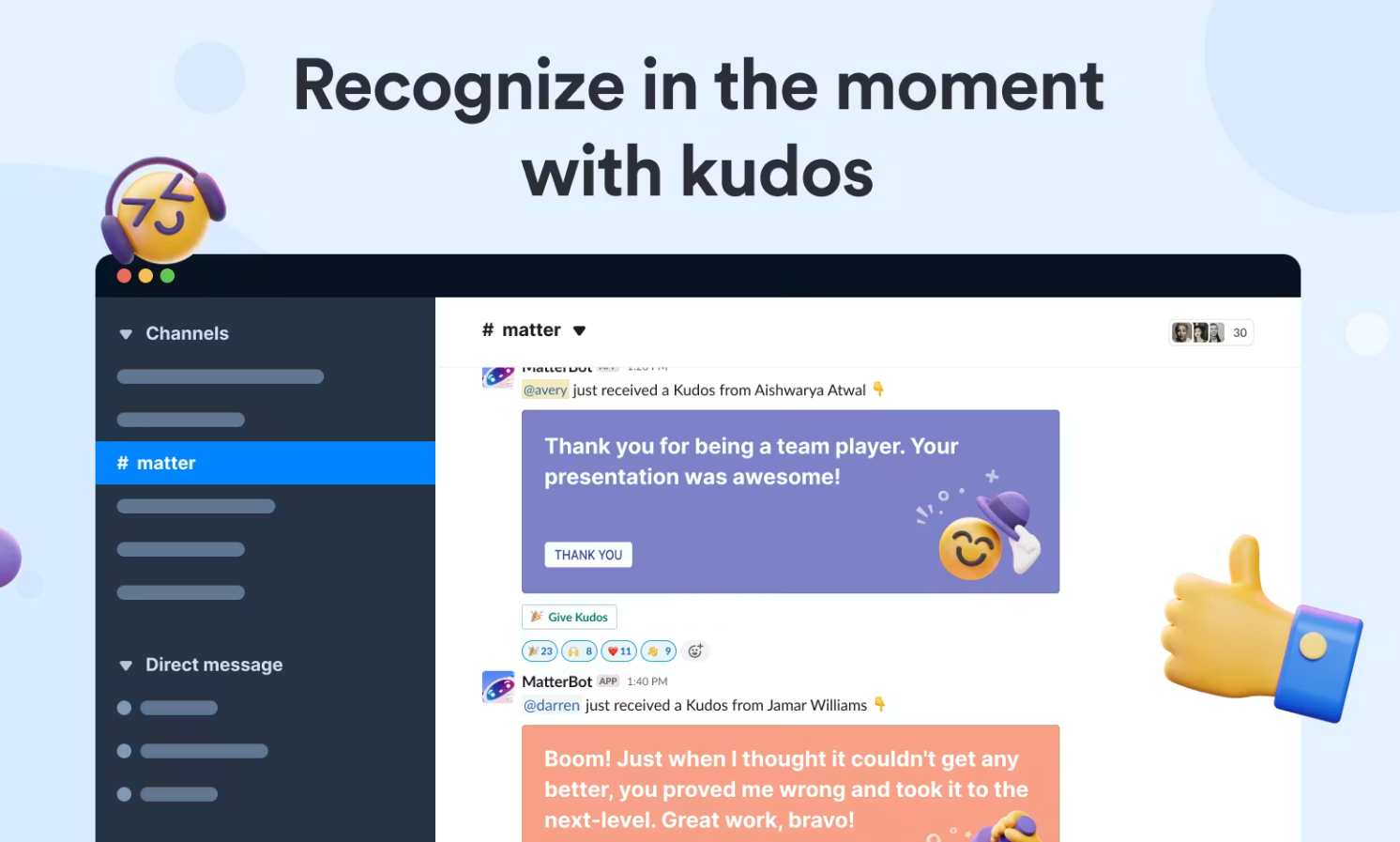
Core Features: Matter's core features include peer-to-peer kudos tied to company values; automated birthday and anniversary celebrations; a rewards catalog (gift cards, donations, custom company rewards) powered by Matter coins; pulse and eNPS surveys; challenges and incentives; and analytics dashboards. It integrates natively with Slack, Microsoft Teams, and a wide range of HRIS systems.
Unique Aspects: Matter's signature feature is "Feedback Friday," an automated weekly prompt that nudges the whole company to pause and recognize one another in a shared moment. This ritual-based approach tackles the most common point of recognition failure directly: consistency. Rather than hoping managers remember to recognize, Matter builds a recurring, low-friction habit into the workweek, making it a strong fit for hybrid teams that live in Slack or Teams.
Mo
Number of G2 Reviews: Mo has a limited presence on G2, so review volume is thinner than the larger platforms on this list.
Pricing: Mo doesn't publish its pricing publicly. To get a quote, you'll need to reach out to their employee culture experts, who will tailor a price based on your goals and company size.
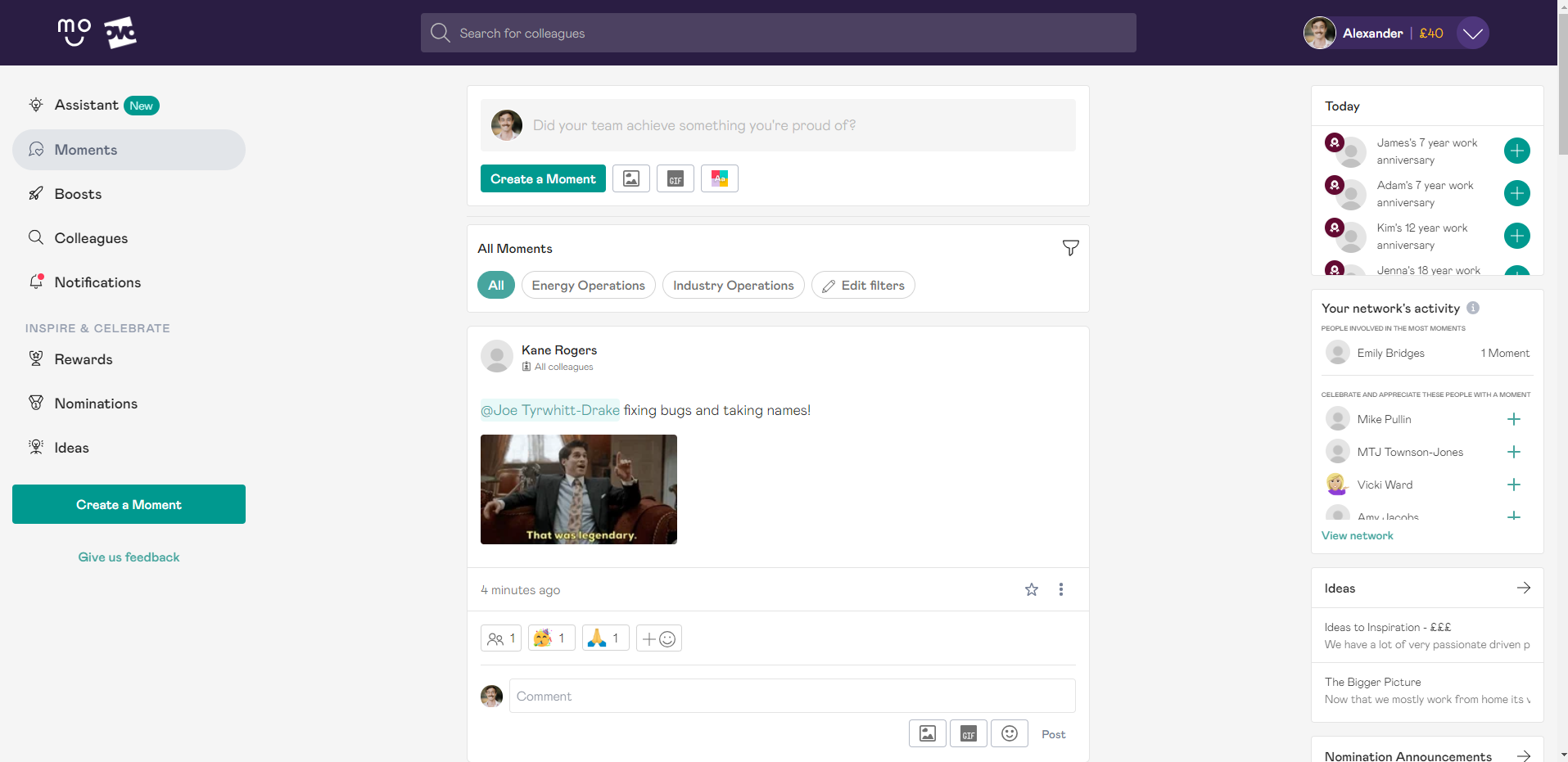
Core Features: Mo's core features center on two concepts: "Moments," a social recognition feed where employees celebrate wins, milestones, and personal events, and "Boosts," automated prompts that nudge teams to recognize behaviors tied to company goals. The platform also includes peer-to-peer nominations, a customizable rewards catalog with gift cards and custom rewards, and an Assistant that surfaces engagement insights for managers. Mo supports 12 languages.
Unique Aspects: Mo's differentiator is its emphasis on prompted, ritual-driven recognition through Boosts, which are particularly well-suited to recurring cadences such as weekly sprint wins or quarterly awards. Its multilingual support and mobile-first design make it a strong option for distributed and internationally spread teams. It's worth noting Mo is a focused recognition-and-rewards point solution rather than a full engagement suite, so teams wanting built-in performance management or deep survey tooling may need to look elsewhere.
Empuls (by Xoxoday)
Number of G2 Reviews: Empuls has received over 1,000 reviews on G2, with a rating in the 4.6–4.7/5 range.
Pricing: Empuls doesn't publish its pricing publicly. To get a quote, you'll need to book a demo and speak with their team, who will tailor a plan based on your needs and organization size.
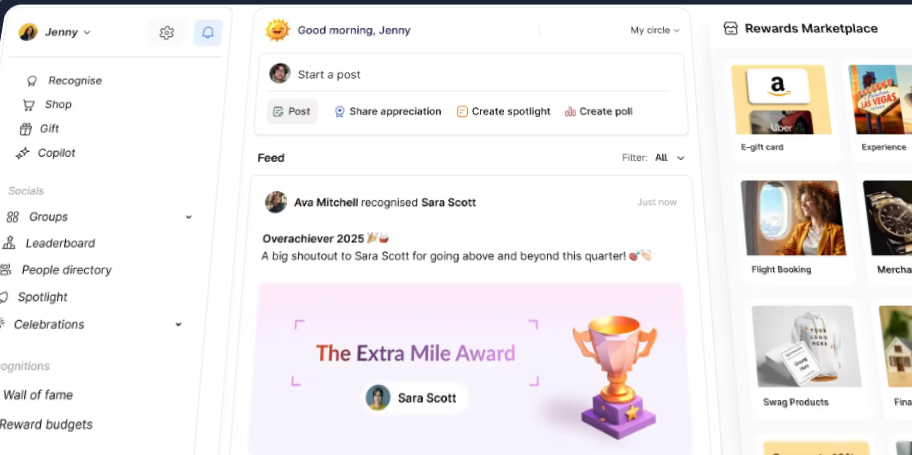
Core Features: Empuls combines four areas into one platform: recognition and rewards (peer-to-peer, manager-to-employee, value badges, approval-based awards), employee surveys and feedback (pulse, lifecycle, eNPS), a social intranet for company-wide communication, and a perks and benefits marketplace. It offers an extensive global rewards catalog, white-labeling options, an AI engagement bot, and integrations with Slack, Microsoft Teams, major HRIS systems, and SSO tools.
Unique Aspects: Empuls positions itself as a comprehensive engagement suite tailored for SMBs, rather than a single-purpose recognition tool. What sets it apart is how far its rewards reach extends, into wellness, financial benefits, and a broad perks marketplace, alongside an AI bot ("Em") that nudges participation and automates routine HR tasks. For an HR leader who wants recognition, surveys, communication, and perks under one roof at transparent pricing, Empuls offers breadth that narrower point solutions don't.
.jpeg)
5 Pro Tips for Choosing The Right Employee Recognition Software
At Qarrot, we've helped many companies launch and implement successful employee recognition and reward programs within their organizations.
We know that picking the right employee recognition software can take time. With all the options on the market and having to get buy-in from your decision-makers, this process doesn't happen overnight--it takes a lot of work!
Since we've advised many companies on this journey, we wanted to share some pro tips for HR professionals who are comparison shopping for recognition vendors or software providers. By following these tips, you can pick the software provider that best suits your business's short- and long-term needs.
1. Define Your Dealbreakers
Before you explore options, determine what's important to your organization. For example, determine whether you're seeking a more “pure” peer-to-peer recognition program or additional features to enhance the impact of employee engagement, like Pulse Survey and employee analytics features. Understanding your dealmakers and dealbreakers will help you choose a software solution that perfectly matches your company's needs and goals.
2. Establish a Realistic Budget
While employee recognition is invaluable, it's essential to have a clear budget in mind when selecting a software provider. Assess your financial resources and create a realistic budget that meets your organization's needs. Keep in mind that while some providers offer comprehensive packages with advanced features, others may offer more budget-friendly options tailored to small or medium-sized businesses.
3. Consider The Type of Rewards Employees Will Prefer
The success of a recognition program heavily relies on the rewards offered. Take the time to understand what motivates your employees and what type of rewards they would most appreciate. Whether it's gift cards, tangible goods, experiences, or even cash rewards, different software vendors offer various types of reward options for all types of employees. Selecting a software provider that offers a diverse range of rewards will ensure you can cater to the varying preferences of your workforce.
4. Evaluate Customization and Flexibility
Every organization operates differently, and your employee recognition program should reflect your unique company culture and values. Look for a software provider that offers customization options, allowing you to tailor the program to suit your specific requirements. Scalability and integration with existing systems are crucial to accommodating future growth and changes within your organization.
5. Seek User-Friendly Interface and Support
Ensure your employee recognition program has a user-friendly interface to ensure widespread adoption. Choose a software provider that offers intuitive and accessible platforms, making it easy for both administrators and employees to navigate and utilize the system effectively. You should also prioritize providers that provide reliable customer support and training resources to help you maximize the benefits of the software and resolve any issues that arise.
Final Thoughts
If you’re looking to launch an employee recognition program in your company, the abundance of software options can leave many HR professionals feeling perplexed. You’re certainly not alone!
This article is meant to ease that burden by providing a curated list of some of the best employee recognition platforms on the market. And most importantly, doing some of the leg work for you and highlighting their price point, key features, and unique capabilities.
We hope this knowledge and information will help you clarify your goals, narrow your options, and ultimately choose the recognition software provider that best matches your organization's needs.
Related: Choose the right recognition software solution with this 5-Step Buyer's Guide
.png)
Qarrot is now available for Slack and Microsoft Teams
Since embarking on our journey to build easy-to-use employee rewards and recognition software for growing businesses, we’ve gotten all kinds of requests.
Our customers aren’t shy about asking for features to improve their experience, and prospects also let us know about functionality that would serve their program objectives. This feedback has helped inform our product roadmap. And it’s resulted in many improvements being developed over the last few years - whether new design, improved functionality, additional features, or apps and integrations with third-party applications.
In fact, early on many customers asked about an integration with Slack. So, we built a fairly basic webhook integration in 2019. It was good, but still required customers’ employees to toggle over to the Qarrot web application to perform most actions.
Much has changed since that early Slack integration.
Qarrot for Slack
In 2023, we finally ditched the webhook integration for Slack! In its place, we’ve launched the Qarrot app for Slack. Find Qarrot in the Slack app directory.

While customers can still connect the Qarrot social feed to a Slack channel, they can also install the Qarrot app. This permits their employees to open Qarrot in Slack and perform a number of actions, including seeing their points balance and sending recognitions (check out how to use Qarrot in Slack).
Employees can also view their personalized social feed in Slack as well as the leaderboard and any incentive campaigns they’re participating in. For actions that are still done in our web application, we’ve included quick links so employees can be redirected with one click.
Our customers tell us that these additions have made using Qarrot even easier, since employees can participate in their recognition program right from a work tool they use everyday! Increased participation improves employee engagement with the program, thereby helping to drive better results for both employers and their staff.
Adding Qarrot to your Slack account is easy. Read our help center article here.
Our work here isn’t done! We’re aiming to provide access to more actions and to further improve the Slack experience over the coming year.
Qarrot for Microsoft Teams
In 2023, we also launched our app for Microsoft Teams. Find Qarrot in the Microsoft AppSource marketplace
We’re very excited about Qarrot for Microsoft Teams. Like with Slack, customers can install Qarrot so that the app is available for all employees. Plus, they can connect the public social feed to a Teams channel.
But, the reason for our enthusiasm is that all Qarrot features and functionality are available in the desktop version of Microsoft Teams.

For example, the look and feel of Qarrot are the same as those of our web application. And admins, managers, and employees can perform all actions within the Teams app! There isn’t any need to toggle between Teams and our web application whether you’re sending a recognition, entering a campaign result, redeeming for a reward, or pulling a report (check out how to use Qarrot in Teams).
Note that Microsoft limits certain actions, such as redeeming rewards, on the mobile version of the Teams app.

Adding Qarrot to your Teams account is easy. Read our help center article here.
And if your organization uses Outlook, you can similarly add Qarrot to your account in the same way as you would for Teams.
Our work here also isn’t done! We’re continually looking for ways to make our Teams and Outlook experience even better, whether that’s through additional alerts and notifications or enabling employees to send recognitions from right within a Teams channel.
Plus, we’re very close to launching Qarrot for another major productivity and communication platform! We’re incredibly excited about this upcoming development and will share further news soon.
.jpeg)
7 Reasons Why Employee Retention is Important
Few aspects of the workplace are as important as employee retention. HR professionals think of it like walking a tightrope. Too many exits weaken a company's foundation, while too few signal a lack of fresh perspectives.
For example, consider a scenario where employees frequently quit. In doing so, they leave knowledge gaps, reduce morale, and increase recruitment costs. In contrast, imagine a workforce where faces rarely change, leading to stagnation and preventing diverse ideas from flowing in.
Striking a balance is key.
This article will provide you with information on how to achieve that balance. First, we'll dive into the question of why employees quit. We will explore some of the most recent statistics and studies that help shed light on this issue. Then, we will examine the importance of employee retention and how it impacts organizations. Lastly, we will explore some top-level frameworks that HR teams and leaders can use to approach employee retention more strategically.
As a result, your efforts to reduce employee turnover will not be hasty band-aid strategies but rather well-thought-out, targeted solutions that address the root of your labor issues.
.jpeg)
Why Employees Quit: 5 Common Reasons for Low Employee Retention
Most employees don't wake up one morning and quit their jobs on a whim...
Poor retention is often caused by underlying factors within a business. But what are those factors affecting retention? We all know some common culprits through anecdotal conversations with our friends—like a bad boss and low pay. But do actual studies and research support these personal stories?
Let's look at recent workplace statistics that shed light on the most common reasons employees choose to leave their jobs. Once organizations understand the main driving factors of employee turnover, they will be better positioned to create targeted solutions that genuinely address their retention issues.
Lack of growth opportunities
Picture yourself in a role where each day feels like a replay of the last. There is little room for learning, growth, or change. Without clear pathways for growth or opportunities to hone their skills, employees can quickly feel stagnant and unfulfilled.
A recent survey by the America's Psychological Association shows that 91% of people say it is somewhat or very important to have a job where they consistently have opportunities to learn. Yet, only 47% report that their workplace offers learning opportunities.
In other words, over half of businesses aren't making an effort to create any learning programs and initiatives for their employees. The desire for personal growth is a basic human need. When companies fail to encourage this ambition, they risk losing their top talent to competitors who offer more fertile ground for development. In the lack of such opportunities, it's only natural for them to look somewhere else for career development.
Lack of appreciation
Everyone wants to be recognized and appreciated. This is another basic human need. It's no wonder that one of the main reasons employees decide to quit is the absence of appreciation and recognition. Many workplace studies support this claim.
For example, a 2021 report by McKinsey found that 54% of employees cited "not feeling valued by their organization" as a top reason for quitting. Another 2017 report by Gallup showed a lack of recognition as one of the most common reasons employees left an organization. It's interesting to note that talented employees tended to leave faster.
To be clear: recognition isn’t always about monetary rewards, although it can be. What we are referring to here is simple verbal appreciation from managers and leaders; the acknowledgment of your employee's hard work. Whenever employees feel undervalued and overlooked, their commitment to the organization fades, and they look for greener pastures. Appreciation isn't just a "nice to have." It's the cornerstone of employee engagement and retention.
Toxic work environment
Picture a workplace where tension, hostility, or passive-aggressiveness pervades the air. In such environments, employees may find themselves constantly fearing leaders, battling office politics, grappling with micromanagement, or contending with unfair treatment. Employees crave workplaces where they feel valued, supported, and empowered to bring their whole selves to work. When faced with toxicity, they often opt to seek out workplaces that prioritize their well-being and foster a culture of inclusivity, collaboration, and mutual respect.
For example, a recent study published by MIT Sloan Management showed toxic company culture was the top predictor of employee turnover, more than pay. 10X more, to be precise!
In other words, if your business is suffering from high turnover, you might have a toxic workplace culture or dysfunction issue on your hands. After all, in a world brimming with opportunities, why stay in a toxic environment that chips away at one's esteem and mental health?
Low Compensation
Poor compensation is also frequently reported as a reason why employees consider leaving a company—no surprise here. When employees perceive a gap between the effort and contributions they make and the reward they receive, it can quickly breed resentment.
A 2022 SHRM study surveyed 1,516 HR professionals in the U.S. to know what they consider the top reasons for turnover at their organizations. The most common reason HR professionals cited for their employees leaving was inadequate total compensation.
In an era where the cost of living steadily rises, employees increasingly find themselves wrestling with the stark reality of making ends meet. When salary fails to align with the value of their contributions or fails to meet their financial needs, it's only natural for them to seek opportunities elsewhere that offer fair and equitable pay.
Bad relationship with manager
Bad management is one of the most common causes of employee turnover. Nevertheless, this may be overlooked because employees tend not to give this feedback upon departure. Let’s look at some data that supports this idea.
For instance, in a workplace survey by GoodHire, 82% of American workers said they would quit their jobs because of a bad manager. In another interesting survey by Real Estate Witch, over 1000 Americans were surveyed, and 75% reported feeling frustrated with their managers.
Employee frustration with leadership was attributed to the following reasons:
- Unclear communication (31%)
- Micromanagement (27%)
- Favoritism of other employees (27%)
The root of poor management often runs deep. It can start all the way at the top; cultural and systemic issues in the company can trickle down to middle management. Or it may be an issue of individual managers lacking proper interpersonal skills and training. Either way, there are standards around management that need to be addressed. By addressing these root factors, companies can create cultures where both managers and employees thrive.
7 Reasons Why Employee Retention Is Important for Businesses
1. Reduced hiring costs
The costs associated with hiring are high. Substantial steps are required to replace an employee, such as posting vacancies, conducting interviews, and training new employees. Each time an employee leaves and a replacement is needed, these costs recur. As a result, the company utilizes resources that could be spent elsewhere. High turnover rates can also negatively impact morale and the company culture, leading to a negative cycle of employee dissatisfaction and departure.
2. Enhanced productivity
Employees who've been in the game longer know the ropes better. They're familiar with the ins and outs of the company. Naturally, this means they're less likely to make mistakes and more likely to come up with clever ways to get things done. This expertise doesn't make them faster at their jobs; it also means they can help out new employees. Plus, when people feel like they're in it for the long run, they're more invested in the company's success. They put in that extra effort because what's good for the company is good for them, too. In short, focusing on keeping your team together means everyone's working smarter, not harder, making the whole organization more effective.
3. Improved employee morale
Employee retention does wonders for team spirit. It's all about trust and stability. The workplace starts to feel like a tight-knit family; everyone feels part of the team. This sense of belonging boosts morale because people know they're valued and not just another number. Plus, a stable team means strong friendships and deeper connections, making it easier for everyone to work together. People are more likely to go the extra mile for their team, share ideas freely, and support each other. This camaraderie doesn't just make coming to work more enjoyable; it actually drives everyone to do better because they're all in it together.
4. Better customer satisfaction
Long-term employees become really good at what they do. They know the products or services inside out, anticipate customer needs, and handle tricky situations with ease. This knowledge means customers receive excellent service every time. And when customers interact with the same friendly faces over time, trust builds. New customers become loyal patrons. This loyalty isn’t just about repeat business. Happy customers become advocates for the brand. In short, they spread the word to friends and family. So, investing in keeping your team together isn’t just good for morale—it’s a direct path to making clients happier and more loyal long-term.
5. Knowledge preservation
As people leave, they take all their knowledge with them, leaving gaps that can be difficult to fill. High turnover means you're playing catch-up. Your leaders are trying to transfer skills and information before they walk out the door. On the flip side, a stable team keeps this valuable knowledge in-house. It makes training new employees easier because there's always someone with the answers. To nail this, companies can encourage mentorship programs. They can also create internal wikis or databases where employees record what they know. This way, knowledge doesn't just live in people's heads—it's available to everyone.
6. Stronger employer brand
When a company is known for keeping its employees happy and engaged for the long term, word gets around. This reputation makes the company stand out as an employer of choice. As a result, it has a better chance of attracting talent looking for stable and rewarding careers. In today's job market, having a strong employer brand is like having a magnet that attracts the best candidates. This positive employer brand image helps companies fill positions quickly and with qualified staff eager to be part of a team.
7. Increased ROI for training and development
Training new hires is costly. And if new employees leave too soon, that investment just walks out the door. However, when companies focus on keeping their people, they see the full benefits of their investment. Employees who stick around become more skilled and efficient, directly boosting the company's bottom line. When people feel their employer is invested in their growth, they're more likely to stay put. This creates a positive cycle: the company invests in training, employees feel valued and stay longer, and the company benefits from their improved skills and loyalty.
.jpeg)
How to Approach An Employee Retention Strategy
The benefit of employee retention is undeniable. Yet, for many businesses, retention efforts tend to be reactive rather than proactive.
In other words, companies only consider them if there is a glaring problem, like high turnover or low morale. This is especially true if the leaders can place a price tag on that problem and see a clear ROI; otherwise, these issues tend to slip to the bottom of the priority list.
Even so, these retention solutions and employee engagement plans are often hastily put in place. Leaders fail to explore the issue's root or question if their staff will benefit from them. In short, they copy/paste "trendy" HR ideas without first considering whether this initiative will be a good fit for their business and employees.
Being more deliberate and proactive about employee retention starts with analyzing what your businesses current offering and seeing how it stacks up aginst employers in your industry.
Auditing your company’s EVP
A company’s EVP, as defined by SHRM, is “everything of value that an employer provides to its employees—pay, benefits, training, career development opportunities and so on—and it is then “marketed” to the workforce.”
Documenting your EVP is the first step to approaching employee retention more strategically.
- Compensation: salary, pay raises, bonuses, profit sharing, reward programs.
- Core Benefits: health insurance, vacation, time off.
- Work environment: Work-life balance, remote work, management style.
- Career: Promotions, training, mentorship, learning opportunities.
- Culture: Mission, prestige, social responsibility.
By auditing everything your employees perceive as valuable, you develop a good idea of where your business stands compared to other companies in your sector.
Is your offering competitive? Are you presenting something unique that other businesses aren't? It will be easier to answer all these questions. Based on the gaps in this analysis, you can start developing your employee retention initiatives.
In the end, these initiatives will be more strategic because they will address weaknesses in your EVP. And most importantly, they will be tailored to the tastes and needs of your actual workforce.
Final Thoughts
The balance between turnover and stability in any workforce is delicate. Both extremes carry potential pitfalls for any organization. Striking a healthy balance is critical.
This goal can be achieved by figuring out why employees leave. In other words, digging down the root causes of employee turnover can help businesses understand how and where to start making improvements to foster greater retention.
That said, understanding all the ways poor retention impacts businesses—from increased hiring costs to damaged employer brand—can help spur organizations to be more proactive about improving employee commitment.
As we have explored, the path to effective employee retention is not merely reactive but requires a proactive, strategic approach. By investing in our employees' satisfaction and engagement, you not only mitigate the risks associated with high turnover but also unlock the full potential of your workforce.
.jpeg)
6 Proven Employee Engagement Ideas for Manufacturing Employees
The manufacturing setting is not your usual work environment. Many of these facilities run 24/7; they never take a day off. Working conditions can be tough — factories are noisy, sweltering hot, and poorly lit. As such, this is not your typical luxuriant office space. Workers face daily challenges, such as long shifts, physically demanding work, and stressful working conditions.
As a result, HR teams face high turnover and burnout rates as well as low engagement rates. Some recent statistics show how difficult employee engagement can be in this sector.
- A workforce institute study found that 62% of manufacturing organizations reported an increase in turnover year over year.
- A PWC study showed only half (48%) of manufacturing leaders say that most of their frontline workers feel engaged in their jobs.
- An employee engagement report by Workday shows the employee engagement rate in manufacturing is one of the lowest across industries at around 34%.
Improving employee engagement in manufacturing can be challenging. HR teams can also be small and busy with day-to-day tasks like employee relations, onboarding, and worker safety. In other words, daily duties can overshadow long-term goals, such as thinking of employee engagement in a big-picture way.
But it doesn't have to be this way. The manufacturing industry can benefit from greater employee engagement and use various initiatives and activities to achieve this. And it's a myth that only companies in more "glamorous" and creative industries can benefit from these programs.
In this article, we'll first explore common myths in the manufacturing industry. These misconceptions tend to prevent leaders from reaping the benefits of employee engagement. Then, we will discuss proven employee engagement ideas you can apply today. These initiatives can be a great first step to helping your factory foster a more engaged workforce.
.jpeg)
Misconceptions About Employee Engagement in Manufacturing
Those who have worked in traditional manufacturing know that factories are frozen in time. Many aspects of automation, processes, and technology have remained the same over the years.
Similarly, the mentality and mindset around work and culture have remained unchanged. However, this stagnant environment is also a fertile ground for certain myths and misconceptions about work to thrive. Recognizing and dispelling these misconceptions can open up new avenues for leaders and their companies to adopt innovative methods and improve their culture and engagement.
To that end, it may be a good idea to question whether these ingrained beliefs are true in your workplace and to consider what initiatives you would pursue if they weren't standing in the way.
Myth 1: Employee engagement is only for creative and “fun” industries
Does employee engagement only "work" in fun industries like creative ones or tech? Absolutely not. This is one of the most pervasive misconceptions about engagement in a factory setting. Leaders in manufacturing falsely believe that since the work environment is so different from that of a typical office, these strategies and programs wouldn't work at all. But that is simply not true.
We agree that the factory work environment is starkly different. But the reality is that if your company employs humans, it will benefit from engagement initiatives. It's a matter of tailoring these initiatives and programs to fit your culture and team. And not just taking a one-size-fits-all approach. For instance, recognition programs, team-building activities, and open communication channels can be applied to the manufacturing setting.
Myth 2: Employee engagement is primarily about salary and benefits
One big myth about employee engagement is that it’s all about money. It’s not entirely wrong, as pay does play a major role in how engaged an employee is at work. But it’s certainly not the entire picture. This reality applies to manufacturing, too.
Yet, many still believe that manufacturing workers are motivated only by compensation. In reality, other components of the work environment influence employee engagement. Factors such as feelings of respect and safety, recognition, career development, and a comfortable working environment play a crucial role in long-term employee happiness and satisfaction.
Myth 3: Manufacturing workers are not interested in professional development
People assume production employees are only interested in their current tasks. They are not interested in growing their career or learning new skills. Not all workers desire rapid career advancement. This fact applies to all sectors, not just factory settings. Yet, people need to remember how important career growth can be to certain people in this sector.
In reality, many manufacturing employees value skill development and career advancement opportunities. To that end, providing training and development programs can significantly increase engagement and retention for these employees.
Myth 4: Flexible work arrangements don't apply to manufacturing
It's easy to assume shift workers can't have flexible work hours. Shift work, by its very nature, seems limiting and rigid. But this is a misconception. You would be surprised that leaders can introduce more flexibility into the workplace in several ways.
In other words, even within the limitations of industrial environments, flexibility can be offered in many forms, such as adjustable shifts, job rotations, and accommodating personal needs, leading to higher job satisfaction and engagement.
Myth 5: Manufacturing employees don’t care about company culture
Manufacturing work is tough. It's physical, task-focused, and repetitive. There is little time for socializing or even building a culture. By extension, people believe these employees are not concerned with company culture. They don't care for things like social events or activities.
But rememeber, company culture is more than events like birthday parties. Work culture can involve these things, but culture is also about how employees are treated, compensated, and looked after by each other and, most importantly, the company's leadership.
Considering this broader meaning of company culture, it's easy to see why it's just as important in factory environments. A positive, respectful, inclusive, safety-focused culture can deeply impact employee morale, engagement, and productivity.
Myth 6: Technology investments are not related to employee engagement
The industrial sector often finds itself frozen in time in terms of technology. Often, technology investments are seen purely as functional or efficiency-driven. In other words, it's not considered a factor that leads to greater employee engagement.
The reality is that younger employees are entering the workforce. Updating your tools and technology can significantly engage employees by making their jobs easier, safer, and more enjoyable. For example, tools enabling communication and feedback can also enhance a sense of belonging and engagement.
.jpeg)
6 Employee Engagement Ideas & Activities for Factory Workers
1. Recognition and reward systems
Recognition is not just about money, although it can be. We are referring to setting up systems and programs that allow your organization to share recognition for employees' hard work in a regular, structured way. Recognition and appreciation are critical to employee engagement, even in the manufacturing setting. In fact, a Manufacturing Institute report showed that workers who felt valued were more than 4X as likely to report high levels of work engagement and less likely to say they feel stressed out on a typical workday. Another popular study of call center workers showed that a simple expression of thanks by someone in authority made people 50% more productive!
Employee recognition initiatives could include employee of the month awards, spot bonuses for exceptional performance, and team achievement celebrations. Platforms like Qarrot can provide a virtual space to carry out these structured recognition programs. Making it easier for HR teams and managers to offer timely rewards and gifts for employee effort and contributions.
2. Professional development and training
As we mentioned at the top of this article, it's a misconception that factory workers are uninterested in career growth or development. Creating programs that offer training, skill development workshops, and career advancement can increase employee engagement in the factory setting. These programs don't have to be complicated or expensive to implement. They can be as simple as setting up cross-training opportunities for people to learn different aspects of your operations.
When leadership makes an effort to create programs and initiatives that foster employee development, it signals the company cares about investing in the employee's future. And when people feel they are being taken care of and invested in the long-term, they are more likely to give back to the company with greater engagement and energy and more likely to be loyal to a business.
3. Paid lunches or snacks
No one loves food more than a hardworking front-line worker. Offering an occasional paid lunch, such as bringing in a food truck or catering meals, can be a simple yet effective employee engagement idea in the factory setting. This is particularly true for locations in food deserts far removed from food establishments.
In remote industrial areas, workers don't have to worry about finding food or bringing their lunch every day. It also encourages socialization in a more relaxed setting, fostering a sense of rapport among employees. For workers, it's not just about the free meal; it's a sign that their leaders value their well-being and appreciate their hard work. Taking a well-deserved break for lunch can lead to greater productivity, enhanced team spirit, and a more positive workplace culture. All of these are crucial for maintaining high levels of productivity and reducing long-term turnover.
4. Communication and feedback channels
Those working on the front line take the brunt of the hard work in factories. They are the ones directly exposed to the toughest conditions and most prone to accidents. Ensuring these workers are treated with fairness and respect is paramount to fostering employee engagement. Showing respect for these workers begins by listening to their opinions and voices.
Gathering feedback and opening lines of communication can be done ad hoc, as simple as leadership making time to walk down to the floor and speak directly with employees. It can also be done in more formal or structured methods, like regular town hall meetings, suggestion boxes, and surveys with follow-up actions. Whether you gather feedback informally, formally, or both, this engagement strategy is critical for fostering a culture of transparency and inclusivity and making employees feel heard and valued.
5. Ergonomic and comfortable work environments
Manufacturing workers face some of the most back-breaking working conditions. For example, most facilities will always be loud, and you cannot do much to change that. But that doesn’t mean improvements can’t be made in other areas. For instance, upgrading equipment, improving lighting, and providing rest areas with features that employees can use during downtime. All this can help create a more pleasant, comfortable, and visually appealing workplace.
Enhancing this area shows that a company respects the hard work of these workers and cares for their physical comfort and health. As a result, investing in these changes can help increase feelings of trust, engagement, and happiness in your workforce.
6. Performance-based incentives
Compensation isn't the entire picture of employee engagement, but it is critical. As such, introducing performance-based incentives can be a helpful employee engagement strategy.
Some examples include monetary incentives such as team bonuses, safety incentives, profit-sharing schemes, or bonus programs for meeting production targets. Employees are more likely to take initiative, work efficiently, and focus on quality when they know their efforts will be directly rewarded. When applied transparently, performance-based incentives can create a positive work environment where employees feel valued and motivated to contribute to the company's success.
Final Thoughts
Being an HR professional in a factory setting is a different ball game. You’re managing office staff, floor workers, and the often delicate relationship between the two. The day-to-day tasks and fires to put out seem endless. As a result, it’s hard to think about long-term projects related to employee engagement and happiness. Not to mention, fighting for a slice of the budget and building a business case for these programs is another daunting obstacle.
Nonetheless, many leaders in the factor setting still operate on misconceptions, such as the idea that engagement initiatives and recognition programs can only work in young or creative industries. But this is simply not true.
If your business employs people, those people want to be respected, appreciated, and recognized. These are a universal human need, and long-term engagement initiatives are critical to achieving this goal. Ultimately, investing in employee engagement holistically can be the key to building a strong factory culture where workers are happier, more productive, and loyal to your business long-term.
.jpeg)
6 Impactful Employee Recognition Letter Samples To Celebrate Your Team
In this digital age of instant messaging and non-stop emails, there’s something special about receiving a real, tangible letter. If you’re a leader looking to express recognition or appreciation to your employees, writing or typing out a personalized letter might be the most simple and cost-effective way to share your gratitude for their hard work.
As we mentioned in our article on how to give better employee recognition, taking the time to vary your recognition efforts is crucial to offering impactful recognition.
For example, if you’re accustomed to only offering verbal “good jobs” at the end of the week, taking the extra time to actually write out a recognition letter for those noteworthy achievements is a great way to show your gratitude for those extra big goals.
In spite of that, we know that as a leader, you are likely extremely busy. Writing a letter from scratch and coming up with the exact right words can be tough. So, we wanted to help you out by providing employee recognition letter templates you can use as a jump-off point. Remember: these letters are most impactful to the receiver when tailored to them. In short, be sure to add some extra words of your own to truly acknowledge and appreciate your employees.
.jpeg)
6 Impactful Employee Recognition Letter Samples For Every Occasion
At work, many opportunities arise to offer employees a written note of recognition, encouragement, well wishes, or even condolence. It is always a wonderful gesture to take the time to write something personal. That said, here are a few employee recognition letter samples that help provide a jump-off point for most situations that may arise in the workplace.
Recognition letter template for an employee work anniversary
Dear [Employee Name],
I can’t believe how fast time flies! It’s been [years] since you came on board, and I can’t believe everything we’ve been through together. It’s been such a pleasure getting to know you over the years, and I couldn’t imagine the team without you!
Your [insert unique qualities or skills of employee] are just some qualities that have made you a pleasure to work with and an asset to this team.
The past year, in particular, has been full of amazing wins and accomplishments. We are so proud of all the hard work you’ve put into [insert specific accomplishments]
All your hard work and dedication have allowed us to achieve some of our biggest goals as a company, and we cannot express our gratitude for your hard work.
We hope the year to come is just as successful, and we look forward to working together and achieving even more!
Sincerely,
[Manager’s name]
Recognition letter template for an outstanding accomplishment
Dear [Employee Name],
I wanted to take the time to write this letter to personally thank you for all your hard work on [insert accomplishment]. It’s been a long road to achieving this goal, but we finally made it! Your perseverance and hard work have allowed us to overcome many obstacles and reach this big win.
Most importantly, your skills in [insert employee’s specific skills] were indispensable for us to accomplish this objective, raise the bar, and stand out against the competition.
It’s been such a pleasure working with you on this project, and I do not doubt that we will continue to accomplish great things together.
Sincerely,
[Manager’s Name]
Recognition letter template for initiative and extra effort
Dear [Employee Name],
I wanted to write this letter to let you know I appreciate all the extra work and initiative you've been taking lately. Don't think all this additional work and effort has gone unnoticed!
The work and initiative you've taken towards [insert project, event, etc] is truly admirable and demonstrates just how valuable you are to our team. I see you care about our company and team's success, and we are lucky to have someone like you who is always willing to raise the bar and go the extra mile.
Your willingness to learn, take risks, and do something new is something I really admire, and I just wanted to take a moment to thank you for that.
Sincerely,
[Manager's Name]
Recognition letter template for promotion or new role
Dear [Employees Name],
I want to take a moment and commend you on your new position as [insert the new title.]
In your past role as [insert former title], you were a true asset to our team and achieved some of the major goals and accomplishments like [insert key accomplishments], of which we are proud.
We are eager to see what you’ll bring to the table in this new role, and we wish you the best for the future as you continue to grow at [company name.]
All the best,
[Manager’s Name]
Recognition letter template for when times are tough
Dear [Employee Name],
I wanted to take a moment to express my gratitude for the dedication you've demonstrated lately.
Recognizing the challenges you've been facing, particularly with [mention the specific challenge], I can only imagine how demanding it must be for you at this time. Despite this, I've been truly inspired by your dedication and unwavering effort.
Remember, my door is always open to you. Please don't hesitate to reach out if you ever feel stressed or need support. We're here for you every step of the way.
Warm regards,
[Manager’s Name]
Recognition letter template for departing employees
Dear [Employee Name],
On behalf of everyone at [Company Name], I wanted to take this chance to thank you for everything that you have done during your time here, as well as wish you all the best as you embark upon this new chapter of your life.
Looking back, it’s amazing how much you’ve accomplished and how much your contributions have made an impact. It was a pleasure having you on our team!
We wanted to take a moment to highlight the achievements we are particularly grateful for. Your work on [a specific project the employee played an important role in], as well as [another specific project the employee played an important role in], contributed significantly to our long-term success.
I hope that you’ll keep in touch, and always feel welcome to collaborate with us again in the future. We do not doubt that you will continue to accomplish great things, and your future looks bright.
All the best,
[Your Name]
3 Tips for Leaders to Offer Impactful Recognition
1. Be Specific
Impactful recognition is always personal. A good test to see if your recognition message is personalized enough is to ask yourself, “Could this message be written about anyone?” If the answer is yes, your message is too generic and should be customized a bit.
You can personalize a recognition message in the following ways:
- Emphasize a specific accomplishment
- Highlight some specific qualities or skills you admire
- Bring attention to the impact of the employee's work on the business.
Your employee recognition letter can be spiced up by including these specifics and personalizing it for the recipient. Writing a more personal message will make a significant difference in how much your appreciation is felt. So, take a moment to reflect on what makes this person special and incorporate those thoughts into your message.
To make your recognition truly impactful, consider the employee's personality. A reserved individual might appreciate a more understated, sincere tone. On the other hand, if they enjoy humor and a lighthearted approach, infuse your letter with a few playful elements. This thoughtful tailoring ensures your gratitude resonates deeply, making the employee feel genuinely seen and appreciated.
By aligning your message with their unique traits, you not only acknowledge their achievements but also celebrate their individuality. This personal touch amplifies the authenticity of your appreciation, transforming a simple note into a memorable gesture.
2. Show your appreciation in other ways
Remember that words of recognition, in other words, verbal recognition are just one way to show your employee appreciation. As described in Dr. Paul White’s book The 5 Languages of Appreciation in the Workplace, there are several other ways leaders can show appreciation to their employees.
For example:
- Quality time
- Acts of service
- Gifts
In other words, if you’re giving the same old "good job team" in a meeting week after week, you might start to sound like a broken record. And your "good job" will not have the desired impact on your team's morale. So, be sure to incorporate some of these different ways of showing appreciation to your employees.
3. Ask for feedback from your employees
A major factor contributing to employee turnover is feeling underappreciated at work. And although appreciation and recognition are relatively simple to offer, sadly, many leaders tend to fall short in this area.
So what can leaders do? We recommend asking your staff how they feel. Yes, it might seem a bit weird initially, especially if you’re not used to asking for feedback about your leadership skills. But this conversation will be an important icebreaker and show employees that you really care about them and their opinions.
You can ask:
- Do you feel appreciated and recognized for your work?
- How would you prefer we show you appreciation (i.e. verbal recognition, team lunch, etc.)
- Can you give me an example of a time you felt appreciated for your accomplishments?
Maintaining communication with your staff on these topics is crucial to preventing employee turnover due to unappreciation. Giving your employees appreciation is truly a low-effort and high-impact action in the workplace. Managers should be doing their best to ensure that employees are feeling fulfilled and satisfied in this area.
How Can Recognition Letters Encourage Continued Excellence?
Recognition letters play a crucial role in fostering an environment where excellence is both appreciated and expected to flourish. Here's how they can be leveraged to encourage ongoing success:
1. Reinforce Positive Behavior
Acknowledging specific achievements helps employees understand what actions are valued. It's important to highlight specific behaviors or outcomes that exemplify excellence. This not only celebrates current success but sets a clear standard for future performance.
2. Inspire Future Efforts
Including forward-looking statements in your recognition letters can serve as a powerful motivator. Phrases such as, "I am eager to see your future accomplishments," can keep employees inspired to strive for continuous improvement and growth.
3. Cultivate a Growth Mindset
Encouraging words like “keep up the great work” can instill a growth mindset, reminding employees that their potential is limitless. This mindset encourages them to embrace challenges and persist in their efforts.
4. Foster a Sense of Belonging
Recognition letters also strengthen the sense of belonging and loyalty within a team. When employees feel valued and recognized, their commitment to maintaining high standards often increases, leading to a more cohesive and motivated workforce.
By focusing recognition letters not just on past achievements, but also on future possibilities, you empower employees to continue aiming high and excelling in their roles.
How Can Recognition Letters Connect to Company Values?
Recognition letters offer a powerful way to align individual achievements with the core values of an organization. Here's how these letters can effectively create a connection:
1. Reinforcing Core Values:
By highlighting how an employee’s actions reflect the company’s principles, recognition letters can serve as a tangible reminder of these values. Whether it’s innovation, teamwork, or customer service, linking these principles to specific achievements showcases their importance within the organization.
2. Personalized Acknowledgment:
Tailoring recognition to fit the distinct contributions of an employee helps in illustrating their role in upholding the company’s values. For instance, acknowledging a team member’s creativity in a project emphasizes the value of innovation.
3. Storytelling:
Crafting a narrative around an employee’s success story can integrate the company’s mission and broader goals. This storytelling approach not only highlights individual contributions but also illustrates how they contribute to the company's higher purpose.
4. Motivation and Engagement:
By connecting recognition to company values, employees can see the bigger picture of how their work contributes to the organization’s mission. This can boost motivation and engagement, making them feel more invested in their roles and the company’s success.
5. Encouraging a Value-Driven Culture:
Regularly using recognition letters as a tool to highlight core values helps in fostering a culture that prioritizes and rewards those principles. Over time, this can strengthen the overall organizational culture and align employees’ efforts with strategic objectives.
In conclusion, when crafted thoughtfully, recognition letters can do more than just appreciate contributions—they can weave the organization's values deeply into its everyday operations.
Final Thoughts
Taking the time to write or type a letter or card might take a little more effort than saying “Good job,” but the effort will be well worth the impact it will have on your team morale. By using these employee appreciation letter examples as a jump-off point, you won’t have to start writing everything from scratch.
Remember: It's not just about the words on paper; it's about the sentiment and effort behind them, creating a meaningful connection between leaders and their teams. By investing in these small gestures of appreciation, leaders can cultivate a thriving culture of recognition and support, ultimately leading to greater job satisfaction and employee engagement.
.jpeg)
6 Tips for Giving Better Employee Recognition at Work
Picture this: you've got a fantastic team. They're putting in the hours, hitting targets, and excelling at their jobs. But when it comes to acknowledging their efforts, you've hit a roadblock. As a leader, the idea of recognition may raise some common questions and concerns.
For example:
- Will others get jealous?
- Will this sound cheesy and not genuine?
- What types of actions or accomplishments am I supposed to be recognizing?
One thing you know for sure: your team deserves more than a surface-level "good job." They deserve personalized, timely, and memorable recognition that keeps them motivated and feeling valued. But you're still not quite sure how to get started.
You're not alone! Mastering the art of consistent and impactful recognition can be a struggle for many leaders. The good news is learning how to give recognition at work is a management soft skill that can be mastered, and we're here to help!
Why Giving Recognition Feels Hard (Even When You Care)
Most managers who struggle with recognition aren't struggling because they don't care. They care deeply. The problem is structural.
Here's what typically happens: a leader decides they want to recognize their team more consistently. They make a mental note to do better. For a week or two, they do. Then things get busy, priorities shift, and recognition slips back to special occasions only — a work anniversary here, a big win there.
This is the consistency trap. And it's not a motivation problem, it's a structure problem. In other words, consistency doesn't create structure. Structure creates consistency.
When recognition is left entirely to memory and goodwill, it will always compete with the hundred other things on a manager's plate and often lose. The managers who give the most reliable recognition aren't necessarily the most naturally appreciative people. They're the ones who've built recognition into the rhythm of their leadership.
This might mean carving out five minutes at the end of each week to think about who on their team deserves a shoutout. It might mean using a platform like Qarrot to make recognition easy to give in the moment. Or it might mean building a mix of formal and informal recognition touchpoints so that appreciation isn't dependent on any one person remembering to do it.
The bottom line: if recognition keeps falling through the cracks, don't just try harder. Build a better home for it.
Mastering employee recognition
At Qarrot, we help companies implement official recognition programs and also help their leadership become better at giving recognition. Through our experience working with organizations, we have noticed a few employee recognition best practices that lead to appreciation having a greater impact on happiness and motivation and, of course, the overall success of their recognition programs.
This article will explore these best practices and uncover tips to help avoid your recognition efforts from falling flat. With these tips, you'll be equipped to offer your employees impactful recognition that truly energizes a team. Our goal is to take you from the place of doubt into clear victories marked by a sense of accomplishment.
.jpeg)
8 Tips for Giving Better Employee Recognition at Work
1. Offer frequent recognition (at least monthly!)
One of the biggest challenges for leaders is getting into a habit of giving recognition at regular intervals. A lot of leaders are great at giving recognition for those big, shiny accomplishments that happen a few times per year. But where they lack consistency is sharing their appreciation for the smaller everyday efforts that happen behind the scenes. In other words, all the steps and work that lead up to the big accomplishment.
Now, we're not necessarily implying you need to give recognition every single day. But ideally, you want to be aiming for more than a few times per year. Workplace studies have demonstrated that the frequency of recognition directly correlates with satisfaction at work. The more frequent the recognition, the more satisfaction increases.
Many leaders might say, "But my employees don't achieve big accomplishments that frequently; what am I supposed to recognize between these bigger wins?
Well, once again, one of the best ways to make sure to give frequent recognition is to focus on praising employees' "behind-the-scenes efforts," not only the big final accomplishment. Praising employees' smaller efforts not only results in more frequent recognition but also more genuine recognition. Ultimately, it will have a greater emotional impact on the employee as they will feel personally appreciated and valued.
2. Focus on one specific goal or accomplishment
What type of recognition do you think sounds more impactful to an employee?
- "Great job on everything you've done this week."
- "Thank you for your standout efforts in dealing with client X this week. They were being particularly difficult, and you did an amazing job at de-escalating the situation."
If there is one recognition tip to remember, it is that impactful recognition is specific. In other words, it focuses on one specific accomplishment or achievement. Of course, the occasional "great job on everything you've done" is acceptable. As we always say, giving some recognition is better than none. But if you want to deliver recognition that really makes an employee feel deeply valued and appreciated, take the time to point out a specific win, especially one that you know they've worked so hard to achieve.
That said, leaders and managers sometimes can be unsure which accomplishments deserve official praise or recognition. We recommend identifying achievements that align with the organization's goals or demonstrate exceptional skills.
For instance, recognizing an employee's ability to deal with challenging clients, as in the second example, acknowledges their effort and highlights a crucial skill — de-escalation. Recognition like this not only boosts morale but also demonstrates what skills or behaviors are valued. Remember, the key is to be genuine and specific in your recognition, showing that you not only notice their efforts but also understand their unique contributions to the team.
3. Highlight the impact of the employee's work on the organization
People want to go to work and feel like they are making a difference. It feels great to know that your contributions are impacting not just your team but the entire organization.
That’s why impactful recognition will always take it a step further and highlight how the employees' work impacted the big picture. Bonus points if it can be quantified. Adding extra words that speak to these finer details will go a long way to instill in the employee a sense of accomplishment for their hard work.
For example, note the stark difference between the following two examples:
- “Thanks for all your hard work on closing the deal with Company X. Your hard work and dedication have been an asset to our team!”
- “Thanks for all your hard work on closing the deal with Company X. Because of your hard work, we will surpass our quarterly quota by over 10%! Amazing job.”
This detailed acknowledgment instills a profound sense of pride and reinforces the understanding that every individual contribution is crucial in steering the entire organization toward success
4. Speak your employee's language of appreciation
Every employee is unique. For example, it’s important to remember that not everyone will enjoy receiving public praise and recognition. Some people don’t particularly enjoy being the center of attention and having the spotlight on them. Keep in mind that this doesn’t mean that they don’t want to be recognized for their work at all. It just means that they may prefer to have recognition delivered privately or in a more personalized way.
Workplace expert Dr.Paul White explains this idea in his book The 5 Languages of Appreciation in the Workplace. We often think verbal appreciation is the only way leaders can share recognition with their teams. But in this book, White explores the many ways leaders can share their appreciation for their team and why just saying “thank you” at work isn’t always enough.
A popular example: is quality time. If a busy manager makes time to give an employee their undivided attention by sharing a meal or booking a time to talk about their career goals, that can be a genuine way of showing appreciation for your employee.
The bottom line is don't limit yourself to verbal "good jobs" or "thanks yous." Of course, you can make that one slice of the pie, but you can also share your appreciation in other ways, like giving your employees a helping hand or making quality time for them.
5. Use a variety of recognition methods
In a similar vein, varying your recognition methods is critical to giving effective recognition to your employees. For example, you might give verbal "good jobs" or shout-outs in meetings. That's what you find the most practical and effective at showing appreciation for your team's work.
However, giving the same "good job team" in a meeting week after week, you might start to sound like a broken record. And your "good job" will not have the desired impact on your team's morale. In this case, you might want to consider switching things up.
You could, for example:
- Offer your employees a written note or letter of appreciation for bigger accomplishments.
- Organize a team event or outing like a paid lunch.
- Offer a small gift or personalized token of your appreciation and verbal recognition.
There are many ways to show employees you care about them and appreciate their hard work. Sometimes, it's beneficial to make an extra effort to do something special and unique, especially when you wish to acknowledge the biggest goals and accomplishments.
6. Build recognition into your routine, don't leave it to chance
This tip is the structural counterpart to tip #1. Knowing you should recognize more often is one thing. Making it happen consistently is another.
The managers who give the most consistent recognition tend to have one thing in common: they've made it easy. They've removed the friction. This might look like:
- A weekly five-minute reflection at the end of each Friday: Who on my team did something worth acknowledging this week?
- Using a recognition platform that lets you send appreciation in the moment, without extra steps
- A standing agenda item in team meetings for peer or manager shoutouts
- A formal program — peer nominations, spot recognition — that creates natural recognition touchpoints throughout the year
Recognition isn't just a personal habit. It's a practice that benefits from structure. When you build the right mix of formal and informal recognition into how your team operates, consistency stops being something you have to force it becomes part of your culture.
7. Address jealousy head-on with specificity
One of the most common concerns leaders have about giving recognition is the worry that it will create jealousy — that spotlighting one person will make others feel overlooked or resentful.
Here's the good news: specific recognition is the antidote to jealousy.
When you recognize someone for a vague, general accomplishment — "great job this week!" — it can feel arbitrary to everyone watching. But when you name exactly what someone did and why it mattered, something different happens. Team members who witnessed that effort usually agree with the recognition. They saw the hard work too. Specific recognition doesn't make others feel left out; it helps the whole team understand what great work looks like — and signals that their own contributions will be noticed with the same attention.
The key is making recognition a regular practice, not a rare event. When appreciation is distributed consistently and specifically across the team over time, there's no single spotlight to fight over. Everyone gets seen.
8. Ask for feedback
Feeling underappreciated at work is a major reason for employee turnover. A Gallup report shows that a lack of recognition remains one of the most common reasons employees leave an organization. In other words, although appreciation is relatively simple to offer (and highly cost-effective), so many leaders tend to fall short in this area.
So what can leaders do? We recommend simply asking your staff how they feel. Yes, it might seem a bit weird initially, especially if you’re not used to asking for feedback about your leadership skills. But this conversation will be an important icebreaker and show employees that you really care about them and their opinions.
You can ask:
- Do you feel appreciated and recognized for your work?
- How would you prefer we show you appreciation (i.e. verbal recognition, team lunch, etc.)
- Can you give me an example of a time you felt appreciated for your accomplishments?
Keeping connected with your staff on these questions is critical to reducing potential employee turnover due to feeling unappreciated. Giving your employees appreciation is truly a low-effort and high-impact action in the workplace. Managers should be doing their best to ensure that employees are feeling fulfilled and satisfied in this area.
Structure First, Habits Follow
Learning how to give recognition at work isn't about becoming a different kind of leader. It's about building better habits and a better structure around something you likely already care about.
The worries are real: Will this sound cheesy? Will someone feel left out? We hear these concerns often, and our consistent finding is that specific, thoughtful recognition disarms both. When your recognition is tied to real effort and real impact, it doesn't sound hollow. And when it's distributed consistently and fairly over time, it doesn't create resentment; it creates a culture where people feel genuinely seen.
Recognition isn't a program you launch once and walk away from. It's a practice. And like any practice, it gets better with structure, intention, and time.
