
Blog


How to Build a Business Case for Employee Recognition Software

Most internal pitches for recognition programs fail for the same reason: they lead with the wrong argument.
HR leaders tend to frame recognition as a culture investment; something that will improve morale, boost engagement scores, and make people feel more connected to the company. All of that is true. But to a CFO or COO who is weighing competing priorities, "culture investment" can easily read as discretionary spending. Something to revisit when things calm down.
The business case that actually lands reframes the conversation entirely. The question isn't whether you can afford to invest in recognition. It's whether you can afford to keep absorbing the cost of not having it. Disengagement, turnover, and inconsistent manager behavior all carry measurable price tags — and in most organizations, those costs are already on the books. They're just not being attributed to anything.
Getting leadership buy-in starts with helping them see the problem they already have.

What Poor Recognition Is Actually Costing Your Organization
Before you build a case for what recognition software will do, you need to quantify what the absence of it is already costing.
This is the section of your business case that speaks directly to finance-minded stakeholders. The numbers don't need to be perfectly precise; they need to be directionally credible and clearly attributable to something leadership cares about.
A few areas to build your cost picture around:
Turnover costs. Replacing an employee costs a significant multiple of their annual salary when you factor in recruiting, onboarding, and lost productivity during ramp-up. If recognition is a meaningful driver of retention, then even a modest reduction in voluntary turnover represents real savings.
Disengagement drag. Disengaged employees aren't just unhappy; they're measurably less productive. Gallup's research shows that highly engaged business units achieve a 17% increase in productivity compared to their least-engaged counterparts, along with a 41% reduction in absenteeism. Across a team of 75 to 200 people, that gap adds up quickly.
Manager inconsistency. When recognition depends entirely on an individual manager's personality, some teams feel constantly seen, while others go months without acknowledgment. That inconsistency doesn't just hurt morale; it creates real equity gaps that erode trust in leadership over time. Research shows that employees who receive feedback and recognition from their manager at least once a week are 61% engaged, significantly higher than the 38% engagement rate among employees who receive feedback frequently but recognition less often.
These aren't speculative costs. There are things that are happening in your organization right now. The business case just needs to give them a number.
How to Frame the ROI Argument for Leadership
Here's something worth saying plainly: the ROI of recognition is genuinely hard to pin down with precision. Anyone who tells you otherwise is oversimplifying.
The impact of recognition compounds across retention, productivity, culture, and manager behavior — and isolating its contribution from everything else happening in your organization simultaneously is difficult. Experienced finance leaders know this, and if you walk in claiming a perfectly clean ROI calculation, you're more likely to lose credibility than gain it.
The stronger move is to acknowledge the complexity upfront, then shift the framing.
Why ROI is hard to pin down
Rather than promising a specific return, position your business case around cost reduction and risk mitigation. You're not asking leadership to fund a new initiative on faith; you're asking them to address a problem that is already costing the organization money. That reframe alone changes the nature of the conversation.
The cost-of-inaction case
Work backward from what you know.
What is your current voluntary turnover rate? What does it cost to backfill a role at your average salary? How many people left in the last 12 months, citing lack of recognition or growth as a factor? Even rough estimates, built transparently, carry more weight than precise figures that look manufactured.
The goal isn't to predict exactly what recognition software will save you. It's to make the current status quo look expensive.
What world-class companies already know
One of the most effective tools in a business case isn't a number; it's a precedent or standard that already exists in the real world.
Companies like Disney, Apple, and Salesforce have built recognition into their operating architecture, not as a perk but as a deliberate driver of culture and performance.
For leadership skeptics, this matters. It shifts the question from "is this proven?" to "why aren't we doing what the best companies are already doing?" That's a much easier conversation to have.

The Four Components of a Credible Business Case
A strong internal pitch for recognition software doesn't need to be a 40-slide deck. It needs to be clear, grounded in real numbers, and honest about what you know and what you don't.
Here's a simple framework to build from.
Quantify the current cost of disengagement
Start with what's already measurable in your organization: turnover rate, average replacement cost, engagement survey scores, absenteeism, and any exit interview data that points to recognition as a factor. You don't need perfect data; you need enough to establish that the problem is real and ongoing.
Define the program scope and expected investment
Be specific about what you're proposing. A vague ask for "a recognition platform" is easy to defer. A defined program with a clear scope — peer recognition, manager-to-team spot awards, a years-of-service component — backed by a per-employee monthly cost is much harder to dismiss. At the $3–$6 per employee per month range that most platforms operate in, the investment is often modest relative to the cost of even a single unwanted departure.
Project measurable outcomes with a realistic timeline
Resist the urge to overpromise. Instead, identify two or three metrics you'll track in the first six months: participation rate, recognition frequency, voluntary turnover, or engagement score movement. Frame these as leading indicators, not guaranteed outcomes. Leadership appreciates honesty about what takes time.
Identify a 90-day win to validate early ROI
This is often the piece that closes the deal. Propose a pilot. For example, a single team, department, or program type with a defined success metric and a review date. A 90-day pilot reduces perceived risk significantly and gives you a concrete proof point to build on. It also signals that you're confident enough in the outcome to be held accountable for it.
What to Look for in a Recognition Platform
Since you're already solution-aware, this isn't about explaining why software beats spreadsheets. It's about knowing what to look for so your pitch is specific, and your evaluation is defensible.
A few things worth building into your requirements:
Support for multiple program types. A recognition platform that only does one thing will limit you. A recognition ecosystem that actually moves the needle needs formal and informal programs running in parallel. Look for a platform that supports all of it without requiring you to stitch together multiple tools.
Manager enablement, not just HR administration. Recognition consistency lives or dies at the manager level. The best platforms make it easy for managers to recognize their teams directly, without routing everything through HR. If adoption depends on behavior change from 15 different people managers, the tool needs to make that behavior as frictionless as possible.
Reporting that connects to your business case. You made commitments when you got this approved. Make sure the platform provides the data you need to report back on them: participation rates, recognition frequency by team, redemption activity, and engagement trends over time.
Integration with the tools your teams already use. For hybrid workforces running on Microsoft Teams, a platform that lives inside Teams isn't a nice-to-have; it's the difference between adoption and abandonment.
Qarrot is built to support all of this: multi-program flexibility, manager-level recognition, Teams integration, and reporting that gives you something real to bring back to leadership.
Anticipating Leadership Pushback
Even a well-built business case will hit objections. Here are the ones you're most likely to encounter, and how to address them.
"We already do recognition informally"
Informal recognition is better than nothing, but it's not a program. When recognition depends entirely on individual manager personality, it creates inconsistency across teams, and inconsistency is exactly what drives the engagement gaps you're trying to close. The goal of a platform isn't to replace genuine appreciation; it's to give it structure so it happens consistently, across every team, not just the ones with naturally expressive managers.
"We can't measure this"
You can measure more than leadership thinks. Participation rates, recognition frequency, voluntary turnover, engagement scores, and absenteeism are all trackable. You won't have a clean input/output ROI formula in year one, but you can establish baselines and demonstrate movement. A pilot with defined success metrics is the clearest answer to this objection.
"The timing isn't right"
This one is worth pressing on gently. The cost of disengagement doesn't pause while timing gets better. If your engagement scores are slipping, turnover is above the industry average, or your hybrid team is showing signs of disconnection, waiting six months to address it comes at a real cost. The business case should make that cost visible.
Bringing It All Together
The strongest business cases for recognition software aren't built on enthusiasm for recognition. They're built on a clear-eyed look at what poor recognition is already costing the organization, a realistic projection of what structured programming can change, and a willingness to be accountable for the outcome.
If you're ready to see what that looks like in practice, book a demo with Qarrot, and we'll walk you through how other companies at your stage have built the case and made it stick.
.jpeg)
How to spot toxic workplace culture
We’re all familiar with the idea that it only takes a few rotten eggs to spoil the bunch. While some of this saying rings true, it doesn’t paint a complete picture. Shouldn’t a company have safeguards in place to identify and address these “bad eggs”? Why are their behaviours tolerated? Who is responsible for stopping undesirable attitudes in their tracks?
It can be easy to blame poor company culture on a few individuals who don’t really care about being part of a team. In reality, however, it’s the responsibility of organizational leaders’ to keep those rotten eggs at bay. If left unaddressed, harmful workplace habits and attitudes can wreak havoc on your organizations’ culture.
The importance of workplace culture
Culture plays a crucial role in the overall success of a company. From retaining top talent to keeping employees engaged and motivated, fostering a favourable ecosystem where team members can thrive is pivotal. Some might argue that your workplace culture is something that grows organically and cannot be forced - but it’s that same laissez-faire attitude that allows toxic culture to brew. Don’t be fooled - the best cultures that appear organic have a considerable amount of thought and strategy supporting them.
What are the risks associated with toxic work culture?
- Low employee morale, trust, and poor relationships
- Dismal employee experience translating into a sad customer experience
- High turnover rate, signalling issues to external audiences and shareholders
- Additional costs associated with unmotivated employees (time, money, and resources)
Related Article: How to keep your startup culture thriving
Sources of toxic workplace culture
Poor internal communications
One of the most important factors when creating an optimal workplace culture is prioritizing internal communications. If you want to create an environment where team members feel empowered and supported, communication is vital. Trust and transparency are paramount in healthy workplace culture. If not, employees won’t feel comfortable discussing potential concerns or issues with leaders - leaving the perfect window of opportunity for toxicity to run wild. If you find contact with your team members stressful, forced, or just unpleasant, take a step back and evaluate your current strategy.
Nonexistent employee engagement
How can you expect employees to be interested in a company if that interest isn’t reciprocated? If employees don’t feel valued for their work, it won’t be long before they start looking for an employer who does. The small rumblings of low engagement can start with absenteeism, lack of morale, or poor performance. None of this translates to a great environment, and things will only escalate from there. However, engaging with employees is a great way to keep people interested in doing well while simultaneously nurturing a healthy work culture. Not sure how to create an engagement strategy? Employee rewards and recognition programs are a great place to start. When team members feel appreciated, that positivity will resonate culturally.
Related Article: Strengthening core values through company culture
Questionable management and leadership
Whether or not you like being the center of attention, if you’re a leader, you have to set the standard for employee expectations. Just because you’re the ‘big cheese’ doesn’t make you an exemption. It’s a slippery slope - if employees see you slacking off or getting away with the bare minimum, they will follow suit. Management must embody the behaviours and attitudes they want from employees. Micromanagement is also a classic toxic culture trait. There is nothing worse than feeling scrutinized continuously, almost like being under a microscope. To get the most out of your employees, foster a culture that encourages a collective experience and expectations while building team members’ confidence in their respective roles.
Foggy mission, vision, and values
You wouldn’t go on a road trip without a roadmap, right? The same rule applies to any business activity without considering your mission, vision, and values. Workplace culture is no exception, as these lay the foundation for setting your team and organization up for success. When these three considerations are unclear or not appropriately communicated, work culture is often a casualty. If employees don’t know where they fit into the mission, vision, and values, how can you expect them to be motivated? Rather than feeling like cogs in a machine, employees want to feel like an integral part of your team and the organization’s success. When everyone knows where they fit within an organization’s trajectory, workplace culture becomes cohesive and inclusive.
Another great way to create an empowering and supportive culture for employees is through positive reinforcement. Discover how fostering a recognition-rich environment can take your culture to new heights - request a demo with Qarrot!
.png)
Why Employee Recognition Programs Fail (And How to Make Sure Yours Doesn't)
You've made the case internally. Leadership is on board. There's budget, there's buy-in, and there's genuine enthusiasm for building something meaningful. Now comes the part no one really prepares you for: actually making it work. Understanding why employee recognition programs fail is one of the most valuable things you can do to set your program up for lasting success.
The reality is that most employee recognition programs don't fail because of bad intentions. They fail because of a handful of predictable, avoidable execution gaps that quietly undermine even the most well-designed initiatives. And for HR leaders at growing companies, where resources are lean, and there's little margin for a costly reset, getting it right the first time matters.
The problem isn't usually a lack of effort
Many HR professionals launching a recognition program for the first time face the same challenge: they know what they want the outcome to look like, but the road between here and there feels uncertain. What are the real risks? Where do programs typically lose traction? And how do you build something that actually sticks?
The good news is that the most common failure points are well-documented, which means they're preventable. Once you know what to watch for, the path forward becomes much clearer.
Here are six reasons why employee recognition programs fail, and exactly what you can do to make sure yours doesn't.

Why Employee Recognition Programs Fail (And How to Make Sure Yours Doesn't)
1. The program launches without real onboarding
One of the most common reasons recognition programs stall has little to do with intention and everything to do with implementation. Even when employees are genuinely excited about the idea of recognition, change requires effort. People need to learn new expectations, new behaviors, and sometimes new tools. And without clear guidance, many default back to old habits.
Organizations that invest in a structured rollout see significantly higher participation rates. Training sessions, clear communication about the program's purpose, and visible leadership involvement all make a meaningful difference. The format of your program matters far less than the clarity and enthusiasm behind how it's introduced.
How to avoid it:
- Plan a structured internal launch across multiple touchpoints: email, team meetings, internal channels
- Run dedicated onboarding sessions that explain the program's purpose, expectations, and mechanics
- Give employees a clear first action (for example, encouraging everyone to recognize one colleague in the first week)
- Ensure managers model participation early and reinforce it consistently
- Have senior leaders publicly endorse the program. When executives visibly participate, it signals that recognition is part of how the organization operates, not just another HR initiative
Recognition programs rarely fail because employees don't care. They fail because no one clearly showed them how to engage.
2. Recognition feels performative or obligatory
Everyone wants to feel appreciated, but not all appreciation is created equal. Recognition loses impact quickly when it becomes routine, generic, or expected. When programs are poorly designed, they can create an appreciation that feels automatic rather than earned. At worst, employees feel pressured to give recognition simply to meet a quota, and that's when it becomes purely transactional.
Workplace psychologist Dr. Paul White draws a clear distinction between traditional recognition and authentic appreciation, noting that recognition often feels impersonal and contrived when it focuses on task completion rather than the individual behind the work. The principle holds: when recognition lacks specificity or emotional sincerity, employees disengage. It starts to feel like going through the motions rather than a meaningful acknowledgment.
How to avoid it:
- Train managers on how to give detailed, behavior-based recognition. What was done, why it mattered, how it contributed
- Tie recognition to real outcomes and company values, not just activity metrics
- Avoid making recognition feel mandatory or quota-driven
- Reinforce that quality and sincerity matter more than volume (i.e. quantity)
- Make space for recognition that is specific to the individual, not just the accomplishment
3. Rewards don't actually feel rewarding
There's nothing particularly inspiring about the same cookie-cutter reward for every employee and every milestone. People are motivated by different things, and a one-size-fits-all approach signals that the organization hasn't really thought about what makes each person tick.
When employees can choose their own rewards from a meaningful selection, recognition lands differently. It feels personal rather than procedural. It also gives HR teams real-time insight into what motivates different people across the organization. Information that's genuinely useful for engagement strategy going forward.
How to avoid it:
- Offer a selection of reward options rather than a single predetermined gift
- Use flexible formats (like gift cards) that give employees genuine choice
- Align reward value with the significance of the contribution being recognized
- Revisit your reward catalog periodically to ensure it stays relevant and appealing
4. The program isn't connected to real goals or behaviors
A recognition program that exists in isolation, disconnected from the work your team is actually doing, quickly feels hollow. The goal of recognition isn't just to make people feel good in the moment. It's to reinforce the specific behaviors, values, and contributions that drive your organization forward.
If your program can't reflect what success looks like for your specific team, it can't do its job. Recognition that isn't tied to meaningful outcomes becomes background noise, present, but not impactful. The most effective programs are built to capture what your organization actually cares about, whether that's collaboration, innovation, customer service, or hitting performance milestones.
How to avoid it:
- Define what behaviors and outcomes you want recognition to reinforce before launching
- Build your program around your company's mission, values, and performance goals
- Allow for customization. Whether that's branded recognition moments, campaign-based incentives, or team-specific criteria
- Regularly assess whether the program is driving the behaviors it was designed to encourage
- If recognition and organizational goals feel out of sync, treat that as a signal to recalibrate, not a reason to abandon the program
5. Over-reliance on a single type of recognition
One of the most common design mistakes is assuming that launching one recognition initiative is enough to shape culture. An organization might introduce a years-of-service program and consider recognition "covered," but milestone awards, while meaningful, are inherently infrequent. They acknowledge tenure, not the day-to-day effort that actually keeps your team motivated.
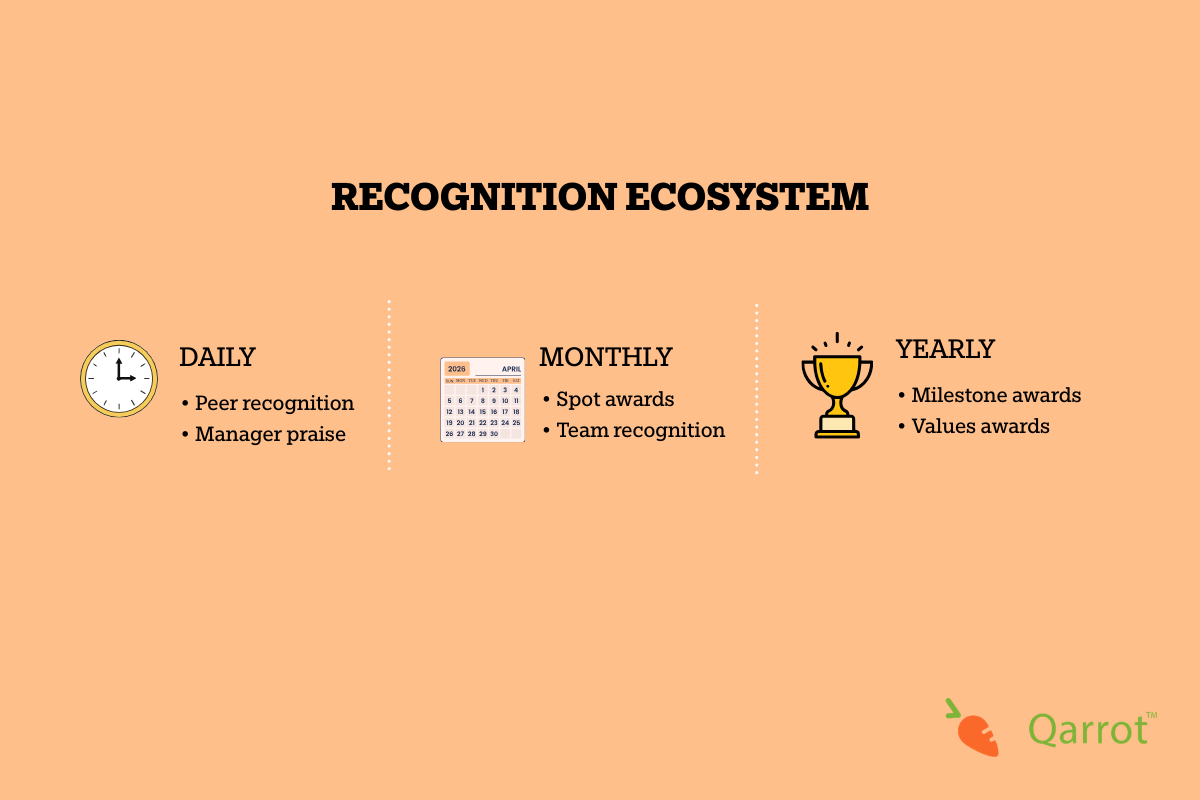
Different types of recognition serve multiple psychological needs. Employees want to feel that their loyalty is valued, but they also want their effort, creativity, and collaboration to be seen in real time. A single program can't address all of those dimensions. The result is a program that exists on paper but doesn't meaningfully influence how people feel about their work. A strong recognition culture requires a recognition ecosystem, a balanced mix of formal and informal programs that ensures employees feel seen all year round, not just on milestone dates.
How to avoid it:
- Audit your current recognition efforts: are you covering both formal milestones and everyday appreciation?
- Layer your approach. Combine structured programs (milestone awards, peer nominations) with informal, peer-to-peer recognition
- Ensure managers have easy tools to recognize their teams spontaneously, not just during formal review cycles
- Build in visibility at multiple levels: individual, team, and company-wide
- Think of recognition as an ecosystem, not a single program
6. The program loses momentum over time
Many recognition programs launch with energy and enthusiasm and then fade. Participation declines, new hires aren't introduced to the program, and leadership attention shifts elsewhere. What started as a meaningful initiative becomes another forgotten initiative.
This is where structure becomes essential. Consistency doesn't create itself. When recognition is treated as a one-time launch rather than an ongoing rhythm, it's only a matter of time before it loses visibility. Research consistently shows that while recognition programs are widespread, only about one in three employees receive recognition regularly, and nearly half want more frequent acknowledgment. The gap between intention and experience is almost always structural.
How to avoid it:
- Monitor participation rates and recognition frequency on an ongoing basis
- Share program highlights in company meetings and internal communications to keep it visible
- Reintroduce the program during onboarding so new hires are part of the culture from day one
- Periodically refresh messaging or run themed campaigns to re-engage the organization
- Integrate recognition into broader cultural moments, values communication, internal events, and team rituals
- Treat recognition as infrastructure, not a campaign. It should be embedded in how your organization operates, not layered on top of it
Recognition isn't a mystery; it's a practice
If this list felt familiar, that's a good thing. It means you're already thinking about the right problems. and that puts you ahead of most organizations that launch a recognition program and hope for the best.
None of these failure points is inevitable. They're patterns, and patterns are preventable.
The HR leaders who build recognition programs that actually stick aren't doing anything radically different. They're deliberately applying the fundamentals.
- They launch with structure, not just enthusiasm.
- They build a recognition ecosystem that covers the full range of employee needs, not just infrequent milestone moments.
- They resist the urge to chase consistency before they've built the structure that makes consistency possible.
- And they treat recognition as an ongoing practice, not a one-time initiative that gets checked off the list.
The road ahead isn't as uncertain as it might feel right now. The challenges are knowable. The solutions are practical. And you don't have to figure it all out from scratch.
.png)
Optimizing remote employee experience through feedback
The future of remote work has been a hot-button issue for managers ever since working from home became the new normal. The number of businesses operating remotely has skyrocketed in the last number of months—leaving leaders scrambling to figure out how this transition has impacted their employees. A large chunk of whom may have never worked virtually before. Transparent, honest, and open communication can be tricky on the best of days face to face —let alone remotely.
You’ve heard the saying, “No news is good news”—and while that may be applicable in some situations, remote work is not one of them. Effective communication, whether between managers or colleagues, is of the utmost importance for successful remote work. Feedback is one of the best, and often overlooked, indicators of gauging employee well being. So how can managers streamline communication and use feedback to optimize remote employee experience?
Regular touch-bases
If you start to feel anxious or nervous when you hear the words “performance review”, know you are not alone. When managers only allocate individual meetings with employees once a year, or even quarterly, it can create a lot of stress. Going several months or longer, without discussing feedback on work or progress? Talk about intimidating. Instead, schedule regular check-ins with your employees. These do not have to be formal meetings. Rather, casual conversations to see if employees need any additional help or support. Not only is this a great addition for employee engagement, but anticipated discussions also empower employees to bring forward any concerns which may seem out of place in a traditional performance review. Managers want input and feedback from everyone. However, if an effort isn’t being made to include remote employees in that conversation, it’s easy for virtual team members to feel overlooked.
Related Article: Spice up your employee engagement with gamification
Empower with collaboration tools
Odds are your team was already using collaboration tools to some extent, but this year has kicked everyone’s reliance on such platforms into overdrive. Introducing tools such as Slack, Microsoft Teams, or Google Hangouts is an easy way to keep everyone informed and on the same page. Encouraging employees to stay connected despite distance boosts employee engagement, experience, and overall well being. Collaborative tools encourage all colleagues, not just employees and supervisors, to communicate with each other. In fact, 39% of remote employees cited difficulties in collaborating with team members during quarantine. The reality is that even after stay-at-home orders have ceased, many teams will continue to work virtually. Adopting tools that help streamline collaboration will help keep your team agile and connected.
Recognize and reward employees
While office gatherings and parties may be on hold for now, that doesn’t mean employee recognition needs to go out the window. Celebrating important milestones and achievements is a great way to keep employee morale up during these strange times, while simultaneously boosting motivation and productivity. Regularly socializing and recognizing team members fosters a culture of trust, transparency, and inclusion—which can be hard to achieve when team members are dispersed geographically. In addition to bringing remote employees together, virtual recognition programs enable managers to witness employee engagement in real-time. Employee recognition, or lack thereof, is a good indicator of how interested an employee is with their colleagues and the organization as a whole. By introducing peer recognition, leaders can collect insightful feedback to help spot wins or opportunities for improvement that may otherwise go unnoticed. Peer recognition is a great solution for strengthening internal communications while also keeping the pulse on employee engagement. In addition to strengthening workplace culture and motivation, recognizing and rewarding employees is an easy way to boost employee experience remotely.
Related Article: Overcoming remote employee burnout
What it means for (digital) employee experience
Employee experience was the top trending employee topic of 2020 and it isn’t hard to understand why. After the year we’ve had, and the likelihood of remote work staying around, many are now referring to a “digital” employee experience instead. In fact, 98% of employees would like to continue working from home in some capacity following the pandemic. While we wait for life to return to some form of normalcy, leaders need to use their employee feedback strategically so the employee experience can remain flexible. Strive to build employee experience strategies that consider remote team members so your organization can support virtual teams while staying ahead of the curve.
Employee feedback is the most powerful resource when it comes to understanding employee engagement and employee experience. While things may not necessarily be "business as usual", including your employees in the conversation is paramount. By simply listening to team members and giving them opportunities to articulate themselves, anyone can craft a killer remote employee experience.
Amplify your employee experience with recognition - request a demo with Qarrot today!
.jpeg)
Strengthening core values through company culture
Just like a house needs a solid foundation to build upon, core values lay the supporting groundwork for an organization’s success. Core values not only define what is important to your company, but also orient employees in their work . While core values are often associated with the “About Us” section on a company's website, they should play a far more important role.
Core values impact decision-making and behaviour at all organizational levels and how an organization is perceived externally. Choosing your core values should be a rigorous and involved exercise, but it’s often putting them into practice that is the hardest part. How do you translate values into daily behaviours and actions amongst managers and employees? The answer can be found in your company's culture.
Company culture is a combination of behaviours and attitudes found in an organization. Whether crafted intentionally or left alone to develop organically, every workplace has a culture of its own. You may not necessarily see it, but it is there. By anchoring your company culture around core values, your team will more strongly identify with the beliefs and attitudes that will help them be successful within your organization. So how can you create a culture that promotes your core values?
Related Article: How to keep a startup culture thriving
First things first - clearly identify and establish your core values. Core values shape, influence, and ultimately guide your company identity. They should be used as a guide when it comes to directing business decisions and activities. In terms of choosing core values, consider what is important to you, your team, and your company as a whole. It could be anything from diversity and inclusion to transparency and sustainability. They should be specific and short enough that they can be understood easily, but consider both internal and external audiences.
Now that you have core values established, put them into action. As the saying goes, “If you’re going to talk the talk you need to walk the walk”. Modelling core values is not limited to just managers or supervisors. Each member of your team has the ability to exhibit core values every day, but it’s particularly crucial that leaders set the example. Start prioritizing core values during onboarding - hiring those who genuinely believe in and respect those values. This not only sets the tone of importance placed on core values, but it also communicates your determination for the company, including its employees, to achieve success according to the standards expressed by those values. What about the roles within your organization - how do they align with those values? Being a core values champion means discussing how your company expresses those values and making choices that reflect them. If not, you run the risk of creating a rift between those values and the culture you are trying to create.
Related Article: Create engaging incentive campaigns with Qarrot
Celebrate and recognize team members who exhibit core values. As previously explored in our blog post on positive reinforcement, praising employees clearly defines and communicates desired behaviours. When an employee is recognized and rewarded for a job well done - or for demonstrating one or more core values - they are more likely to repeat those behaviours. Leaders have the power to use employee recognition and rewards to build a culture that is steadfast in core values. Recognition also means optimized feedback, communication, and transparency. This leaves the doors open for ongoing discussions about opportunities for further alignment and possibly evolving core values.
As the guiding principles for your company, core values cannot be underrated. Rather than leaving them to collect dust and only seeing the light of day when it comes to PR interests, turn the conversation inward. Empowering your employees to embody core values through leadership and recognition will foster a culture that will truly nourish success. Interested in discovering how you can use recognition to foster a culture that promotes core values?
Unlock the power of peer-to-peer recognition - book a demo with Qarrot today!
.png)
How to Use Incentive Campaigns to Drive Real Results with Qarrot
Most HR leaders think of recognition platforms as tools for the casual stuff — a peer shoutout here, a manager thank-you there. And those moments matter. But if that's all you're using your platform for, you're leaving a lot on the table.
Qarrot's incentive campaigns feature is built for something more structured: recognition programs that are tied to real goals, tracked over time, and designed to drive specific behaviors. Think sales targets, customer satisfaction scores, training completion, productivity thresholds. The kind of programs that give employees a clear target to work toward and a meaningful reward when they get there.
This article walks you through how incentive campaigns work in Qarrot and offers some inspiration for putting them to work in your organization.
How Incentive Campaigns Work
When you set up an incentive campaign in Qarrot, the first decision is how awards get distributed: manually or automatically.
Manual campaigns give you full control. You define the goal, track progress however makes sense for your team, and award employees yourself, either during the campaign or at the end. It's flexible, low-setup, and works well when results aren't easy to quantify automatically.
Automatic campaigns let the platform do the work. Employees log their own results, and if they hit the targets you've set, Qarrot issues the award automatically. You choose how rewards are structured:
- Ongoing earn: employees can earn awards continuously throughout the campaign as they hit targets
- Threshold bonus: the team earns a reward once a collective milestone is reached
- Winner takes all: one top performer is rewarded at the end, making it well-suited for friendly competition

Campaign Ideas to Get You Started
Incentive campaigns work across almost any goal you're tracking, from performance metrics to culture initiatives. Here are some common use cases to spark ideas.
Customer support goals
Recognize reps who consistently earn high satisfaction scores or hit first-call resolution targets. Run an ongoing earn campaign so top performers are rewarded as results come in, or a winner-takes-all campaign at the end of the quarter to encourage a little friendly competition.
Sales and revenue goals
Tie campaigns to deal closures, upsell conversions, or pipeline milestones. Automatic campaigns work well here: set the target, let employees log results, and let Qarrot handle the awards. A threshold campaign can also be powerful for rallying the whole team around a shared revenue goal.
Learning and development
Encourage employees to complete training courses, earn certifications, or attend professional development sessions. A manual campaign works well here. At the end of the period, award everyone who completed the requirement. It's simple to run and reinforces a learning culture without a lot of admin overhead.
Wellness and participation
Drive participation in wellness programs, team events, or company initiatives. A threshold campaign, where the whole team is rewarded once a collective milestone is reached, builds camaraderie and shared accountability alongside the recognition.
Values and culture
Recognize employees who go above and beyond to demonstrate company values, whether that's a standout client interaction, cross-team collaboration, or stepping up during a high-pressure period. A manual campaign gives managers the flexibility to award employees based on their own observations and judgment.
.png)
Recognition Platforms Can Do More Than You Think
There's a common assumption that tools like Qarrot are mainly for the informal side of recognition: the spontaneous shoutouts, the quick peer-to-peer thank-yous, the "great work this week" moments. And yes, Qarrot does all of that.
But that's only half the picture.
The incentive campaigns feature is designed to support a different kind of recognition entirely. Structured, goal-driven programs that look less like a shoutout and more like a formal performance initiative. Programs where employees know exactly what they're working toward, where results are tracked, and where recognition is tied directly to outcomes that matter to the business.
This matters because a strong recognition culture isn't built on informal moments alone. It requires both layers: the spontaneous appreciation that makes people feel seen day-to-day, and the structured incentive programs that connect recognition to real work and real results. That combination is what a recognition ecosystem looks like in practice.
Incentive campaigns are the structured layer. They give HR teams the infrastructure to run formal recognition programs tied to sales, productivity, development, or values, without needing a separate tool or a complex implementation. Everything lives in one place, alongside the peer recognition and manager shoutouts your team is already using.
If you've been thinking of Qarrot primarily as a tool for everyday appreciation, campaigns are worth a closer look. They're how you take recognition from a nice-to-have cultural practice to a program with measurable impact.
Discover how you can align employee engagement with your organizations core values - book a demo with Qarrot today!

How Qarrot makes remote work easy
Although the future of the workplace remains uncertain, one thing is for sure - flexible and remote work options have become the new normal. In our unforeseen pandemic reality, companies are faced with redefining the notion of “business as usual” - as business activities are now happening at dining room tables and living room couches. Although remote work is nothing new, the number of companies that perform business operations outside of the traditional office has skyrocketed.
While the shift towards remote work is a learning curve for both employers and employees alike, with the right tools in tow, work can happen just about anywhere. In addition to being productive, keeping employees motivated and engaged can also be achieved while working from home. For example, Qarrot let’s managers and colleagues recognize great work no matter where they’re working. Plus, our automation makes it easy to keep your program running even when you’re not all under the same roof. So, you’ll be well-armed to keep both your employees and business thriving in our new remote reality.
Foster a digital workplace culture
The task of creating a workplace culture is no longer constrained to office parties or casual Fridays. Instead, companies now have to craft the same experience, digitally - a culture that can exist without geographical limits. Luckily, with Qarrot, you can create a recognition rich environment that encompasses every member of your team near and far. A collective approach to rewards and recognition is a sure-fire way to keep your employees engaged while fostering a supportive work culture. During these unfamiliar times, streamlining internal communications and transparency is imperative. Qarrot also features custom badges and rewards you can create to further solidify your organization's unique core values.
Related Article: Customize your rewards and recognition process with Qarrot
Reward employees instantly
Celebrating employees when they achieve goals both big and small is a great way to boost confidence and morale. When it comes to choosing a rewards and recognition process, the most effective ones will deliver rewards promptly. If there is a lag time between recognizing and rewarding an employee, there is a loss in momentum that can sidetrack future employee motivation. When employees redeem their points earned in the Qarrot reward catalog, digital gift cards are immediately sent to their email. If they are redeeming a company-provided reward, the details are instantly sent to the appropriate contact who is responsible for reward distribution. You can also update your rewards catalog and budget at any time. Qarrot makes rewarding your employees easy and instant - no office required.
Incentivize employees with objective-driven campaigns
Qarrot makes keeping track of multiple incentive campaigns and teams a breeze - no matter how widely dispersed. You can create incentive campaigns that measure whatever objective you like and award your employees with both points and badges. Campaigns are conveniently enabled with gamification features - so employees can keep score with their colleagues through the leaderboard and see each others’ campaign awards and recognitions. Managers can easily create incentive campaigns for their own teams, and team members can upload their own results.
Related Article: 6 mistakes that kill employee motivation
Monitor campaign and employee progress
Keeping track of your employees’ progress - whether that's individual accomplishments or campaign performance - can also be done remotely with Qarrot. Admins and Team Leads in charge of automatic campaigns can view both the progress reports and results of their respective campaigns. They also have the option to export that information to Excel. You can review all points and badges earned by an employee through an employee's activity history, or by generating a points/badges earned report. No matter how many employees, teams, or incentive campaigns you may be juggling, Qarrot makes it easy to monitor everyone's progress. Plus, keeping an eye on employee activity means you can learn exactly what motivates your team members and drives performance.
Discover how your team can benefit from peer-to-peer recognition - book a demo with Qarrot today!
.png)
Customize Your Rewards and Recognition Process With Qarrot
Rewarding and recognizing employees is both a powerful tool for reinforcing desirable behaviors and for strengthening company values and culture. Celebrating those individuals who exhibit favorable attitudes boosts both workplace culture and internal communications. From increasing employee morale to organizational loyalty, every member of your team can benefit from working in a recognition-rich environment.
But how can you ensure that your recognition process packs a punch? Offer your employees a process that accurately reflects the goals, vision, and core values of your organization. Tailoring your process to fit your company's unique needs fosters engaged employees—who may otherwise be unresponsive to a more generic approach. The opportunity to create and customize your own program also gives managers the ability to learn what does—and what does not— motivate their teams.
Related Article: Signs it’s time to automate your rewards and recognition program
One size rarely fits all—and the same can be said for employee recognition platforms. Here at Qarrot, we believe in rewarding and recognizing your people on your own terms. As a manager or supervisor, you should be able to customize and update your recognition process as you see appropriate. Here are a few ways that Qarrot enables a custom, unique rewards and recognition solution tailored specifically to your team.
Custom Badges

Badges can be attached to recognitions or used as campaign awards. Admins can create badges based on any theme —so your creative license can run wild! Perhaps you want to create a badge for a monthly team challenge or quarterly sales target. Or maybe you’d like to create badges for each of your company’s core values. Once named, you can enter a brief description of the badge, explaining the award in more detail. You can then select an image from our library that best captures the essence of the badge, or you can upload your own image.
Custom Rewards
.gif)
Your rewards and recognition process should be customizable at all points - including the rewards themselves. The Qarrot catalog hosts a large selection of e-gift cards from over 20 countries, but if you’re looking to further customize your rewards you can create as many company-provided rewards as you like. These can be any product, service, or benefit that your company wishes to provide. For example, days off, lunch with the boss, and company swag are common themes. Once you have given your reward a name, for example “Morning coffee and bagels on the boss”, add an accompanying description, image, and point value. Custom rewards are a unique way you can complement and reinforce existing company culture.
Related Article: 5 ways your workplace can motivate employees
Integration with existing tools

Your recognition process should also be easily accessible for admins and employees alike—so we’ve enabled Qarrot to integrate easily with your existing HR and communications tools. If your team is already using BambooHR, you can easily sync your employee database with Qarrot. This means no manual updating, adding, or deleting employees— reducing the administrative load. You also have the option of connecting Microsoft Teams and Slack accounts to Qarrot. This enables activities such as recognitions and campaign awards to appear directly within dedicated channels on those applications—providing an easy, hands-free way that keeps everyone in the loop.
Add your organizational branding
.gif)
Part of having a rewards and recognition program that compliments your organization is that it also feels like part of your organization. Qarrot makes it easy to customize your company account with logos and color schemes of your choice. From the Settings page, SuperAdmins can easily import custom logos to their Qarrot account and select choices from our color palette. Colors and logos can be updated at any time, so your recognition program can always be tweaked to reflect your current branding.
Learn how to make any of these customizations in your own Qarrot account by visiting our support page:
- Create a custom badge
- Create a custom reward
- Connect Qarrot with HRIS
- Connect Qarrot with Microsoft Teams
- Connect Qarrot with Slack
- Add organization branding
Empower your employees’ by recognizing company core values - book a demo with Qarrot!

Qarrot enters strategic partnership with Weeve.ai
For the past few months, we’ve been in discussions with Weeve.ai, a really cool conversational employee platform, about a strategic partnership.
To date, Qarrot hasn’t entered into any partnerships that I would describe as "strategic". So, you might be curious to ask: Why now? And, why Weeve.ai?
If nothing else, the past 6 months have caused us to think deeply about how the workplace is changing. Remote work is creating many challenges that most managers hadn’t previously had to contend with. For many, the days of casually catching up with a colleague or team member in the hallway or in a meeting room are gone for good.
These changes not only impact how organizations boost morale and improve performance, but also how managers stay in touch with their employees to gauge how they’re doing and what support they may need.
That’s what’s so cool about Weeve.ai. They’ve developed an empathetic AI chatbot, called Kim, that has organic conversations with employees to understand what’s going well and where change is needed.
When there are issues, Kim escalates them. Now, with the power of Qarrot, Kim also brings your team's wins to your attention so you can recognize and reward them in a timely and meaningful way.
Combined, we believe that Weeve + Qarrot represents a truly powerful solution for people leaders and managers of all stripes.
To learn more about our combined solution, see our video here: www.weeve.ai/weeve-qarrot
